How to ask for help: 도와주실 수 있나요? and more
Master 도와주실 수 있나요? and 부탁드려요 to ask for help politely in Korean. Learn natural phrasing for work and chat. Master polite requests!
Master 도와주실 수 있나요? and 부탁드려요 to ask for help politely in Korean. Learn natural phrasing for work and chat. Master polite requests!
Learn how to navigate the delicate balance of asking for favors in Korean without sounding demanding or overly stiff.
You want to ask a colleague or a new acquaintance for a hand. Instead of a blunt command, use: 혹시 이것 좀 도와주실 수 있나요?hoksi igeot jom dowajusil su itnayo? — Could you perhaps help me with this?
10-second rule
Use 도와주실 수 있나요?dowajusil su itnayo? when you need physical or technical assistance, while 부탁드려요butakdeuryeoyo is the go-to for handing over a task or asking for a favor in a professional setting.
Tone ladder (casual → polite)
도와줘dowajwo — Help me (Close friends)도와주세요dowajuseyo — Please help (Standard polite)도와주실 수 있나요?dowajusil su itnayo? — Could you help me? (Soft, very polite)
Quick cheat sheet
Expressions in this post

This is the gold standard for asking "Can you help me?" politely. The addition of -실 수 있나요-sil su itnayo (can you...?) turns a request into a soft inquiry, giving the other person a polite way to say no if they are busy. In Korea, being direct can sometimes feel like a burden to the listener, so adding 혹시hoksi (perhaps/by any chance) at the start makes it even smoother.
Natural alternatives
도움이 필요해요doumi piryohaeyo — I need some help.시간 좀 되시나요?sigan jom doesinayo? — Do you have some time? (A common prefix before asking for help).
Example (chat)
저기... 혹시 시간 되실 때 이것 좀 도와주실 수 있나요?jeogi... hoksi sigan doesil ttae igeot jom dowajusil su itnayo? — Hey... could you perhaps help me with this when you have time?
Example (work)
팀장님, 이 부분 코드 리뷰 좀 도와주실 수 있나요?timjangnim, i bubun kodeu ribyu jom dowajusil su itnayo? — Team lead, could you help me with a code review for this part?
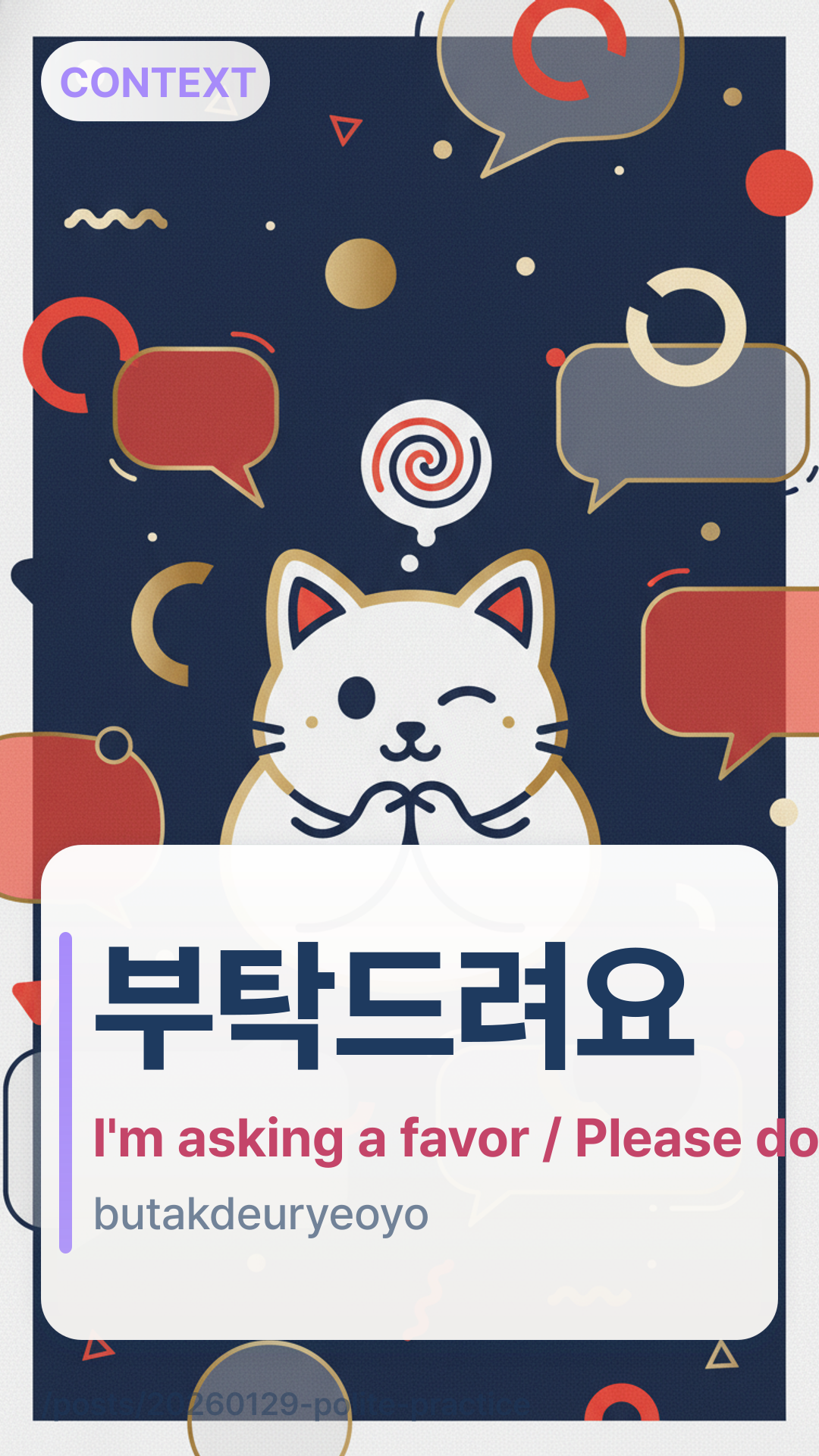
Literally meaning "I entreat you" or "I ask of you," this is used when you are delegating a task or asking for a favor. It is extremely common in work emails and group chats. It sounds professional and respectful. Use it when the help you need is more of a "favor" or a "request" rather than just physical assistance.
Natural alternatives
부탁합니다butakhapnida — I request (Slightly more formal/stiff).잘 부탁드립니다jal butakdeuripnida — I look forward to your help/cooperation.
Example (chat)
내일 회의 자료 공유 부탁드려요!naeil hoeui jaryo gongyu butakdeuryeoyo! — Please share the meeting materials tomorrow!
Example (work)
수정 사항 확인 부탁드려요.sujeong sahang hwagin butakdeuryeoyo. — Please check the revisions.
Rewrite drill
Test your knowledge by choosing the most natural polite expression for each situation.
- You need a colleague to check a document for you. (Professional favor)
- You are carrying heavy boxes and need someone to open the door. (Physical help)
- You want to ask a senior if they have time to explain a concept. (Soft inquiry)
Answers:
부탁드려요butakdeuryeoyo /확인 부탁드려요hwagin butakdeuryeoyo도와주실 수 있나요?dowajusil su itnayo? /좀 도와주실 수 있나요?jom dowajusil su itnayo?도와주실 수 있나요?dowajusil su itnayo? /알려주실 수 있나요?alryeojusil su itnayo?
Notes:
- Q1:
부탁드려요butakdeuryeoyo is the standard for delegating a task or asking for a professional favor like checking a document. - Q2:
도와주실 수 있나요?dowajusil su itnayo? is used for physical assistance or immediate help. - Q3: Using the
-실 수 있나요?-sil su itnayo? ending makes the request softer and more respectful when asking for someone's time or knowledge.
Mini dialogues (with EN)
Next steps
- Try adding
혹시hoksi (by any chance) before your next request; it instantly lowers the pressure on the listener. - Practice the "Soft Landing": start with
죄송하지만...joesonghajiman... (I'm sorry but...) before asking for help to sound like a pro at Korean etiquette. - Convert these 5 blunt sentences into polite requests using the patterns above:
이거 해줘igeo haejwo (Do this)나 도와줘na dowajwo (Help me)파일 보내pail bonae (Send the file)알려줘alryeojwo (Tell me)체크해chekeuhae (Check it)