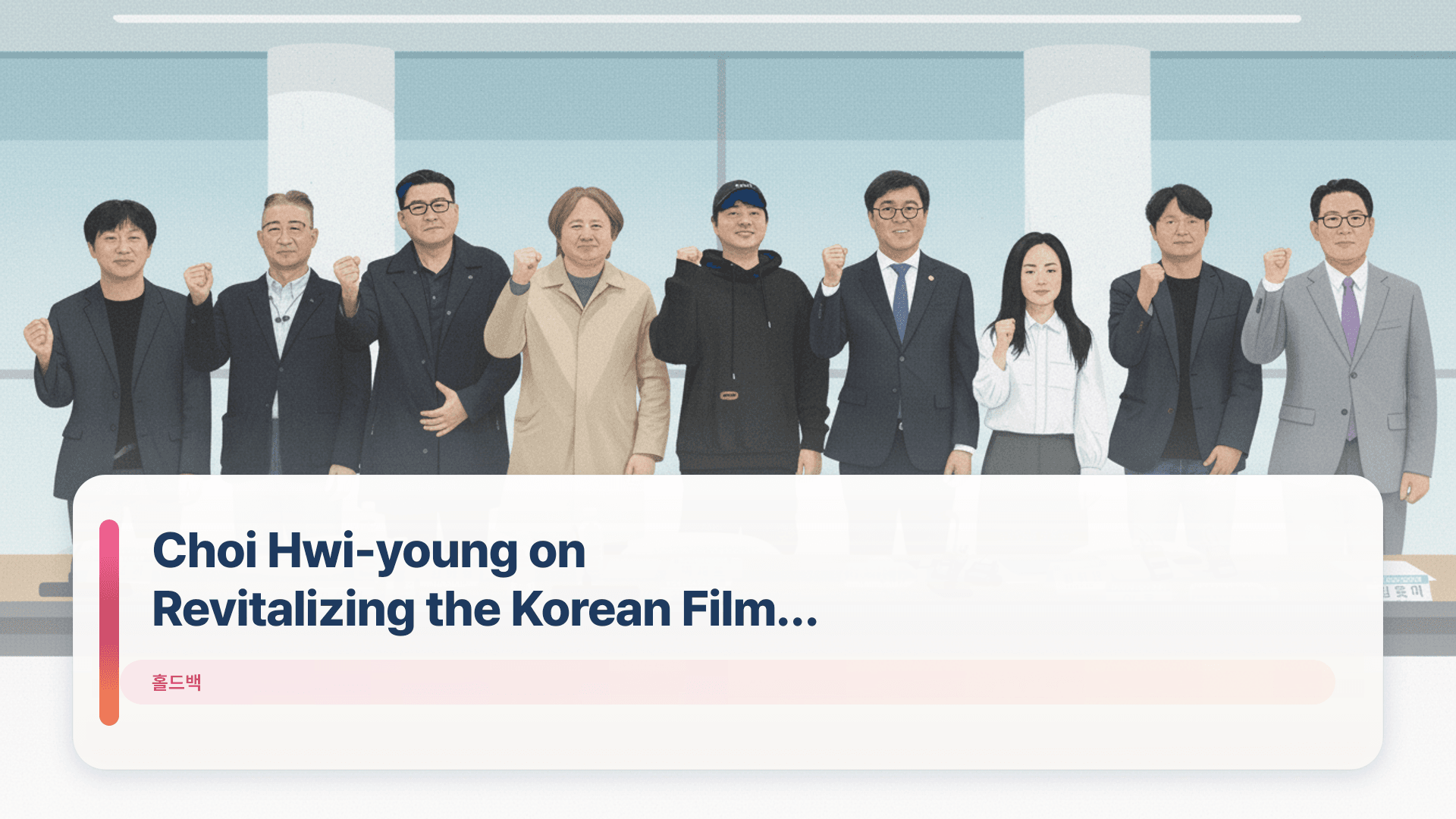
EN brief: 최휘영 “영화시장에 돈 돌게 할 것…홀드백은 민관협의하자” (culture) + 1 glossary term.
Summary
Choi Hwi-young, the newly appointed chairman of the Korean Film Council (KOFIC), has expressed a strong commitment to revitalizing the domestic film industry. His primary focus is on ensuring that capital flows back into the market, which has been struggling since the pandemic. He believes that creating a healthy investment cycle is essential for the production of high-quality Korean content.
One of the most contentious issues he addressed is the 'holdback' policy. This refers to the mandatory period between a film's theatrical release and its availability on streaming platforms (OTT). Choi suggested that instead of rigid government mandates, the industry should move toward a consensus through public-private consultations.
He also highlighted the need to support diverse genres and independent films to maintain the ecosystem's health. By balancing the interests of theaters, distributors, and streaming giants, he aims to find a sustainable path forward for Korean cinema.
홀드백holdeubaek (Holdback) refers to the exclusive period during which a movie is shown only in theaters before it can be released on other platforms like VOD, IPTV, or streaming services (OTT). It is a crucial mechanism for protecting theater revenue.
Overall, the chairman's stance reflects a pragmatic approach to modernizing the industry's distribution model while protecting the traditional theatrical experience that remains the backbone of film revenue.
Full story (translated & rewritten)
In a recent press conference, Choi Hwi-young emphasized that his top priority is "making money circulate in the film market." He noted that while Korean films continue to gain international acclaim, the domestic investment environment remains chilly. To fix this, KOFIC plans to expand support for film funds and improve the profit-sharing structure between creators and distributors.
Regarding the 'holdback' system, which many theater owners demand to protect their ticket sales, Choi took a nuanced position. He acknowledged that the rapid rise of OTT platforms has shortened the exclusive theatrical window, sometimes to just a few weeks. However, he argued that a one-size-fits-all regulation might not work in the current fast-paced digital era.
Instead of a strict law, Choi proposed a consultative body involving the government and private sectors. This group would negotiate flexible holdback periods that vary depending on the film's budget or genre. For example, a massive blockbuster might require a longer theatrical window than a small-scale documentary.
Choi also touched upon the rising cost of movie tickets, which has driven some audiences away. While he didn't promise an immediate price drop, he suggested that improving the overall value of the theater experience is key to bringing people back. He concluded by stating that KOFIC will act as a mediator to ensure that all stakeholders—from actors to theater staff—can benefit from the industry's recovery.
Context
KOFIC (Korean Film Council) is the primary government-supported body that promotes and supports the Korean film industry.
The 'holdback' period in Korea used to be roughly six months, but it has drastically shrunk since 2020 due to the influence of platforms like Netflix and Disney+.
Theater attendance in Korea has not yet fully returned to pre-2019 levels, leading to a crisis in the traditional distribution model.
극장 매출을 보호하기 위해 홀드백 기간을 연장해야 합니다.geukjang maechureul bohohagi wihae holdeubaek giganeul yeonjanghaeya hapnida. — The holdback period must be extended to protect theater revenue.
최근에는 홀드백 기간이 짧아져서 영화가 금방 OTT에 올라옵니다.choegeuneneun holdeubaek gigani jjalbajyeoseo yeonghwaga geumbang OTTe olraopnida. — Recently, the holdback period has shortened, so movies appear on OTT platforms quickly.
극장과 OTT 사이의 홀드백 규정이 필요합니다.
geukjanggwa OTT saiui holdeubaek gyujeoi piryohapnida.
A holdback regulation between theaters and OTT platforms is necessary.
홀드백이 짧아지면 사람들이 극장에 잘 안 가요.
holdeubaegi jjalbajimyeon saramdeuri geukjae jal an gayo.
If the holdback period shortens, people don't go to the theater as much.