Beyond the Window: The Korean Concept of Chagyeong
Discover the traditional Korean concept of Chagyeong (차경) and how it shapes modern travel and cafe culture. Learn this essential cultural term!

Discover the traditional Korean concept of Chagyeong (차경) and how it shapes modern travel and cafe culture. Learn this essential cultural term!

Gapyeong-gun celebrates Children's Day with a free 'Picnic Concert' featuring yodeling and magic shows. Discover this family-friendly event!

Discover how the National Pension Service achieved record-breaking returns through the AI semiconductor rally. Learn the term 대반전 today!

Explore the rise of 'digital ghosts' in Korean media and the growing fear of a 'Bugmageddon' tech collapse. Discover this cultural shift.

Netflix shares drop as bad news piles up. Seaport Research issues a 'Buy' rating despite the crash. Learn the term 악재 for market news.

EN brief: [김태일의 산림치유 일지] 차경을 넘어 여행으로 (it-life) + 1 glossary term.
A recent travelogue by Kim Tae-il explores the deep-seated Korean aesthetic of "borrowed scenery" and how it contrasts with Western philosophical approaches to nature. While traveling in Jeju with friends, the author realized that the most fulfilling moments weren't found at famous photo spots, but in the shared stories and songs inside the car.
The essay reflects on how Koreans traditionally viewed nature from a distance, a practice known as chagyeong. This perspective emphasizes enjoying nature without owning it, a sentiment rooted in the philosophy of living in poverty but enjoying the Way (anbin-nakdo).
However, the author notes a shift. While traditional views favored contemplation from afar, modern Korean society is seeing a rise in active exploration, such as walking trails like the Olle-gil. Yet, the popularity of large cafes with massive windows suggests that the desire for "borrowed scenery" remains a powerful force in contemporary leisure.
Ultimately, the piece suggests that while looking at nature provides comfort, true travel involves stepping into the landscape and engaging with the reality of the environment, much like the peripatetic philosophers of the West.
In early April, the author embarked on a trip to Jeju Island with long-time friends. Despite being guided to hidden gems by a local resident, the author felt a sense of emptiness. The smartphone was filled with high-quality photos of famous landscapes, but the emotional connection to the journey felt thin. The pressure to "see everything" often overshadowed the actual experience of being there.
The true highlight of the trip occurred unexpectedly inside a moving vehicle. As a friend sang a modified version of a folk song and shared jokes, the group began reminiscing about a trip to Gapa Island six years ago during the height of the COVID-19 pandemic. These shared memories, some spanning 40 years, poured out like a never-ending story, proving that the company and the conversation were more vital than the destination itself.
This experience led to a reflection on chagyeong, the traditional Korean architectural and philosophical principle of "borrowing" a view of distant mountains through a door or window. This concept allowed scholars to enjoy nature's beauty without the greed of possession. It is a philosophy of observation and detachment, which has historically influenced Korean life and thought.
The author compares this to Western philosophers like Aristotle and Nietzsche, who famously walked through forests to think. While the Korean tradition often involved observing nature from a safe, comfortable distance, the Western tradition involved direct physical contact with the earth. The author argues that while chagyeong offers a peaceful perspective, it can sometimes weaken the resolve to face and solve real-world problems directly.
Today, this "borrowed scenery" tradition lives on in Korea's vibrant cafe culture. Huge "gallery cafes" with floor-to-ceiling windows are built specifically to provide a framed view of the ocean or mountains. While many people now enjoy walking local trails to experience the "inner flesh" of a city or forest, a significant portion of the population still defines travel as the act of looking at a beautiful view from a comfortable, safe vantage point.
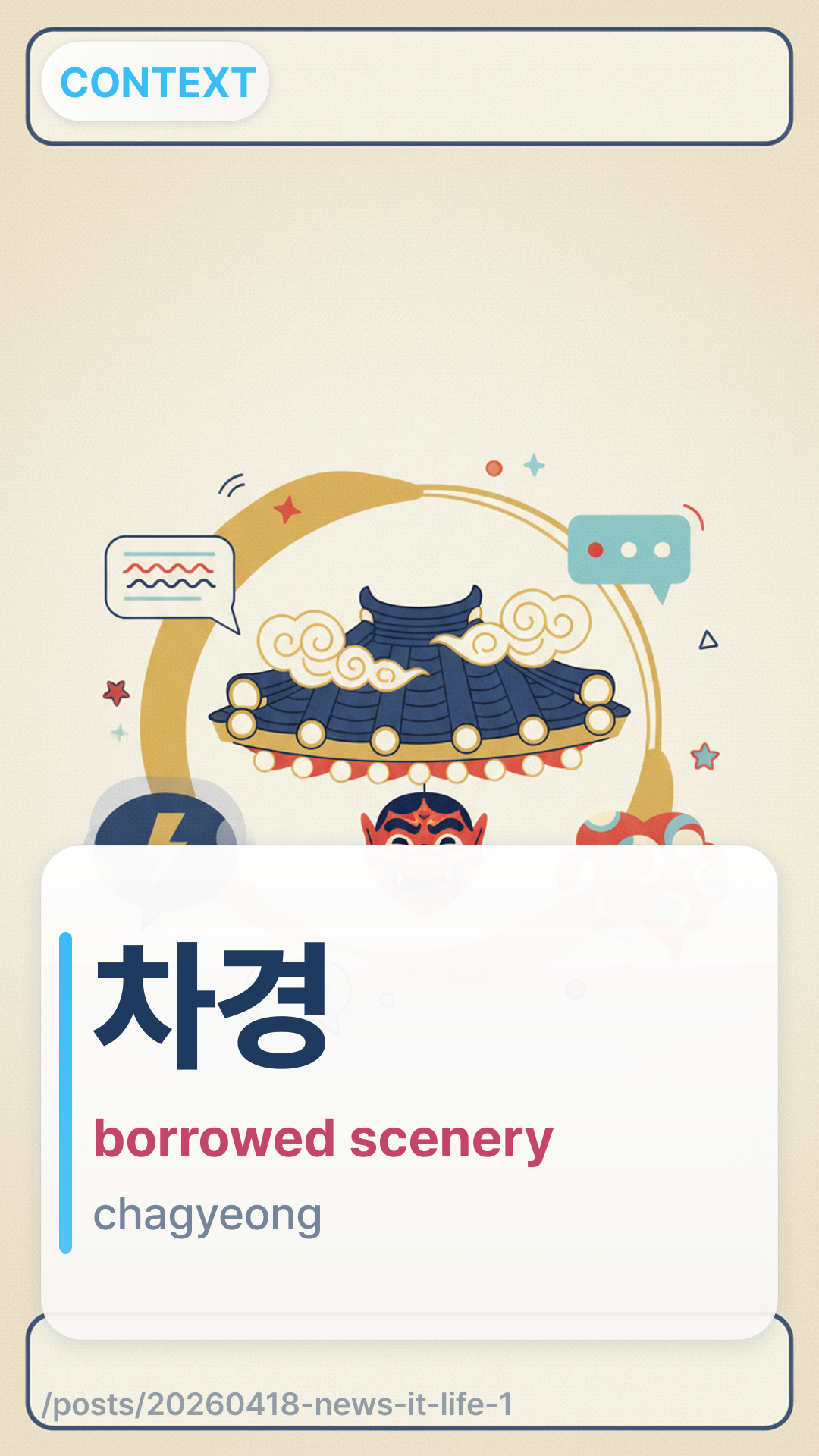
차경chagyeong (Chagyeong) refers to "borrowed scenery." In traditional Korean architecture, windows and doors were not just for ventilation; they were frames for the natural world outside. It represents a mindset of enjoying nature without needing to own or alter it.
우리 선비들은 차경을 통해 자연을 즐겼다.uri seonbideureun chagyeoeul tonghae jayeoneul jeulgyeotda. — Our ancestors enjoyed nature through borrowed scenery.
이 카페는 차경이 아름답기로 유명하다.i kapeneun chagyeoi areumdapgiro yumyeonghada. — This cafe is famous for its beautiful borrowed scenery.