눈치 vs 센스: What They Mean in Korean
눈치 vs 센스 explained with examples, rewrites, and a 5-step decision tree so you sound natural at work or in DMs—learn
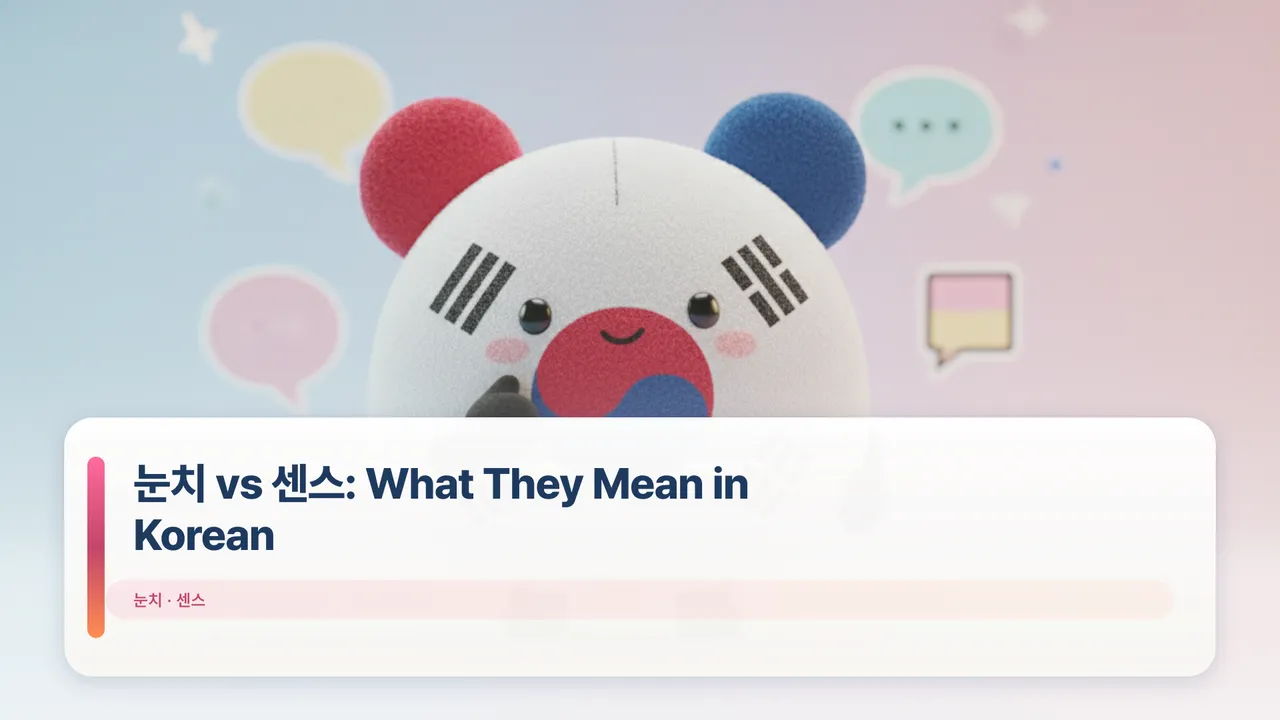
눈치 vs 센스 explained with examples, rewrites, and a 5-step decision tree so you sound natural at work or in DMs—learn
A risk-first chooser plus compliment/critique scripts separates 눈치 (burden-avoidance) from 센스 (comfort-adding) without sounding mean or judgey.
A small moment I remember from my first month in Seoul: I brought a “nice” surprise snack to a study meetup… and realized later it was loud, messy, and hard to share. People were still kind, but the vibe taught me the difference between 눈치nunchi (not creating extra burden) and 센스senseu (adding comfort).
Quick answer
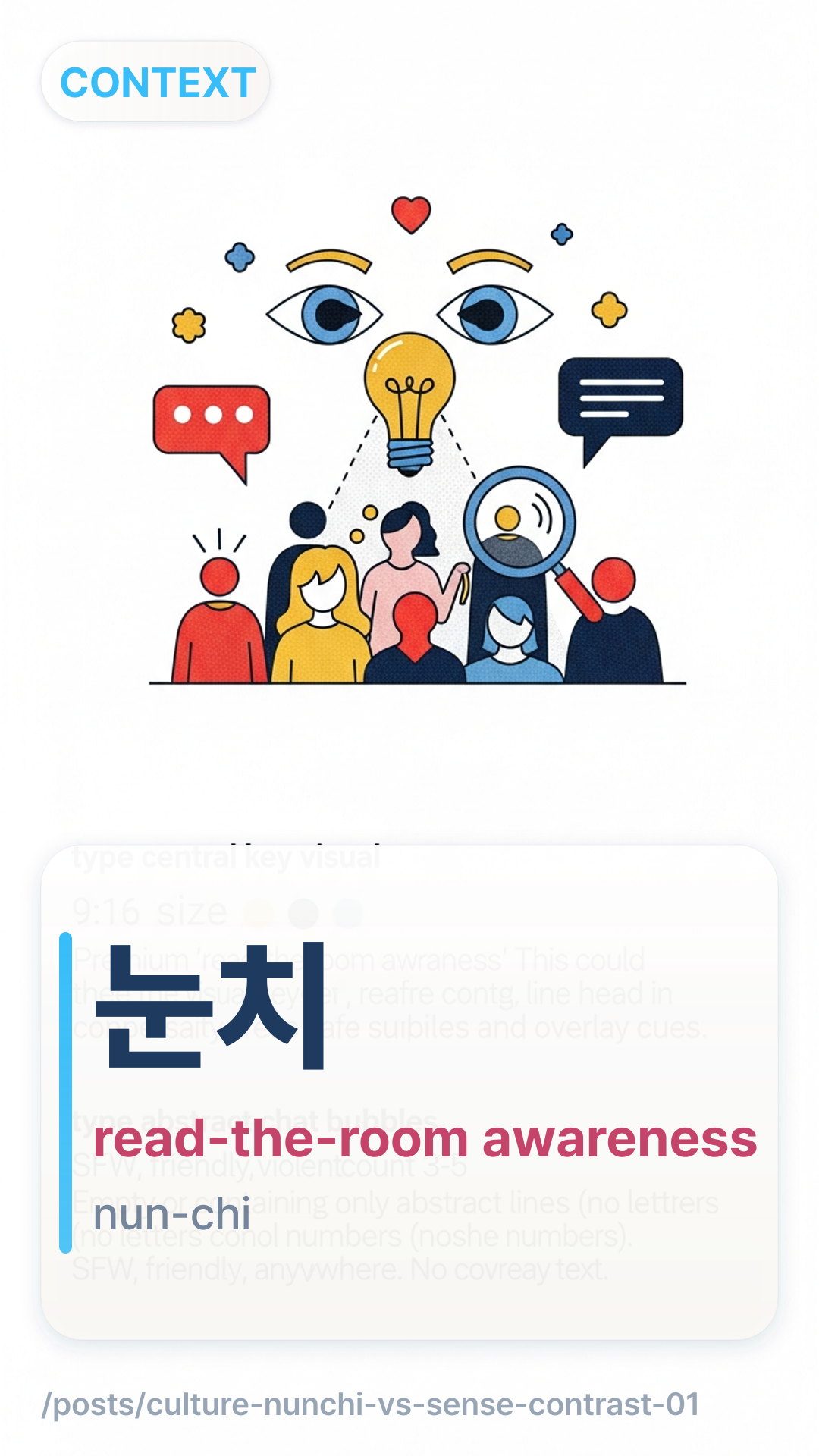
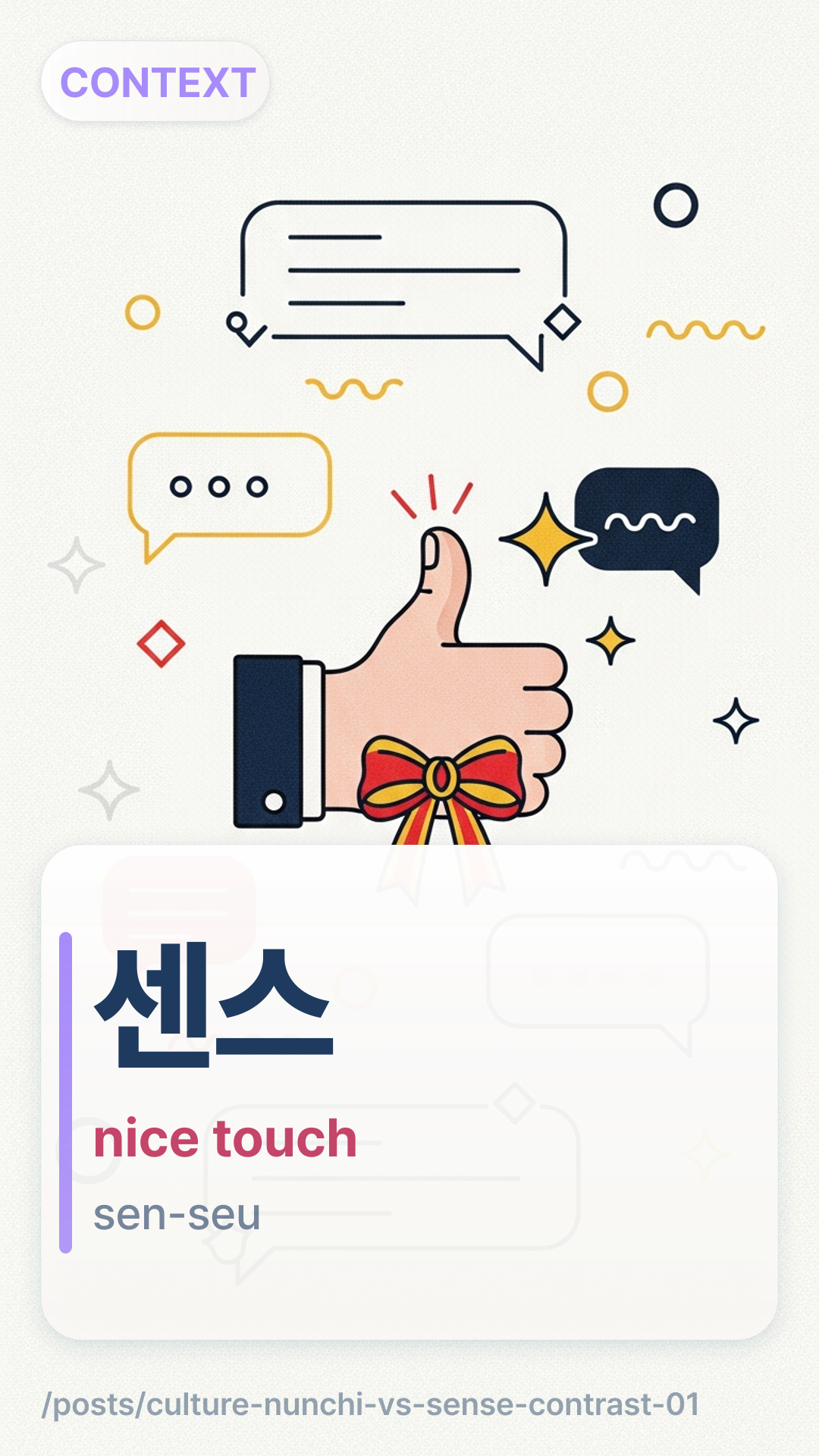
눈치nunchi is reading the room to avoid burden or awkwardness; 센스senseu is adding a thoughtful touch that makes things easier or nicer.
Quick cheat sheet
Expressions in this post
When it’s the right choice
Use 눈치nunchi when the main goal is risk control: not interrupting, not embarrassing someone, not making extra work. It often shows up when timing, hierarchy, or mood matters.
Minimal pairs (vs 센스)
눈치 있다nunchi itda — you read the room well (you avoid burden)센스 있다senseu itda — you add a nice touch (you improve comfort)눈치 좀 봐nunchi jom bwa — please read the room (you’re about to cause awkwardness)센스 좀 발휘해senseu jom balhwihae — show some taste/thoughtfulness (you could make this nicer)
Examples
지금은 조용히 하는 게 눈치야.jigeumeun joyonghi haneun ge nunchiya. — Being quiet now is the “read the room” move.제가 눈치가 없었네요. 죄송해요.jega nunchiga eopseotneyo. joesonghaeyo. — I wasn’t reading the room. Sorry.눈치 좀 봐줘.nunchi jom bwajwo. — Please read the room.
Wrong → Right rewrites (10)
-
Wrong:
센스 좀 있어.senseu jom isseo. — Have some tact. Right:눈치 좀 봐.nunchi jom bwa. — Please read the room. Tone note: The wrong one sounds like a personal critique; the right one points to the situation. -
Wrong:
너 눈치 없어.neo nunchi eopseo. — You have no nunchi. Right:지금은 분위기 좀 봐줘.jigeumeun bunwigi jom bwajwo. — Please watch the mood right now. Tone note: Calling someone “없어” is a direct insult. -
Wrong:
눈치 있어요?nunchi isseoyo? — Do you have nunchi? Right:지금 이야기해도 될까요?jigeum iyagihaedo doelkkayo? — Is it okay to talk about it now? Tone note: The wrong one sounds like a test of their character. -
Wrong:
센스 없게 왜 여기서 말해?senseu eopge wae yeogiseo malhae? — Why say it here, so tactlessly? Right:이 얘기는 나중에 하면 좋을 것 같아요.i yaegineun najunge hamyeon joheul geot gatayo. — I think it’d be better to talk later. Tone note:센스 없게senseu eopge can sound like a personal attack. -
Wrong:
눈치 좀 채워.nunchi jom chaewo. — Fill up your nunchi. Right:눈치 좀 챙겨줘.nunchi jom chaenggyeojwo. — Please be a bit more aware. Tone note:채워chaewo sounds unnatural and harsh. -
Wrong:
센스 있게 조용히 해.senseu itge joyonghi hae. — Be quiet with sense. Right:지금은 조용히 해줄래?jigeumeun joyonghi haejulrae? — Can you be quiet right now? Tone note: The wrong one mixes “thoughtful touch” with a command in a weird way. -
Wrong:
눈치 있게 해.nunchi itge hae. — Do it with nunchi. Right:상황 봐가면서 해.sanghwang bwagamyeonseo hae. — Do it while watching the situation. Tone note: The wrong one is vague; it can sound like blame without guidance. -
Wrong:
센스 좀 봐.senseu jom bwa. — Read the sense. Right:눈치 좀 봐.nunchi jom bwa. — Please read the room. Tone note:센스senseu doesn’t mean “read the room,” so it sounds off. -
Wrong:
눈치 없어서 힘들어.nunchi eopseoseo himdeureo. — It’s hard because you have no nunchi. Right:내가 좀 예민한가 봐. 잠깐만 배려해줄래?naega jom yeminhanga bwa. jamkkanman baeryeohaejulrae? — I might be sensitive. Can you be considerate for a moment? Tone note: The right version lowers blame and stays polite. -
Wrong:
센스 없네, 진짜.senseu eopne, jinjja. — You’re so tactless, seriously. Right:다음에는 타이밍만 좀 맞춰주면 좋겠어.daeumeneun taimingman jom matchwojumyeon jotgesseo. — Next time, I’d like you to match the timing a bit. Tone note: The wrong one sounds like a put-down; the right one is actionable.
Mini-dialogues (6)
-
Friends (compliment
센스senseu) A:야, 네가 자리 미리 잡았어?ya, nega jari miri jabasseo? — You saved us seats? B:응, 사람 많을까 봐.eung, saram manheulkka bwa. — Yeah, in case it got crowded. A:와, 센스 있다.wa, senseu itda. — Wow, that’s thoughtful. -
Friends (polite
눈치nunchi critique) A:지금 그 얘기하면 좀 그래.jigeum geu yaegihamyeon jom geurae. — If you say that now, it’s a bit awkward. B:아, 미안. 내가 눈치가 없었네.a, mian. naega nunchiga eopseotne. — Sorry, I wasn’t reading the room. -
Work (compliment
센스senseu) A:자료 제목을 한 줄로 정리해봤어요.jaryo jemogeul han julro jeongrihaebwasseoyo. — I summarized the title into one line. B:오, 센스 좋네요. 보기 편해요.o, senseu jotneyo. bogi pyeonhaeyo. — Nice touch. It’s easy to read. -
Work (polite
눈치nunchi critique) A:지금은 회의 중이라서요. 잠깐만요.jigeumeun hoeui jungiraseoyo. jamkkanmanyo. — We’re in a meeting right now. One moment. B:아, 죄송합니다. 제가 눈치가 없었네요.a, joesonghapnida. jega nunchiga eopseotneyo. — Sorry. I didn’t read the room. -
Dating (compliment
센스senseu) A:춥지 않아? 담요 가져왔어.chupji anha? damyo gajyeowasseo. — Aren’t you cold? I brought a blanket. B:헉, 센스 있다.heok, senseu itda. — Wow, that’s so considerate. -
Dating (soft
눈치nunchi hint) A:나 오늘은 좀 조용히 있고 싶어.na oneureun jom joyonghi itgo sipeo. — I want to be quiet today. B:알겠어. 내가 눈치 좀 챙길게.algesseo. naega nunchi jom chaenggilge. — Got it. I’ll be more aware.
When it’s the right choice
Use 센스senseu when the goal is to add comfort, polish, or a pleasant surprise: a better choice of words, timing that feels considerate, or a small detail that makes things smoother. It’s commonly used as a compliment.
A common trap: 센스senseu is not the same as “common sense.” In Korean, it’s closer to “good taste” or “a thoughtful touch.”
Minimal pairs (vs 눈치)
센스 있다senseu itda — thoughtful, tasteful, considerate눈치 있다nunchi itda — socially aware, reads the room센스 좋다senseu jotda — nice touch (often praise)눈치 없다nunchi eopda — blunt to say about others; sounds insulting
Examples
포장까지 해온 거야? 센스 있다.pojangkkaji haeon geoya? senseu itda. — You even brought it wrapped? Nice touch.말을 그렇게 해주니까 센스 좋다.mareul geureotge haejunikka senseu jotda. — The way you said it is really considerate.이런 건 센스가 중요해.ireon geon senseuga jungyohae. — For this, the “thoughtful touch” matters.
Comparison table
| 눈치 | 센스 | |
|---|---|---|
| Meaning | reading the room to avoid burden | adding a thoughtful touch that improves comfort |
| Tone | can become sharp if you blame someone | usually positive, compliment-friendly |
| Safer in workplace? | yes if you talk about timing/situation, not “you have none” | yes, very safe as praise |
| Common mistake | using it to insult: 눈치 없다nunchi eopda | translating it as “common sense” or using it for “read the room” |
Decision tree
- Setting: Is this friends, dating, or workplace/public?
- Relationship: Are you close enough to be blunt, or should you soften?
- Risk: Could this embarrass someone or create extra work?
- Goal: Do you want to avoid burden/awkwardness, or add comfort/polish?
- Best word: Avoid burden → use
눈치nunchi. Add comfort → use센스senseu.
If you mean avoiding awkwardness or extra burden → use 눈치nunchi. If you mean adding a thoughtful touch → use 센스senseu.
Next steps
- Write 2 lines you could say at work: one that praises
센스senseu, one that hints at눈치nunchi without blaming. - Take any sentence you often say in DMs and rewrite it two ways: “risk-first” (
눈치nunchi) and “comfort-adding” (센스senseu).
Mini quiz
- You’re in a meeting and someone starts telling a personal story. You want to hint “read the room”:
___ 좀 봐줘.___ jom bwajwo. - A friend brought extra chopsticks so everyone can share easily. You want to compliment them:
와, ___ 있다.wa, ___ itda. - You realize you spoke too loudly on the subway and want to apologize:
제가 ___가 없었네요. 죄송해요.jega ___ga eopseotneyo. joesonghaeyo. - A coworker renamed a file so it’s easier to find. You want to praise the “nice touch”:
오, ___ 좋네요. 찾기 쉬워요.o, ___ jotneyo. chatgi swiwoyo.
Answers:
눈치nunchi센스senseu눈치nunchi센스senseu
Notes:
- Q1:
눈치nunchi fits the fixed expression눈치 좀 봐(줘)nunchi jom bwa(jwo) meaning “read the room / be socially aware.” - Q2:
센스 있다senseu itda is a common compliment for a thoughtful detail that makes things easier or nicer. - Q3:
눈치가 없다nunchiga eopda means you failed to read the situation; saying it about yourself is a common soft apology. - Q4:
센스 좋다senseu jotda praises a small improvement that adds comfort/polish (here, easier retrieval).