
-할게요 vs -할 거예요: Promise or Plan?
Learn -할게요 & -할 거예요 with real-life nuance, minimal pairs, and a decision tree so you stop sounding unsure at work—master
Anchor promise-vs-plan future to real response situations, not textbook tense rules.
Quick answer
Use -할게요-halgeyo to accept/commit in the moment; use -할 거예요-hal geoyeyo to state a future plan or prediction.
Quick cheat sheet
Expressions in this post
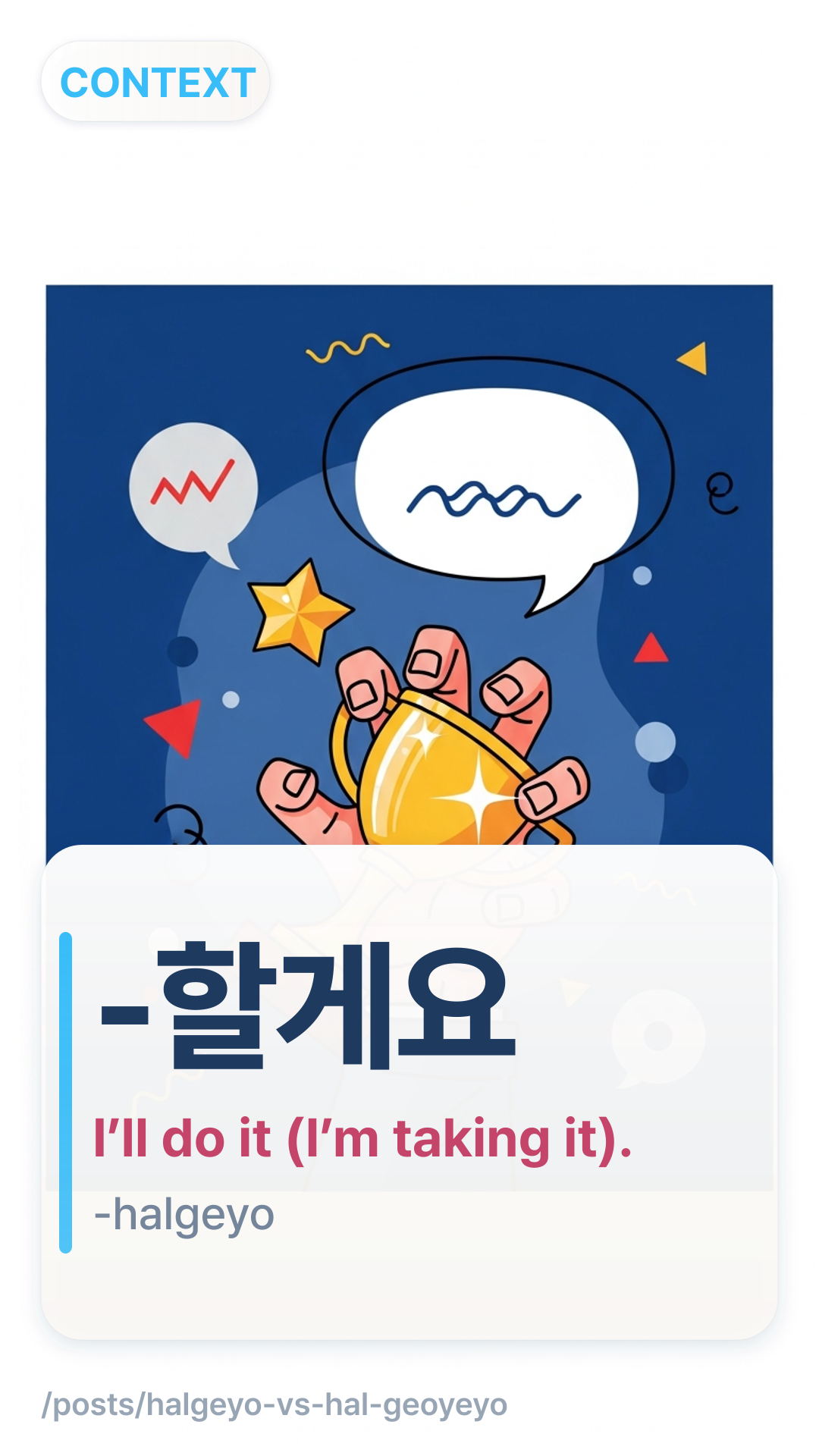
When it’s the right choice
You reach for -할게요-halgeyo when someone’s words trigger a response from you: a request, suggestion, or a situation where you’re volunteering on the spot.
Think of it as a small promise you’re making in real time.
A tiny cultural note: in Korean service settings (cafés, salons, delivery calls), you’ll hear this a lot because it sounds responsive and responsible—like you’re actively taking care of the next step.
Minimal pairs (vs -할 거예요)
-
Request → commitment now:
제가 할게요.jega halgeyo.- EN: I’ll do it (I’ll take this one).
제가 할 거예요.jega hal geoyeyo.- EN: I’m going to do it (as a plan), but it can sound less like “I’m taking it right now.”
-
Suggestion → quick agreement:
그럼 내일 제가 전화할게요.geureom naeil jega jeonhwahalgeyo.- EN: Then I’ll call tomorrow (I’m committing).
그럼 내일 전화할 거예요.geureom naeil jeonhwahal geoyeyo.- EN: Then I’m going to call tomorrow (plan statement; less “I’m responding to you”).
Examples

When it’s the right choice
Use -할 거예요-hal geoyeyo when you’re describing a future intention, schedule, or prediction—especially when nobody just asked you to do it, or you’re explaining what will happen.
It’s great for:
- personal plans (what you intend to do)
- forecasts (what you think will happen)
- explaining a timeline (what’s planned)
Minimal pairs (vs -할게요)
-
Reporting a plan (not a live acceptance):
내일 병원 갈 거예요.naeil byeowon gal geoyeyo.- EN: I’m going to the hospital tomorrow.
내일 병원 갈게요.naeil byeowon galgeyo.- EN: I’ll go to the hospital tomorrow (can feel like you’re responding/agreeing to a suggestion).
-
Prediction:
비 올 거예요.bi ol geoyeyo.- EN: It’ll probably rain.
비 올게요.bi olgeyo.- EN: (Wrong/odd) “I’ll rain.”
Examples
Comparison table
| -할게요 | -할 거예요 | |
|---|---|---|
| Meaning | I’ll do it (accepting/committing in response) | I’m going to do it / it will happen (plan or prediction) |
| Tone | Responsive, takes ownership | Neutral, informational |
| Safer in workplace? | Yes for accepting tasks/requests | Yes for timelines/plans, but can sound non-committal as a reply |
| Common mistake | Using it for predictions (sounds wrong) | Using it as a reply and sounding “not on it” |
Decision tree
If you’re responding to a request/suggestion and taking it on → use -할게요-halgeyo. If you’re stating a plan or prediction → use -할 거예요-hal geoyeyo.
Next steps
- You’re in a meeting and your lead says: “Can you send the updated file today?” Reply naturally using one ending.
- A friend asks what you’ll do tomorrow evening. Answer with one sentence using the other ending.