Dongju: The Poet and the Village of Wanggok
Explore the filming location of the film 'Dongju' in Goseong's Wanggok Village and learn the meaning of 집성촌. Discover Korean history!

Explore the filming location of the film 'Dongju' in Goseong's Wanggok Village and learn the meaning of 집성촌. Discover Korean history!

Comedian Jang Dong-min joins forces with 'Blood Game' PD for a new Netflix brain survival series. Discover the latest in K-entertainment!

Discover how global hits like 'Made in Korea' and 'XO, Kitty' are turning Seoul into a primary filming location. Learn the term 로케.

Discover the controversy over AI companies accessing public health data in Korea. Learn the meaning of 비정형데이터 (unstructured data).

Discover how the Seoul Cinema Center and local Eulji-myeongbo merchants are collaborating to revitalize the historic Chungmuro film district.
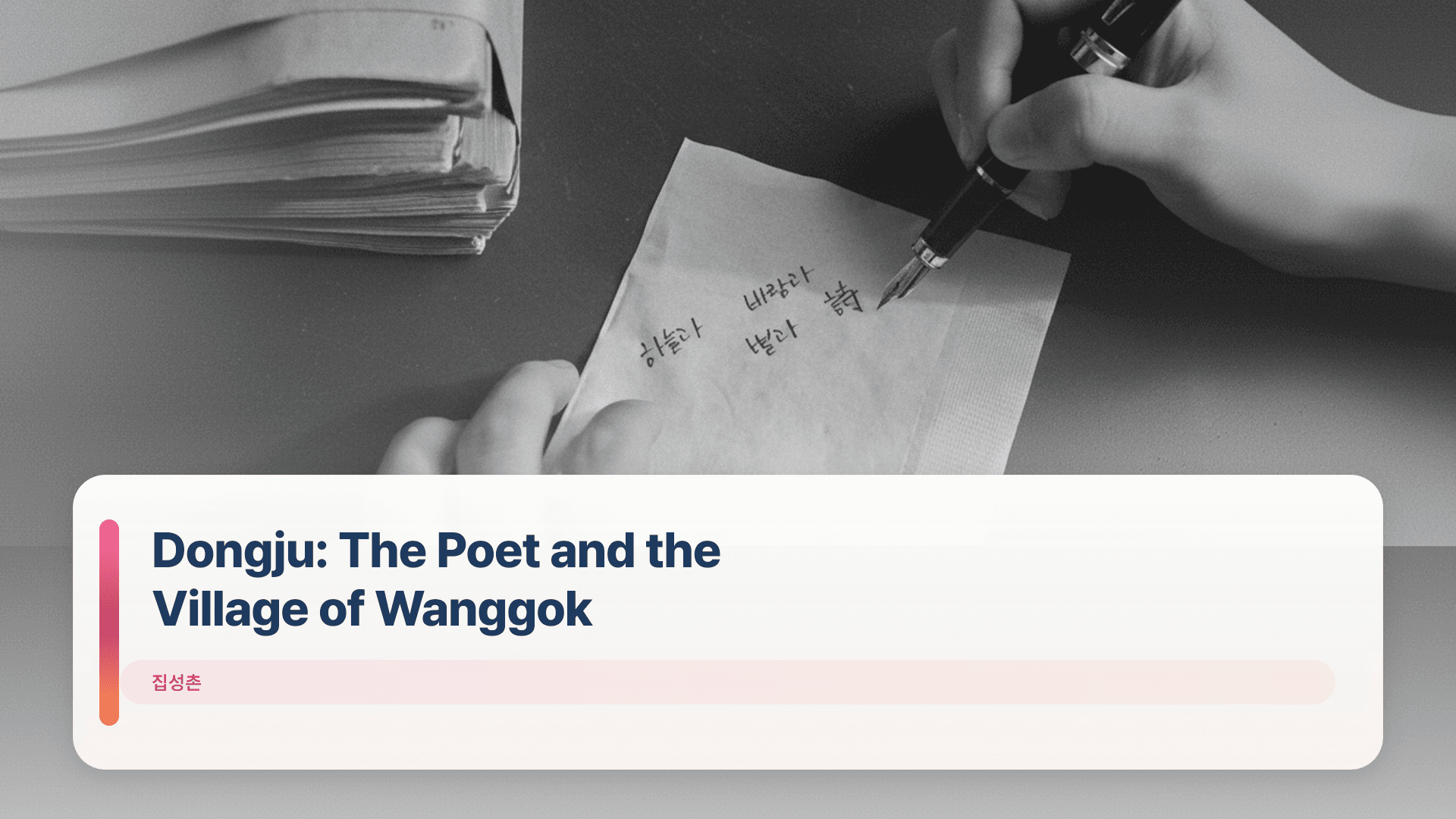
EN brief: [영화 속 농촌] (9)별 헤는 소년들 마음 그린 ‘동주’…고성 왕곡마을 (culture) + 1 glossary term.
The 2016 film 'Dongju,' directed by Lee Joon-ik, portrays the lives of poet Yun Dong-ju and activist Song Mong-gyu during the Japanese colonial period. The movie captures their struggle to maintain hope and identity through poetry and action in a dark era. It highlights the deep bond and differing paths of these two young men as they navigate a world where their names and language were suppressed.
While the story is set in Yongjeong, North Kando (Manchuria), the actual filming took place in Wanggok Village in Goseong, Gangwon Province. This village was chosen for its remarkably preserved traditional atmosphere, which served as a perfect stand-in for the historical setting of the poet's youth.
Wanggok Village is a unique cultural site protected by five surrounding mountain peaks, which helped it escape damage during the Korean War and major forest fires. It has been designated as National Folklore Cultural Heritage No. 235, maintaining its 600-year history and northern-style Hanok architecture.
The village's layout is specifically adapted to the snowy northern climate, featuring 'L-shaped' houses with attached stables and high foundations. The absence of perimeter walls allows sunlight to reach deep into the homes, while the surrounding mountains block harsh winds, creating a serene and historically authentic environment.
The film 'Dongju' opens a window into the soul of Yun Dong-ju, a poet who sought to plant 'seeds of hope' even when the sky was dark. The movie uses black-and-white cinematography to emphasize the texture of time and the gravity of the colonial era. Yun Dong-ju, played by Kang Ha-neul, and his cousin Song Mong-gyu, played by Park Jeong-min, represent two different responses to oppression: the quiet resistance of literature and the active pursuit of independence.
To recreate the atmosphere of 1940s Yongjeong, the production team headed to Wanggok Village in Goseong. This village is a rare example of a northern-style Korean settlement. Unlike the open structures found in southern Korea, these houses are built to withstand heavy snow and freezing temperatures. The 'Keunsangnamal-jip' in the village served as the primary filming location for Dongju’s family home, where the poignant scene of the family taking a final commemorative photo was captured.
One of the most striking features of Wanggok Village is the 'pot on the chimney.' Local legend says the village is shaped like a ship; digging a well would be like poking a hole in the hull, leading to disaster. Therefore, residents used specific traditional methods to manage their water and heating without compromising the 'ship.' This preservation of folklore alongside architecture makes the village a living museum.
Director Lee Joon-ik specifically noted that the village was the most suitable place to implement a 'jipseongchon' (clan village) of North Kando. The lack of modern fences and the natural integration of the houses into the landscape allowed the film to achieve a level of realism that would be impossible on a studio set. Today, visitors can walk through the same courtyards where the cinematic versions of Dongju and Mong-gyu once stood.
집성촌jipseongchon (jipseongchon) refers to a traditional Korean village where most residents share the same surname and belong to the same family clan. These villages were the backbone of rural Korean society for centuries, preserving specific family traditions and ancestral rites.
이 마을은 경주 이씨의 집성촌입니다.i maeureun gyeongju issiui jipseongchonipnida. — This village is a clan village of the Gyeongju Lee family.
한국에는 아직도 전통을 지키는 집성촌이 많이 남아 있습니다.hangugeneun ajikdo jeontoeul jikineun jipseongchoni manhi nama itseupnida. — There are still many clan villages in Korea that preserve traditions.