Galaxy S26 Privacy Display: A Game Changer for Commuters
Samsung's new Galaxy S26 Ultra features a 'Privacy Display' that hides your screen from side-viewers. Discover how it works and learn the term '솔깃하다'.

Samsung's new Galaxy S26 Ultra features a 'Privacy Display' that hides your screen from side-viewers. Discover how it works and learn the term '솔깃하다'.
Comedian Jang Dong-min joins forces with 'Blood Game' PD for a new Netflix brain survival series. Discover the latest in K-entertainment!

Discover how global hits like 'Made in Korea' and 'XO, Kitty' are turning Seoul into a primary filming location. Learn the term 로케.

Discover the controversy over AI companies accessing public health data in Korea. Learn the meaning of 비정형데이터 (unstructured data).

Discover how the Seoul Cinema Center and local Eulji-myeongbo merchants are collaborating to revitalize the historic Chungmuro film district.
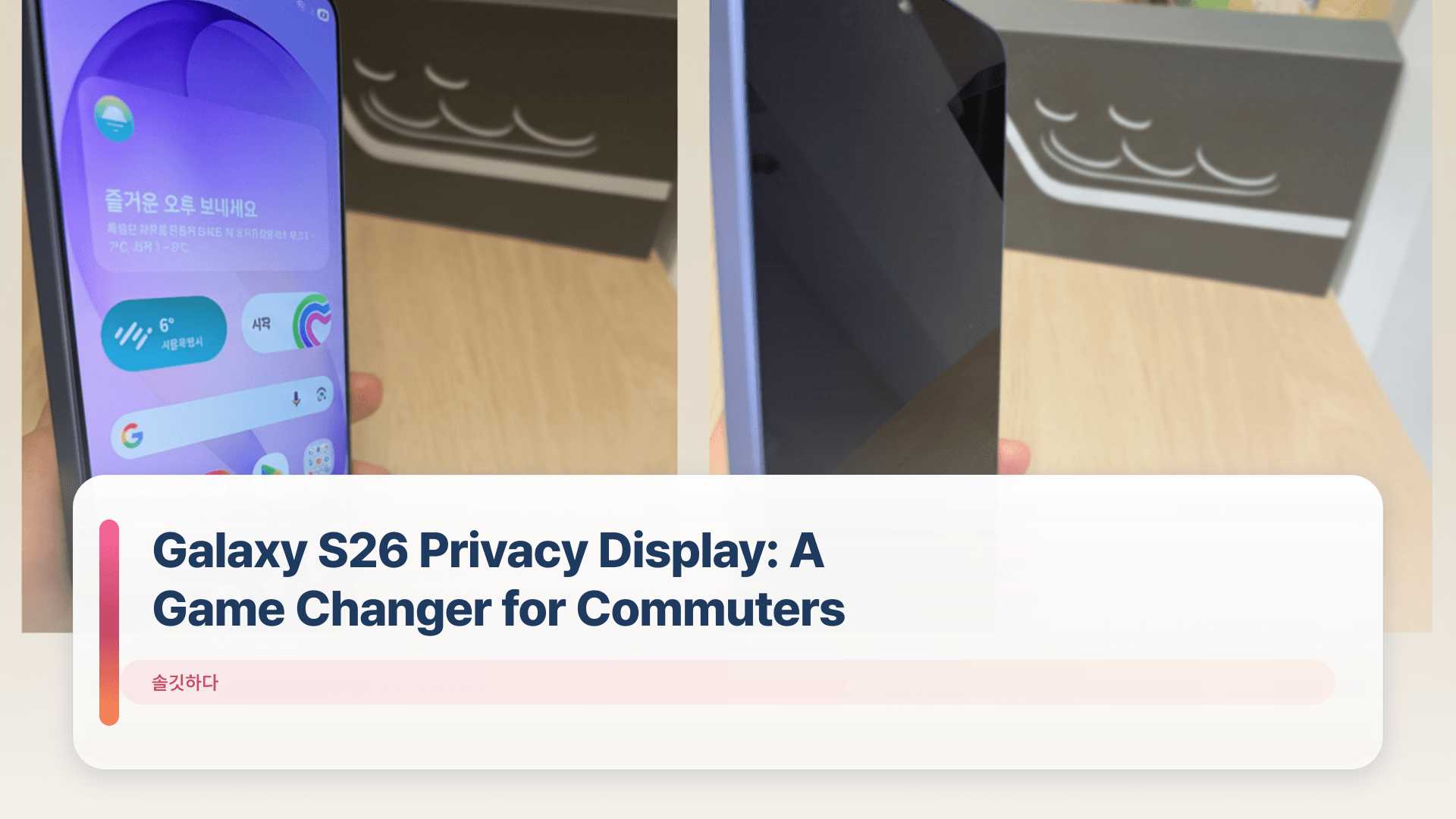
EN brief: [써보니]17년차 아이폰 유저도 솔깃…‘사생활 보호’ 디스플레이 도입한 갤럭시S26 (it-life) + 1 glossary term.
Samsung Electronics recently unveiled the Galaxy S26 Ultra, introducing a standout feature called 'Privacy Display.' This technology allows the screen to turn black when viewed from an angle of approximately 30 degrees or more. It is designed to prevent onlookers from seeing sensitive information in crowded public spaces.
A long-time iPhone user of 17 years reviewed the device and noted that this feature is particularly tempting. Unlike traditional physical privacy films, this is a hardware-level solution that controls light at the pixel level. This means users don't have to deal with the usual downsides of privacy stickers, such as reduced brightness or blurry text.
The feature can be toggled on and off through the phone's settings. It can also be set to activate automatically during specific actions, such as entering a PIN or opening certain apps. This level of control offers a significant advantage over permanent physical filters.
While the Ultra model receives this advanced display technology, the standard Galaxy S26 and S26 Plus models do not include it. Samsung spent over five years developing this tech and holds several patents to prevent competitors from easily replicating the 'Privacy Display' experience.
The tech world is buzzing after the hands-on reviews of the Galaxy S26 Ultra. For many, the highlight isn't just the faster processor, but a practical solution to a common urban problem: 'visual hacking' in crowded subways. The 'Privacy Display' works by narrowing the viewing angle electronically. When someone looks at your phone from the side, the screen appears completely dark, while it remains crystal clear for the person holding it directly in front of them.
For a veteran iPhone user who has stayed within the Apple ecosystem since 2010, this feature was enough to cause a moment of hesitation. The reviewer noted that while they are deeply integrated into iOS, the lack of a built-in privacy filter on iPhones is a noticeable 'deficiency' when compared to this new Samsung hardware. The ability to handle work emails or personal messages on a packed bus without worrying about the person standing next to you is a major selling point.
Technologically, this is a leap forward from the adhesive privacy films many users buy separately. Those films often degrade touch sensitivity and make the screen look dim even to the owner. Samsung’s approach maintains high resolution and brightness because it is integrated into the OLED panel's light-emitting pixels. It solves the 'double-sided' privacy issue: protecting your data from others, and protecting yourself from accidentally seeing someone else's bright screen in a dark environment.
Beyond the display, the S26 Ultra has also upgraded its AI-powered 'Photo Assist.' Users can now edit photos using simple text or voice commands, such as removing objects or changing backgrounds entirely. While impressive, the ease of these 'deepfake-like' edits has raised some concerns regarding image manipulation and digital ethics, which Samsung plans to address with mandatory AI watermarks.
In the headline, the reviewer uses the word 솔깃하다solgithada (sol-git-ha-da) to describe their reaction to the new Galaxy feature. It refers to the feeling when you hear something so interesting or beneficial that your ears 'perk up' and you are tempted by the idea.
새로운 제안에 마음이 솔깃했다.saeroun jeane maeumi solgithaetda. — I was tempted by the new proposal.
그의 설명을 들으니 솔깃하더라고요.geuui seolmyeoeul deureuni solgithadeoragoyo. — Hearing his explanation, it sounded quite tempting.