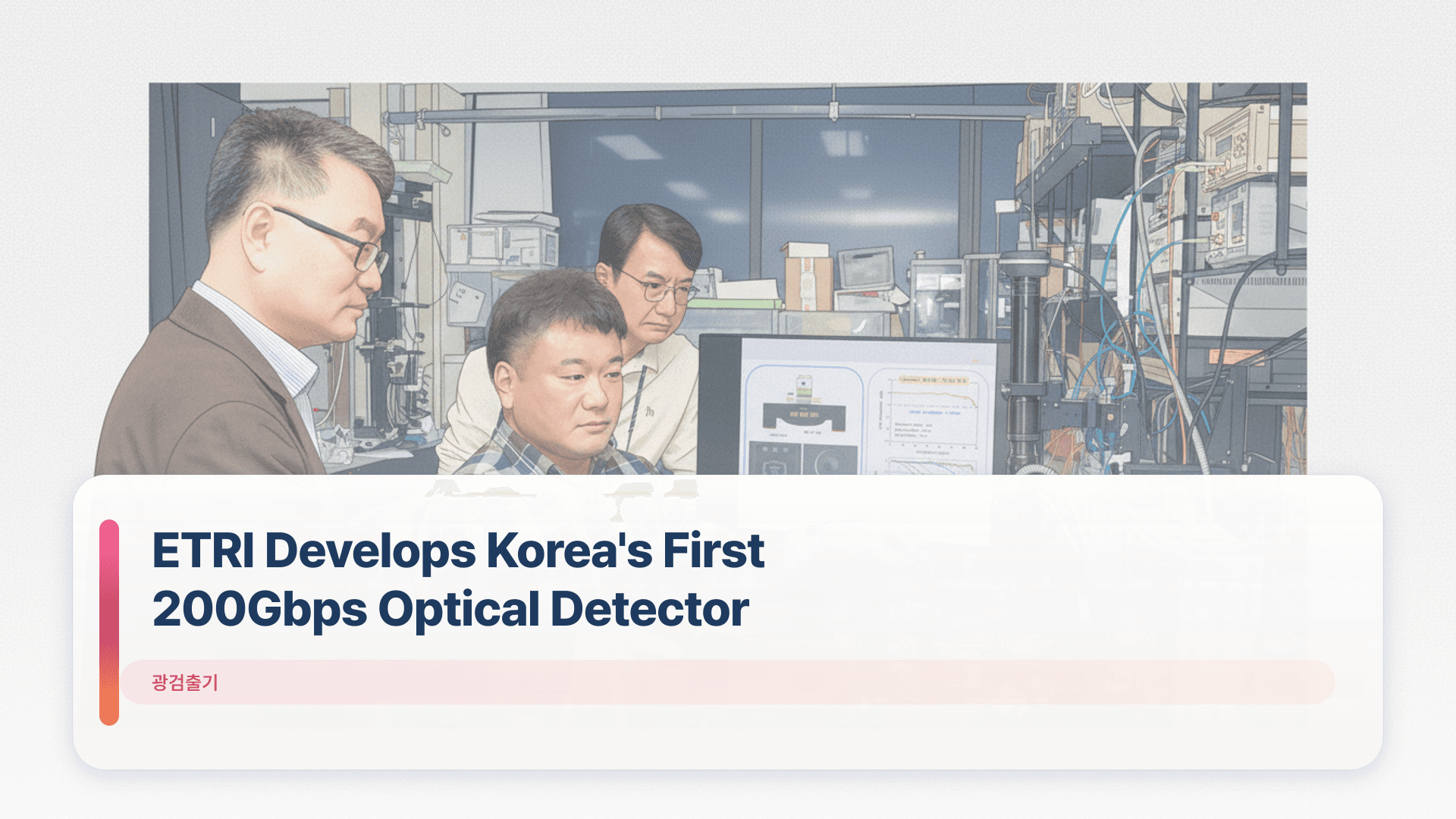
EN brief: 풀HD 영화 1초에 5편 전송...ETRI, 200Gbps 광검출기 '국내 최초' 개발 (culture) + 1 glossary term.
Summary
South Korean researchers have achieved a significant milestone in telecommunications by developing a 200Gbps-class optical detector. This device is a critical component for the next generation of AI data centers and 5G/6G network infrastructure.
This new technology allows for incredibly fast data reception, capable of transferring five 5GB Full HD movies in a single second. The development was led by the Electronics and Telecommunications Research Institute (ETRI), which announced the breakthrough on March 19.
An optical detector is a specialized semiconductor component that converts light signals into electrical signals. This conversion is essential for processing the massive amounts of data that travel through fiber-optic cables in modern networks.
By successfully creating this 200Gbps chip, Korea reduces its reliance on foreign imports for high-end optical components. The technology has already been transferred to a local company, WooriRo, to bolster the domestic industry's competitiveness.
광검출기gwanggeomchulgi (Gwang-geom-chul-gi) refers to an "Optical Detector" or "Photodetector." It is a semiconductor device that senses light (photons) and converts it into an electrical signal, acting as the "eye" of a fiber-optic communication system.
The Electronics and Telecommunications Research Institute (ETRI) announced the successful development of a 200Gbps-class optical detector element capable of handling ultra-high-speed data signals. This component is designed to meet the skyrocketing demand for data processing in massive AI data centers and future 6G mobile infrastructures.
The developed device achieves a bandwidth of over 70GHz and a high optical responsivity of 0.75A/W. Measuring only 0.5mm by 0.4mm, the chip features a unique "backside lens integrated structure." By integrating a convex lens made of Indium Phosphide (InP) directly onto the back of the chip, the researchers significantly improved light reception efficiency and alignment convenience.
One of the major advantages of this integrated structure is that it eliminates the need for separate light-receiving lens components. This simplifies the packaging process and reduces production costs. ETRI managed to handle the entire process—from design to fabrication—using purely domestic Korean technology and their experience operating a compound semiconductor foundry.
Currently, only a few elite global companies possess the technical capability to produce 200Gbps-class optical detector chips. With this achievement, ETRI has secured core original technology in the field of Indium Gallium Arsenide (InGaAs) detectors. This is expected to double the data processing capacity compared to existing mainstream technologies, which typically operate at lower speeds.
Kwon Yong-hwan, head of ETRI's Optical Wireless Research Division, noted that this development will strengthen the competitiveness of the domestic optical component industry. The institute has already filed for relevant patents both domestically and internationally, ensuring that the intellectual property remains protected as the technology moves toward commercialization.
Context
AI Data Centers: These facilities require massive bandwidth to train and run large language models, making 200Gbps components essential for internal networking.
6G Preparation: While 5G is still being optimized, researchers are already building the hardware foundations for 6G, which targets even lower latency and higher speeds.
Foundry Power: ETRI's ability to use its own compound semiconductor foundry was key to iterating on these sensitive semiconductor designs.
연구소에서 새로운 광검출기를 테스트하고 있다.yeongusoeseo saeroun gwanggeomchulgireul teseuteuhago itda. — The research lab is testing a new optical detector.
광검출기는 초고속 인터넷망의 핵심 부품이다.gwanggeomchulgineun chogosok inteonetmaui haeksim bupumida. — Optical detectors are core components of ultra-high-speed internet networks.