Red Skies in Australia: Why the Sky Turned Blood Red
Discover why the Australian sky turned a cinematic blood-red and learn the essential term 종말 (end of the world) in this news brief.

Discover why the Australian sky turned a cinematic blood-red and learn the essential term 종말 (end of the world) in this news brief.

Comedian Jang Dong-min joins forces with 'Blood Game' PD for a new Netflix brain survival series. Discover the latest in K-entertainment!

Discover how global hits like 'Made in Korea' and 'XO, Kitty' are turning Seoul into a primary filming location. Learn the term 로케.

Discover the controversy over AI companies accessing public health data in Korea. Learn the meaning of 비정형데이터 (unstructured data).

Discover how the Seoul Cinema Center and local Eulji-myeongbo merchants are collaborating to revitalize the historic Chungmuro film district.
EN brief: [영상] "영화 속 종말 장면?" 호주 하늘이 새빨갛게 변했다…왜? (culture) + 1 glossary term.
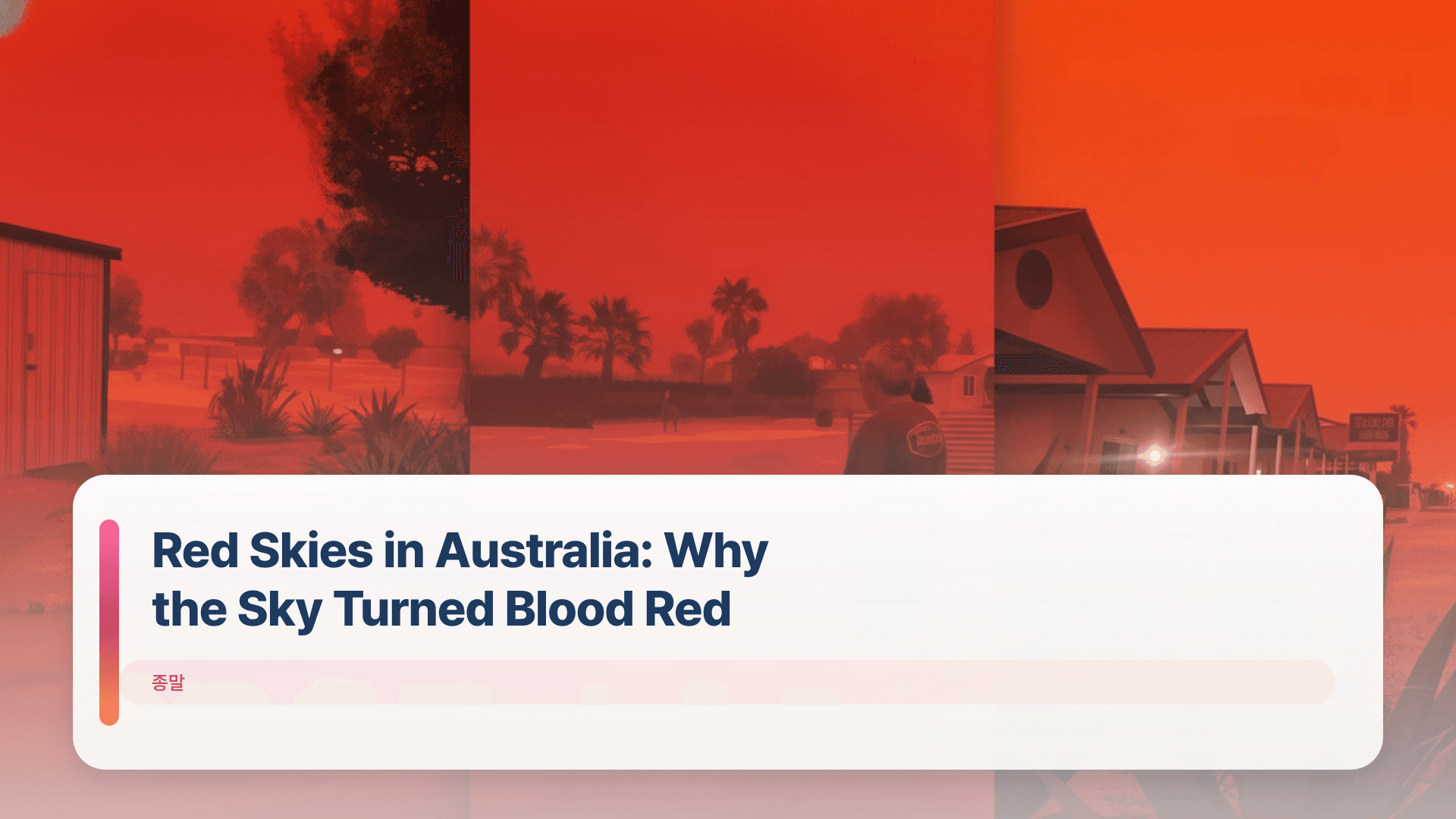
Residents in Western Australia recently witnessed a startling atmospheric phenomenon where the sky turned a deep, vivid red. The transformation was so intense that many locals compared the view to scenes from a post-apocalyptic movie.
This unusual sight followed the arrival of Tropical Cyclone 'Narelle,' which hit the region for the first time in about 20 years. The cyclone brought powerful winds and heavy rain, creating the perfect conditions for this rare visual display.
Social media was quickly flooded with unedited photos and videos of the crimson horizon. Unlike the orange hues often seen during wildfires, this particular event was noted for its exceptionally dark and saturated red tones.
Experts have clarified that the phenomenon is a result of specific geological features in North Western Australia combined with extreme weather. It is a natural, albeit eerie, interaction between light and local dust.
On March 30, international media outlets including the New York Post and Futurism reported on the striking images coming out of Western Australia. The region's sky was dyed a thick, dark red, capturing global attention. This occurred just as Tropical Cyclone Narelle made landfall, marking a significant weather event for an area that hadn't seen such a storm in two decades.
Local resident Kerry Shepperd described the experience to ABC News, noting that the sky began shifting to orange in the afternoon. By 3:30 PM, however, the entire environment had turned completely red. Shepperd remarked that no matter where one looked, the world appeared saturated in a deep crimson light.
Weather service AccuWeather confirmed on social media that these images were not the result of digital filters. Instead, they were caused by a massive influx of dust into the upper atmosphere. As the low-pressure system of the cyclone approached, it kicked up vast amounts of soil and debris, which then scattered the sunlight in a unique way.
According to the National Environmental Satellite, Data, and Information Service (NESDIS) under NOAA, the science behind the color lies in the soil. North Western Australia is rich in iron-heavy rocks. In the region's typically hot and dry environment, these rocks oxidize and take on a distinct rust-red color.
When the cyclone's fierce winds ground these rocks into fine dust and lofted them into the air, the particles acted as a filter. While sunlight usually passes through dust relatively easily, the specific density and composition of this iron-rich dust during the storm caused the intense red scattering observed by residents.

In the headline, the word 종말jongmal (jong-mal) is used to describe the "end of the world" or "apocalypse." It is often used in the context of movies (종말 영화) or religious contexts to describe the finality of time. In this news story, it highlights how surreal and terrifying the red sky looked to those on the ground.
이 영화는 인류의 종말을 다루고 있다.i yeonghwaneun inryuui jongmareul darugo itda. — This movie deals with the end of humanity.
하늘 색깔이 마치 종말이 온 것 같았어요.haneul saekkkari machi jongmari on geot gatasseoyo. — The color of the sky looked as if the end of the world had come.