4.3 트라우마 치유: New Film ‘My Name Is’ Explores Jeju History
Discover how the film 'My Name Is' addresses 4.3 trauma and Jeju Island's history. Learn the meaning of 트라우마 in a Korean context.

Discover how the film 'My Name Is' addresses 4.3 trauma and Jeju Island's history. Learn the meaning of 트라우마 in a Korean context.
Comedian Jang Dong-min joins forces with 'Blood Game' PD for a new Netflix brain survival series. Discover the latest in K-entertainment!

Discover how global hits like 'Made in Korea' and 'XO, Kitty' are turning Seoul into a primary filming location. Learn the term 로케.

Discover the controversy over AI companies accessing public health data in Korea. Learn the meaning of 비정형데이터 (unstructured data).

Discover how the Seoul Cinema Center and local Eulji-myeongbo merchants are collaborating to revitalize the historic Chungmuro film district.
EN brief: “4.3 트라우마 치유”…시민이 만든 영화 ‘내 이름은’ (culture) + 1 glossary term.
A new citizen-led film titled "My Name Is" has been released to address the deep-seated trauma associated with the Jeju April 3 Incident. The project focuses on the healing process for survivors and their families who have carried these emotional burdens for decades.
Produced by local citizens rather than a major commercial studio, the film aims to provide a voice to those often silenced by history. It emphasizes the importance of communal storytelling in overcoming past tragedies.
Commemorative events for the 78th anniversary of the Jeju 4.3 Incident also highlighted the need to prevent the distortion or disparagement of historical facts. Leaders at the ceremony stressed that understanding the truth is the first step toward genuine reconciliation.
This cultural movement through cinema represents a shift toward grassroots historical preservation in South Korea. By focusing on individual names and stories, the film seeks to humanize a complex political history.
The film "My Name Is" (내 이름은) recently premiered as part of a broader effort to facilitate "trauma healing" for those affected by the Jeju April 3 Incident. Unlike large-scale historical epics, this movie was created by ordinary citizens who felt that the personal scars of the tragedy were not being sufficiently addressed in mainstream discourse. The narrative centers on the identity and recovery of individuals whose lives were irrevocably changed by the events of 1948.
During the 78th anniversary memorial service, participants gathered to honor the victims and discuss the ongoing challenges of historical memory. A recurring theme at the event was the protection of the incident's legacy against political distortion. While the article does not list specific modern instances of disparagement, it notes a collective call to action to ensure the tragedy is remembered accurately by future generations.
The production of "My Name Is" involved local residents of Jeju, some of whom have direct or indirect links to the survivors. The film's title reflects a desire to reclaim the dignity of the victims, moving beyond being mere statistics in a history book. It explores how the act of naming and sharing one's story can serve as a therapeutic tool for those still living with the psychological aftermath.
While the KBS report focuses on the cultural and commemorative aspects, it also touches upon the broader social atmosphere in Jeju. The island continues to balance its identity as a major tourist destination with its role as a site of significant historical mourning. This film is seen as a bridge between those two identities, inviting visitors and locals alike to reflect on the island's past.
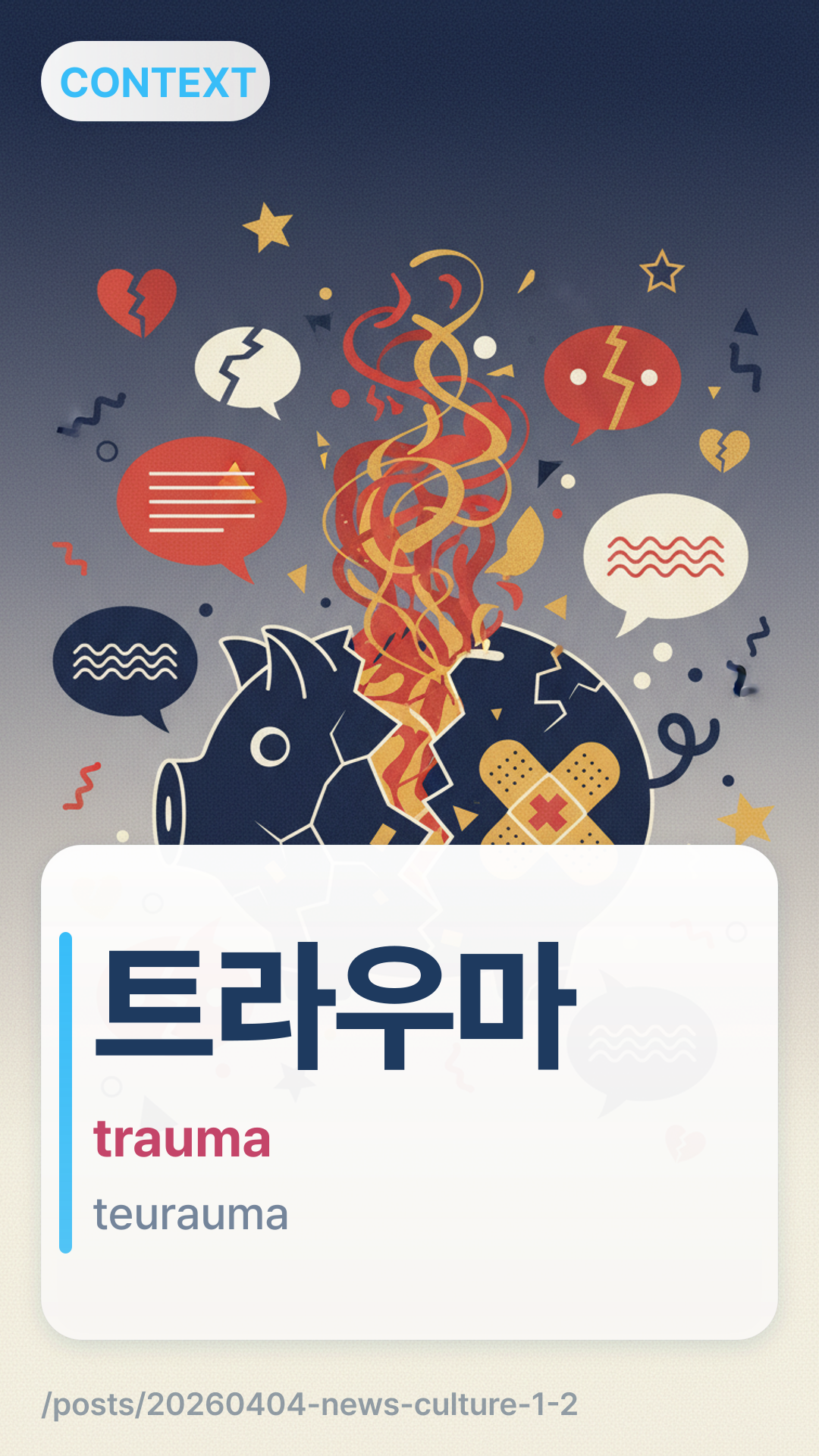
In the context of Korean news and psychology, 트라우마teurauma (trauma) refers to a lasting emotional wound or shock resulting from a distressing event. While used similarly to English, in Korea, it is frequently paired with historical events (like the Jeju 4.3 or Sewol Ferry) to describe a collective national or regional psychological scar.
그는 사고 이후 트라우마에 시달리고 있다.geuneun sago ihu teuraumae sidalrigo itda. — He has been suffering from trauma since the accident.
우리는 과거의 트라우마를 함께 치유해야 합니다.urineun gwageoui teuraumareul hamkke chiyuhaeya hapnida. — We must heal our past traumas together.
To understand more about Jeju's history, look for documentaries or films tagged with 4.3 사건4.3 sageon. When discussing sensitive historical topics in Korea, using terms like 치유chiyu (healing) and 희생자huisaengja (victim) shows respect for the gravity of the subject matter.