Master TOPIK Reading: 3 Essential Economy Headline Keywords
Decode Korean economy news with keywords like 인상, 하락, and 전망. Master TOPIK reading strategies with our guide and quiz.
Decode Korean economy news with keywords like 인상, 하락, and 전망. Master TOPIK reading strategies with our guide and quiz.
Learn to decode complex Korean economic headlines by mastering high-frequency hanja-based nouns and their common patterns.
Summary
Korean economic news often uses concise, formal vocabulary derived from Chinese characters (Hanja) to save space. These terms appear frequently in the TOPIK II reading section, specifically in the headline-matching questions.
Understanding these keywords allows you to grasp the core message of a report—such as whether prices are going up or employment is going down—without needing to translate every single particle or verb.
Most headlines omit subject markers and use noun-heavy structures. For example, instead of saying "Prices have risen significantly," a headline will simply state "Price Rise."
By focusing on the direction of change (up, down, or neutral), you can quickly eliminate wrong answers in exam settings and improve your overall reading speed for professional materials.
Headline in one sentence (paraphrase)
Experts predict a steady rise in consumer prices despite the recent sharp drop in export volumes.
Quick cheat sheet
Expressions in this post
Common collocations
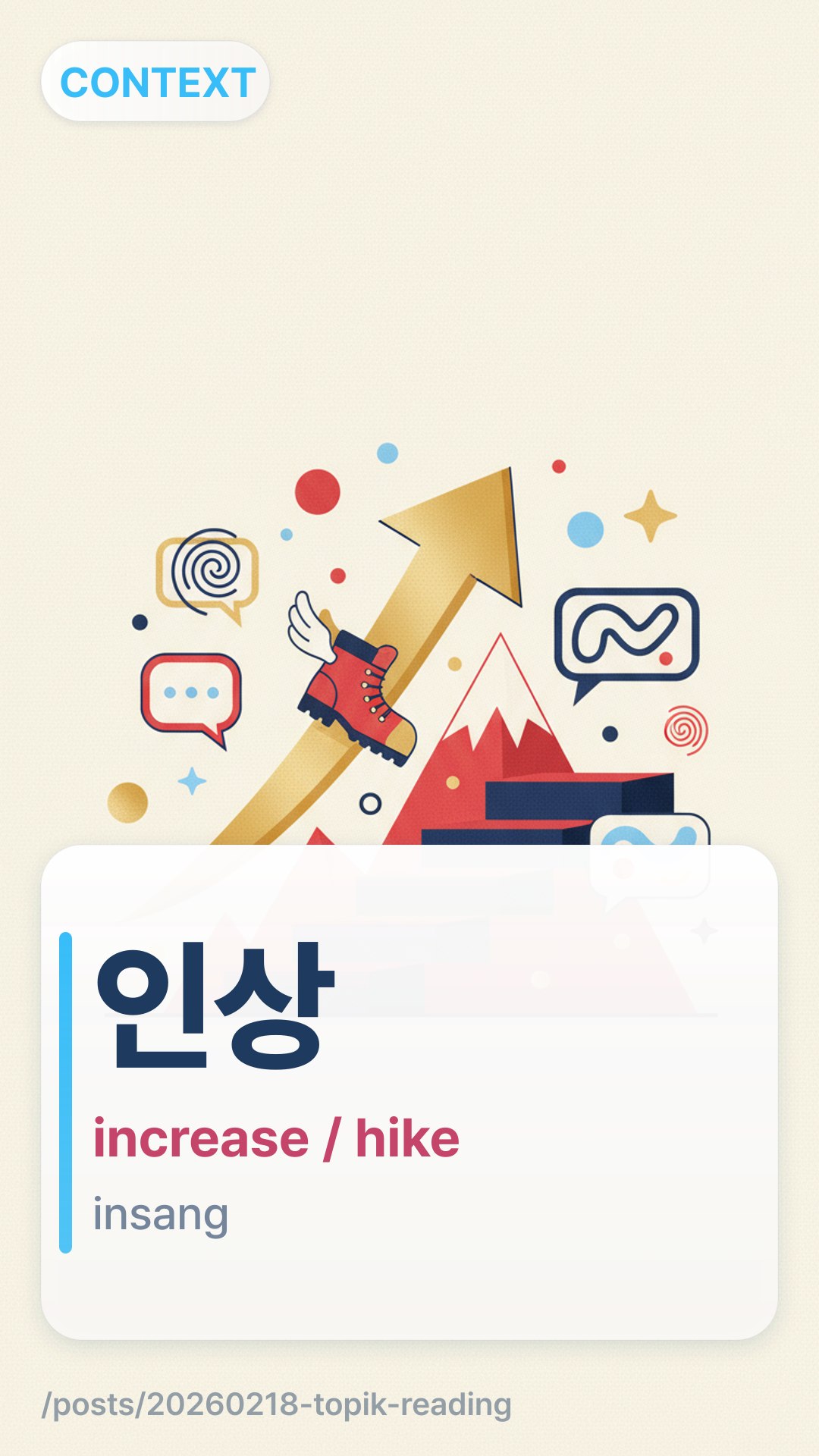
금리 인상geumri insang — Interest rate hike
최저임금 인상choejeoimgeum insang — Minimum wage increase
Rewrite (headline → simple)
수도 요금 인상sudo yogeum insang → 수도 요금이 올랐습니다.sudo yogeumi olratseupnida.

Common collocations
주가 하락juga harak — Stock price drop
수출 하락세suchul harakse — Downward trend in exports
Rewrite (headline → simple)
소비자 신뢰 지수 하락sobija sinroe jisu harak → 소비자들이 경제를 부정적으로 보고 있습니다.sobijadeuri gyeongjereul bujeongjeogeuro bogo itseupnida.

Common collocations
경기 전망gyeonggi jeonmang — Economic outlook
성장 전망 불투명seongjang jeonmang bultumyeong — Uncertain growth forecast
Rewrite (headline → simple)
내년 물가 안정 전망naenyeon mulga anjeong jeonmang → 내년에는 물가가 안정될 것으로 보입니다.naenyeoneneun mulgaga anjeongdoel geoseuro boipnida.
Rewrite drill
금리 인상 기조 유지geumri insang gijo yuji →금리를 계속 올릴 계획입니다.geumrireul gyesok olril gyehoegipnida.부동산 가격 하락 전환budongsan gagyeok harak jeonhwan →집값이 떨어지기 시작했습니다.jipgapsi tteoreojigi sijakhaetseupnida.수출 회복 전망 우세suchul hoebok jeonmang use →수출이 다시 좋아질 것이라는 의견이 많습니다.suchuri dasi johajil geosiraneun uigyeoni manseupnida.
Mini quiz (2 minutes)
Notes:
- Q1:
인상insang is correct because "rising prices" (물가 인상) is a common cause for public concern. - Q2:
전망jeonmang is used here as a verb (전망하다) to indicate a future prediction about growth rates. - Q3:
하락harak fits because a decrease in demand (수요 감소) typically leads to a drop in stock prices.
Next steps
When skimming Korean news, look for the final noun in the headline. If it ends in 인상insang or 하락harak, you immediately know the direction of the news. Practice by visiting the 'Economy' section of Naver News and circling these three words.