-(으)ㄴ/는 게 좋다: How to Give Soft Advice in Korean
Master -(으)ㄴ/는 게 좋다 to give polite advice and suggestions. Learn the difference between present and past tense forms and master TOPIK grammar.
Master -(으)ㄴ/는 게 좋다 to give polite advice and suggestions. Learn the difference between present and past tense forms and master TOPIK grammar.
Learn to distinguish between suggesting a helpful path and demanding action with this essential advice pattern.
Many learners accidentally sound bossy by using -아/어야 하다-a/eoya hada (must/have to) when they really just want to say "It would be better if..." or "I suggest you...".
Wrong: 감기에 걸렸으면 병원에 가야 해요!gamgie geolryeosseumyeon byeongwone gaya haeyo! (You MUST go to the hospital!) — Sounds like a command.
Right: 감기에 걸렸으면 병원에 가는 게 좋아요.gamgie geolryeosseumyeon byeongwone ganeun ge johayo. (It’s better if you go to the hospital.) — Sounds like caring advice.
Quick cheat sheet
Expressions in this post
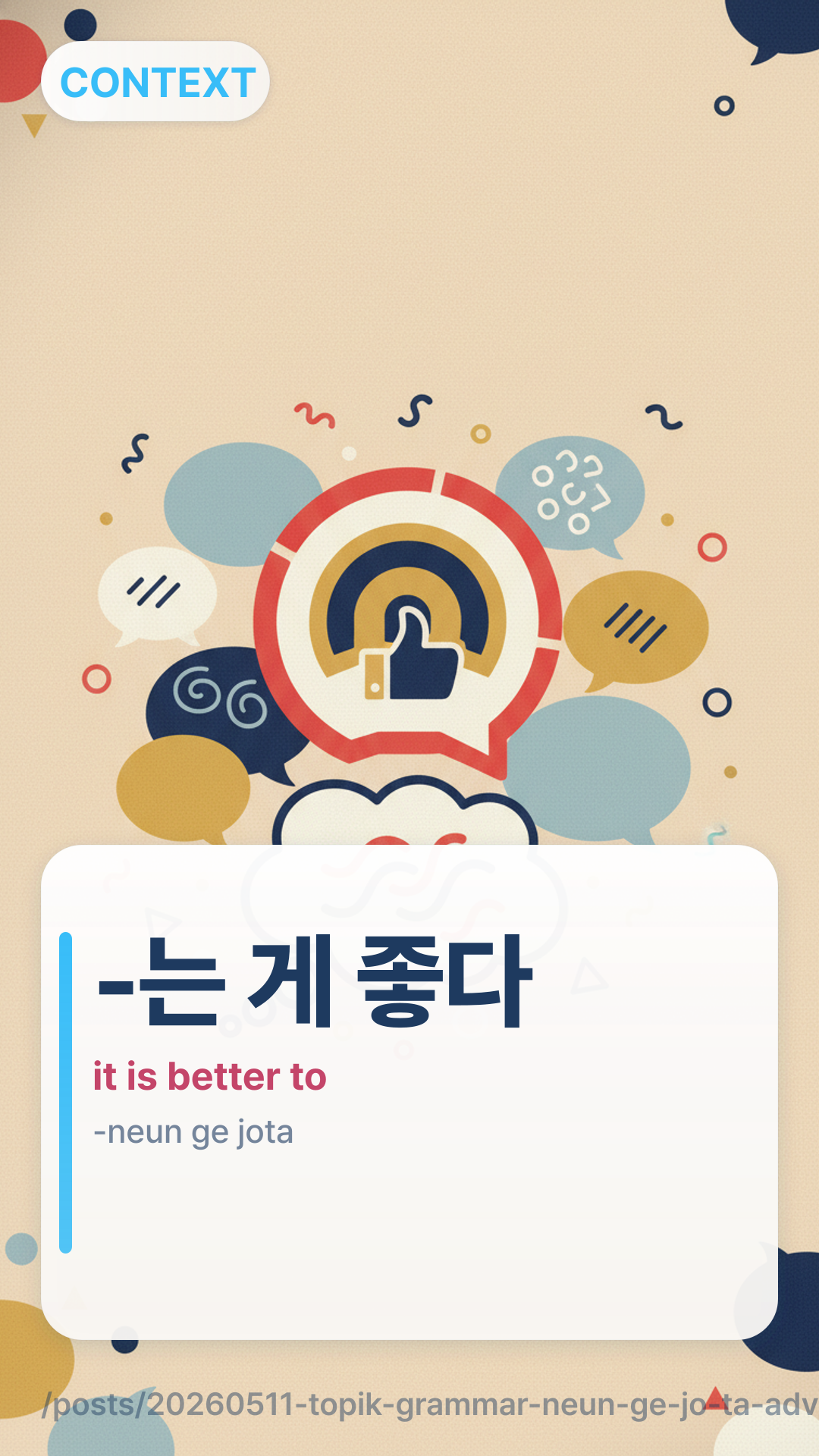
Form (how to attach)
Attach -는 게 좋다-neun ge jotda to the stem of an action verb.
가다gada →가는 게 좋다ganeun ge jotda먹다meokda →먹는 게 좋다meokneun ge jotda
Meaning range (what it can/can’t mean)
This pattern literally translates to "The act of doing [X] is good." It is the standard way to offer a recommendation or a soft suggestion. It is less forceful than -아/어야 하다-a/eoya hada and more natural in daily conversation than -는 것이 좋다-neun geosi jotda (which is the written/formal version).
Register (neutral/polite)
- Polite:
-는 게 좋아요-neun ge johayo (Standard) - Formal:
-는 게 좋습니다-neun ge jotseupnida (Presentations/Public service) - Casual:
-는 게 좋아-neun ge joha (Friends)
Politeness Ladder
-아/어야 해요-a/eoya haeyo (Strongest: You must)-는 게 좋겠어요-neun ge jotgesseoyo (Polite/Soft: I think it would be good if...)-는 게 좋아요-neun ge johayo (Neutral Advice: It's good to...)
Common mistakes (wrong → right)
Don't use the object marker 를reul here.
Wrong: 운동을 하는 게를 좋아요.undongeul haneun gereul johayo.
Right: 운동을 하는 게 좋아요.undongeul haneun ge johayo. — The 게ge is a contraction of 것이geosi (subject), so it takes the subject marker.
Examples
비가 오니까 우산을 가져가는 게 좋아요.biga onikka usaneul gajyeoganeun ge johayo. — Since it's raining, it's better to take an umbrella.한국어를 잘하고 싶으면 매일 연습하는 게 좋아요.hangugeoreul jalhago sipeumyeon maeil yeonseuphaneun ge johayo. — If you want to speak Korean well, it's good to practice every day.밤에는 일찍 자는 게 좋아요.bameneun iljjik janeun ge johayo. — It is better to sleep early at night.매운 것을 못 먹으면 이 메뉴는 피하는 게 좋아요.maeun geoseul mot meogeumyeon i menyuneun pihaneun ge johayo. — If you can't eat spicy food, it's better to avoid this menu.건강을 위해서 채소를 많이 먹는 게 좋아요.geongangeul wihaeseo chaesoreul manhi meokneun ge johayo. — For your health, it's good to eat a lot of vegetables.
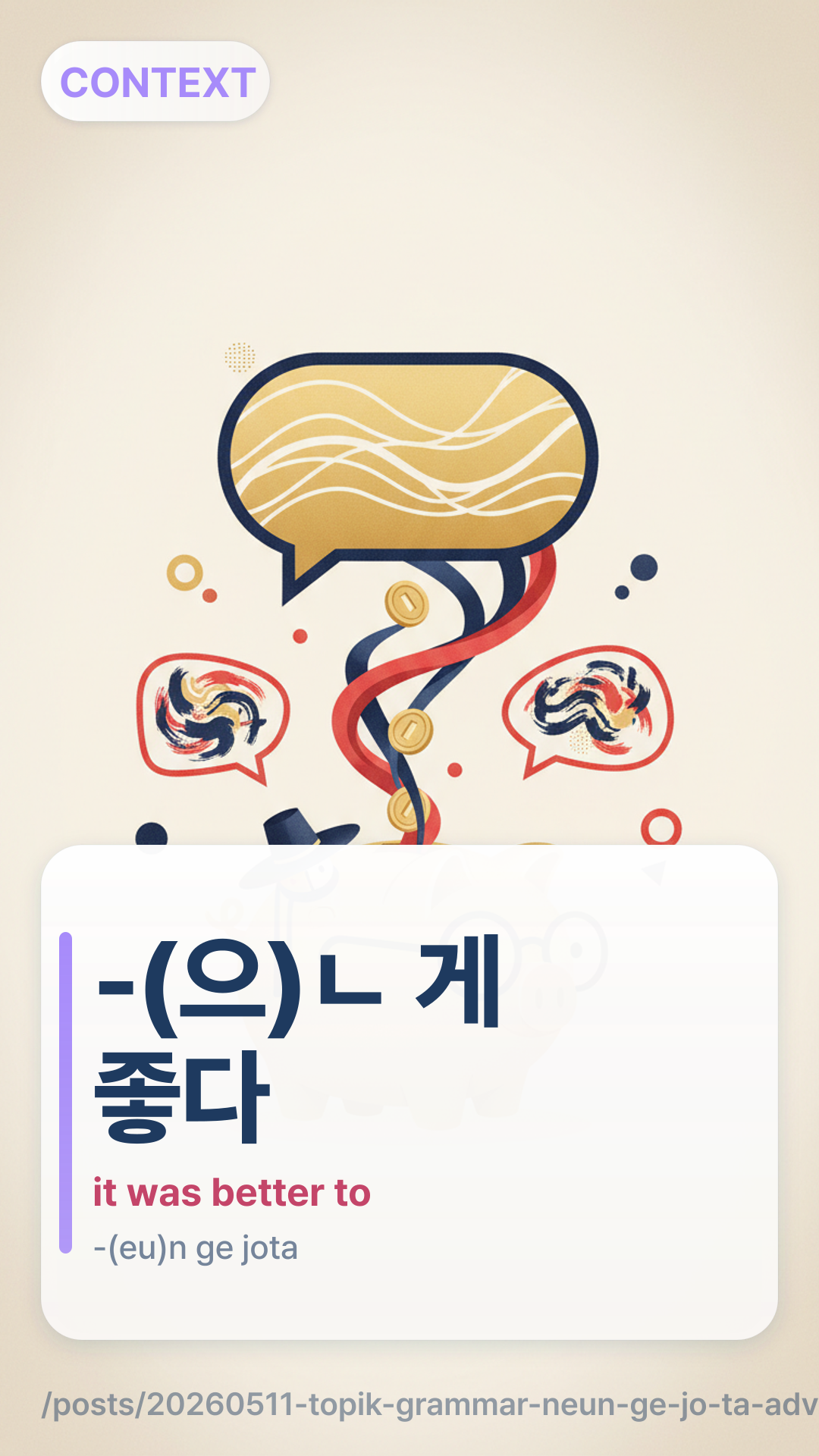
Form (how to attach)
Attach -(으)ㄴ 게 좋다-(eu)ㄴ ge jotda to the stem of an action verb to indicate a completed action or a specific choice.
가다gada →간 게 좋다gan ge jotda먹다meokda →먹은 게 좋다meogeun ge jotda
Meaning range (what it can/can’t mean)
While -는 게 좋다-neun ge jotda is for general habits or future suggestions, -(으)ㄴ 게 좋다-(eu)ㄴ ge jotda often refers to a choice already made or a specific state. It can also be used with adjectives to mean "It is good that [something] is [adjective]."
Common mistakes (wrong → right)
Learners often confuse this with the past tense of the verb "to be good" (좋았다johatda).
Wrong: 어제는 일찍 자는 게 좋았다.eojeneun iljjik janeun ge johatda. (Grammatically okay, but sounds like a diary entry about your feelings).
Right: 어제는 일찍 잔 게 좋았어요.eojeneun iljjik jan ge johasseoyo. (It was good that I went to bed early yesterday.)
Examples
일찍 도착한 게 좋았어요.iljjik dochakhan ge johasseoyo. — It was good that we arrived early.그 옷을 안 산 게 좋아요.geu oseul an san ge johayo. — It's good that you didn't buy those clothes (referring to a past decision).어제 푹 쉰 게 다행이에요.eoje puk swin ge dahaengieyo. — It's a relief that you rested well yesterday.비밀로 한 게 좋았을까요?bimilro han ge johasseulkkayo? — Would it have been better to keep it a secret?결국 솔직하게 말한 게 좋았어요.gyeolguk soljikhage malhan ge johasseoyo. — In the end, it was good that I spoke honestly.
Mini quiz (2 minutes)
Notes:
- Q1:
-는 게 좋아요-neun ge johayo is used here because it provides general advice for a current or future situation. - Q2:
-(으)ㄴ 게 좋아요-(eu)ㄴ ge johayo is correct because it refers to a past decision or a completed action (not watching the movie). - Q3:
-는 게 좋아요-neun ge johayo is used to describe a general healthy habit or recurring action.
Next steps
Convert these 5 sentences into soft advice using the -는 게 좋다-neun ge jotda pattern:
- 한국 신문을 읽으세요. (Read Korean newspapers.)
- 비타민을 드세요. (Take vitamins.)
- 단어장을 만드세요. (Make a vocabulary notebook.)
- 모르는 단어는 사전에서 찾으세요. (Look up unknown words in the dictionary.)
- 수업에 늦지 마세요. (Don't be late for class.)