-(으)ㄴ/는 편이다: How to Describe Tendencies in Korean
Master the TOPIK II grammar -(으)ㄴ/는 편이다 to describe habits and tendencies. Learn to avoid common mistakes and sound more natural. Master it now!
Master the TOPIK II grammar -(으)ㄴ/는 편이다 to describe habits and tendencies. Learn to avoid common mistakes and sound more natural. Master it now!
Stop stating everything as an absolute fact; learn to describe your subjective tendencies and habits like a native speaker with this essential TOPIK II pattern.
Many learners say 저는 매일 운동해요jeoneun maeil undonghaeyo (I exercise every day) when they actually mean they usually or tend to exercise. Using the absolute form for subjective habits can sound a bit stiff or even inaccurate.
Wrong: 저는 키가 커요.jeoneun kiga keoyo. (I am tall. — Sounds like an objective measurement statement)
Right: 저는 키가 큰 편이에요.jeoneun kiga keun pyeonieyo. (I'm on the taller side. — More natural for personal description)
Quick cheat sheet
Expressions in this post
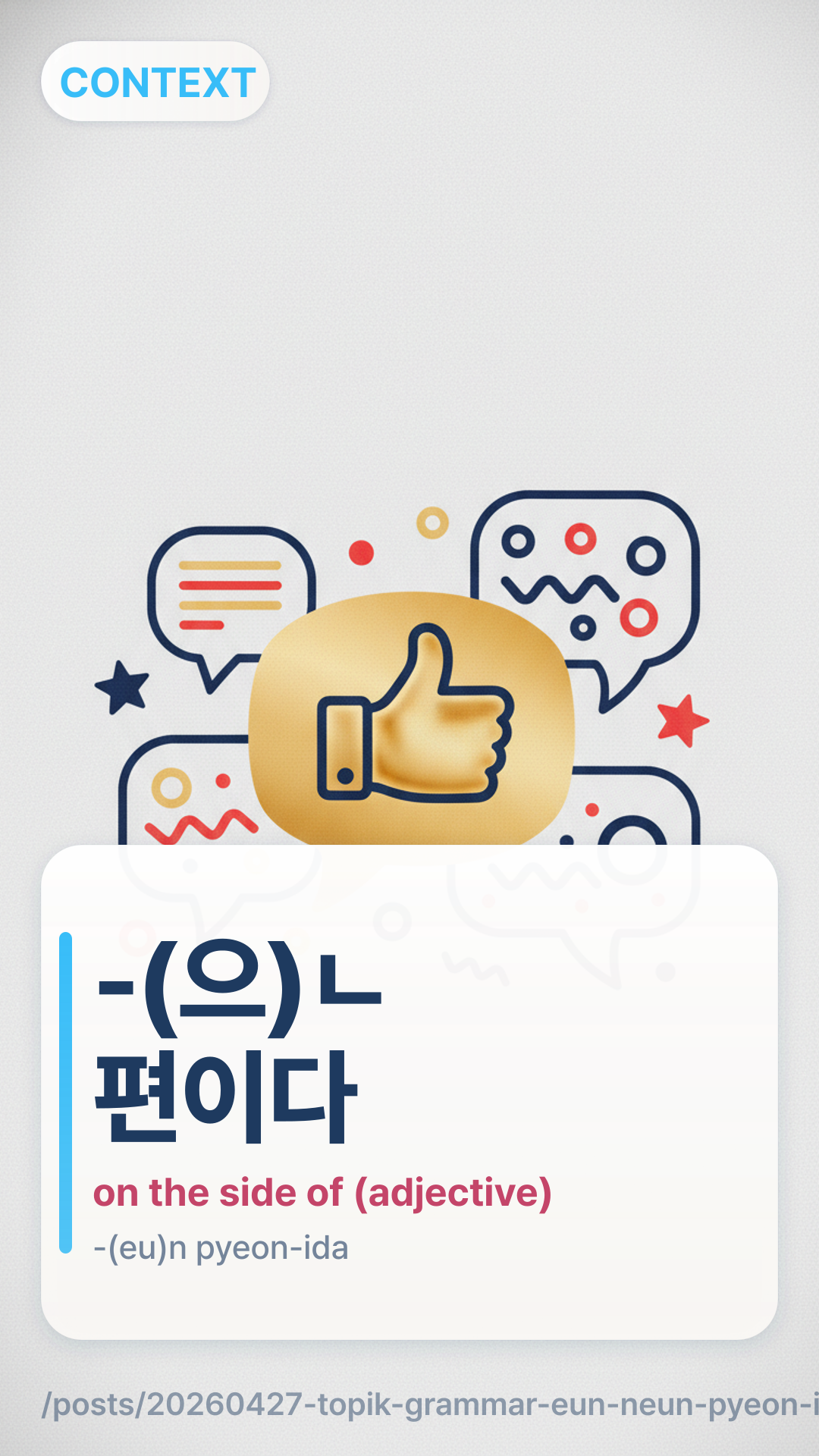
Form (how to attach)
For adjectives (Descriptive Verbs):
- Consonant ending:
작다jakda →작은 편이다jageun pyeonida (on the small side) - Vowel ending:
크다keuda →큰 편이다keun pyeonida (on the large side) ㄹㄹ irregular:멀다meolda →먼 편이다meon pyeonida (on the far side)
Meaning range (what it can/can’t mean)
This pattern categorizes something into a general group rather than stating an exact value. It is inherently subjective. You cannot use this for absolute, unchangeable facts. For example, you wouldn't say 저는 사람인 편이에요jeoneun saramin pyeonieyo (I tend to be a human).
Register (neutral/polite)
This is a neutral-to-polite pattern. In casual speech, use -(으)ㄴ 편이야-(eu)ㄴ pyeoniya. In polite settings, use -(으)ㄴ 편이에요-(eu)ㄴ pyeonieyo or -(으)ㄴ 편입니다-(eu)ㄴ pyeonipnida.
Common mistakes (wrong → right)
Wrong: 한국은 아시아에 있는 편이에요.hangugeun asiae itneun pyeonieyo.
Right: 한국은 아시아에 있어요.hangugeun asiae isseoyo.
Reason: Geography is a fixed fact, not a tendency or a "side."
Examples
우리 집은 학교에서 가까운 편이에요.uri jibeun hakgyoeseo gakkaun pyeonieyo. — My house is on the closer side to school.이 가방은 디자인은 예쁜데 가격이 비싼 편이에요.i gabangeun dijaineun yeppeunde gagyeogi bissan pyeonieyo. — This bag has a pretty design, but it's on the expensive side.제 성격은 좀 조용한 편이에요.je seonggyeogeun jom joyonghan pyeonieyo. — My personality is on the quiet side.요즘 날씨가 작년보다 따뜻한 편이에요.yojeum nalssiga jaknyeonboda ttatteuthan pyeonieyo. — The weather lately is on the warmer side compared to last year.시험 문제가 생각보다 쉬운 편이었어요.siheom munjega saenggakboda swiun pyeonieosseoyo. — The exam questions were on the easier side than I thought.
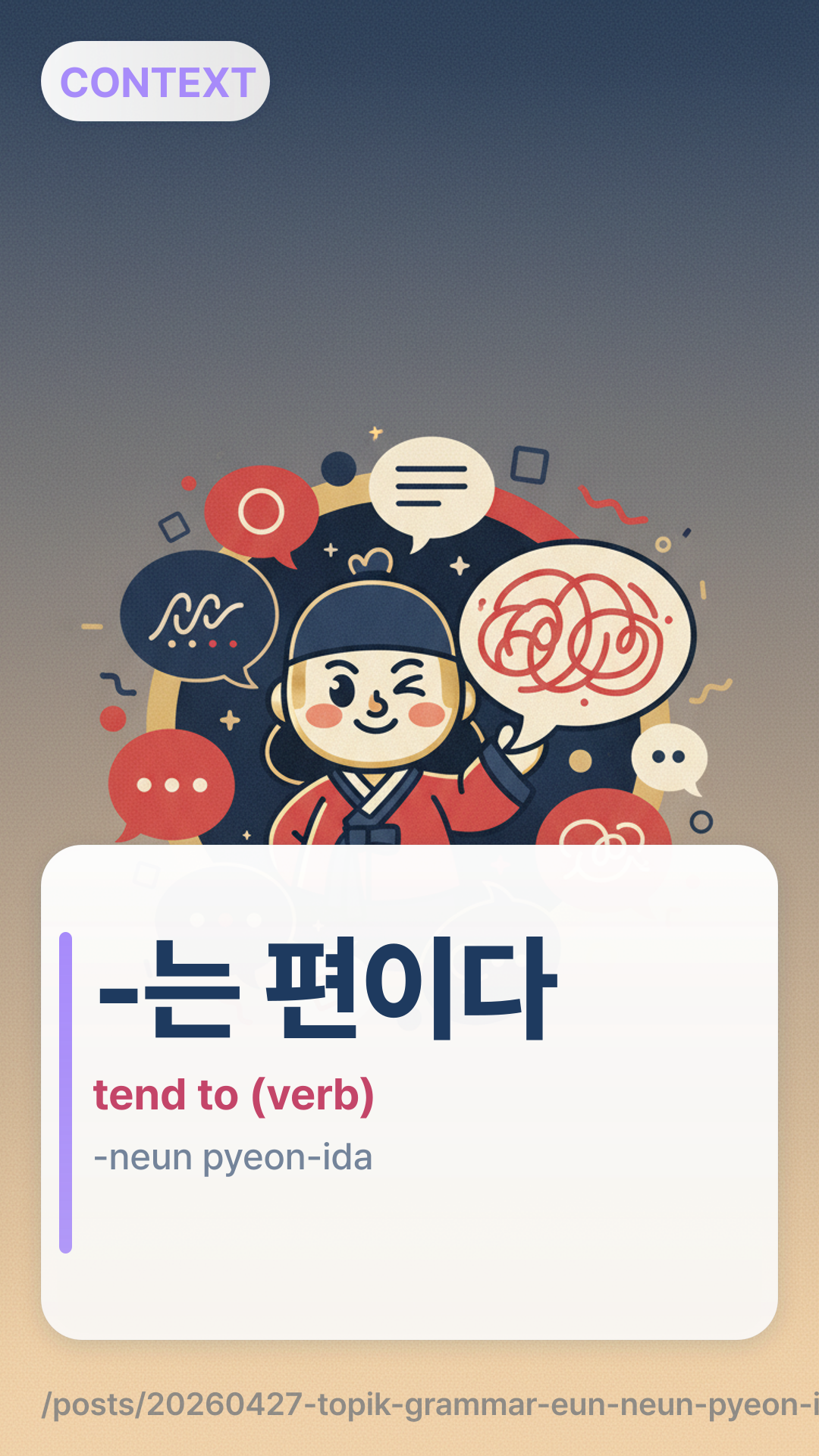
Form (how to attach)
For verbs (Action Verbs):
- Always use
-는 편이다-neun pyeonida regardless of the final consonant. 먹다meokda →먹는 편이다meokneun pyeonida (tend to eat)가다gada →가는 편이다ganeun pyeonida (tend to go)ㄹㄹ irregular:만들다mandeulda →만드는 편이다mandeuneun pyeonida (tend to make)
Meaning range (what it can/can’t mean)
It describes a habit or a frequent action. It is often paired with adverbs like 자주jaju (often) or 잘jal (well/often). It cannot be used for actions happening right now or one-time events.
Common mistakes (wrong → right)
Wrong: 지금 숙제를 하는 편이에요.jigeum sukjereul haneun pyeonieyo.
Right: 지금 숙제를 하고 있어요.jigeum sukjereul hago isseoyo.
Reason: You cannot use this pattern for an action currently in progress.
Examples
저는 주말에 집에서 쉬는 편이에요.jeoneun jumare jibeseo swineun pyeonieyo. — I tend to rest at home on weekends.제 친구는 한국 음식을 자주 먹는 편이에요.je chinguneun hanguk eumsigeul jaju meokneun pyeonieyo. — My friend tends to eat Korean food often.저는 아침에 일찍 일어나는 편이에요.jeoneun achime iljjik ireonaneun pyeonieyo. — I tend to wake up early in the morning.그 배우는 연기를 아주 잘하는 편이에요.geu baeuneun yeongireul aju jalhaneun pyeonieyo. — That actor tends to act very well (is on the side of acting well).돈을 아껴 쓰려고 노력하는 편이에요.doneul akkyeo sseuryeogo noryeokhaneun pyeonieyo. — I tend to try to save money.
Decision Tree: Adjective vs. Verb
- Is the word a state/quality? (e.g., Pretty, Small, Cold) → Use
-(으)ㄴ 편이다-(eu)ㄴ pyeonida. - Is the word an action/process? (e.g., Eat, Study, Exercise) → Use
-는 편이다-neun pyeonida. - Exception:
있다/없다itda/eopda words (e.g.,재미있다jaemiitda) always take-는 편이다-neun pyeonida →재미있는 편이다jaemiitneun pyeonida.
Mini quiz (2 minutes)
Notes:
- Q1:
작은 편이에요jageun pyeonieyo is correct because작다jakda is an adjective ending in a consonant, requiring-(으)ㄴ 편이다-(eu)ㄴ pyeonida. - Q2:
공부하는 편이에요gongbuhaneun pyeonieyo is correct because공부하다gongbuhada is an action verb, which always takes the-는 편이다-neun pyeonida form. - Q3:
재미있는 편이에요jaemiitneun pyeonieyo is correct because words ending in있다/없다itda/eopda follow the-는 편이다-neun pyeonida pattern regardless of their descriptive nature.
Next steps
Frequency Drill: Categorize your own life. Convert these 5 sentences into the -(으)ㄴ/는 편이다-(eu)ㄴ/neun pyeonida pattern based on your habits:
- 저는 매일 커피를 마셔요.
- 저는 밤에 늦게 자요.
- 제 방은 깨끗해요.
- 저는 매운 음식을 잘 먹어요.
- 한국어 공부는 재미있어요.