-야 vs -이야: Master Casual Korean Teasing
Learn how to use -야 and -이야 for casual Korean sentences. Master the batchim rule to tease your friends correctly and avoid common mistakes!
Learn how to use -야 and -이야 for casual Korean sentences. Master the batchim rule to tease your friends correctly and avoid common mistakes!
Stop sounding like a textbook when joking with friends by mastering the essential 'it is' ending for casual speech.
The one rule you need
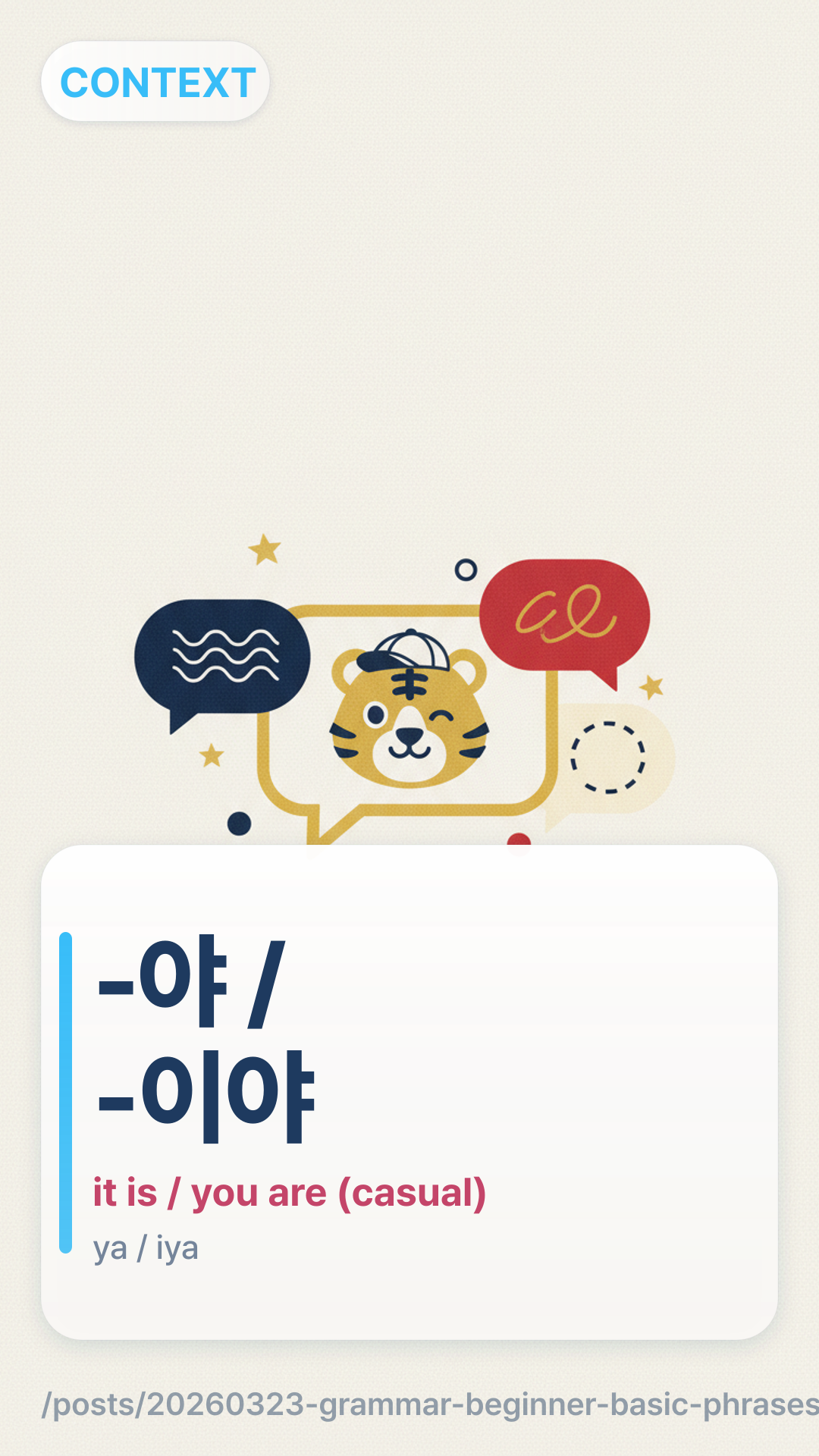
In casual Korean (Banmal), use -야-ya or -이야-iya to say "It is [Noun]." The choice depends entirely on whether the noun ends in a vowel or a consonant (batchim).
Quick cheat sheet
Expressions in this post
Attach rules
Choosing the right ending is a matter of smooth pronunciation. Follow this decision tree:
- Does the noun end in a consonant (Batchim)?
- Yes → Add
-이야-iya (e.g.,바보babo +이야iya is wrong, but선생님seonsaengnim +이야iya is right). - No (Ends in a vowel) → Add
-야-ya (e.g.,친구chingu +야ya).
- Yes → Add
Constraints
- Register: Use this ONLY with close friends, siblings, or people younger than you. Using this with a boss or teacher is a major social error.
- Tense: This is for the present tense. For the past tense, you would use
-였어-yeosseo or-이었어-ieosseo.
Minimal pairs
바보야baboya (Ba-bo-ya) — You are a fool (Casual/Friendly).바보예요baboyeyo (Ba-bo-ye-yo) — You are a fool (Polite/Formal). Note: Calling someone a fool in polite speech is very awkward and confusing!
Common mistakes
-
Wrong:
나 바보이야na baboiya (Na ba-bo-i-ya) -
Right:
나 바보야na baboya (Na ba-bo-ya) -
Reason:
바보babo ends in a vowel (ㅗㅗ), so it must take-야-ya. -
Wrong:
이거 내 책야igeo nae chaegya (I-geo nae chaek-ya) -
Right:
이거 내 책이야igeo nae chaegiya (I-geo nae chaek-i-ya) -
Reason:
책chaek ends in a consonant (ㄱㄱ), so it needs the filler sound이i to bridge the gap.
Examples
너 진짜 천재야!neo jinjja cheonjaeya! — You are a total genius!이거 내 선물이야.igeo nae seonmuriya. — This is my present (for you).오늘 우리 집 주인공은 너야.oneul uri jip juingongeun neoya. — You are the main character at our house today.
Next steps
Spot the mistake
Fill in the blank with one of: -야-ya, -이야-iya
Answers:
-야-ya-이야-iya-야-ya-이야-iya-이야-iya
Notes:
- Q1:
친구chingu ends in a vowel (ㅜㅜ), so-야-ya is the correct natural flow. - Q2:
설탕seoltang (sugar) ends in the consonantㅇㅇ, requiring-이야-iya. - Q3:
바보babo ends in a vowel (ㅗㅗ), making-야-ya the standard teasing ending. - Q4:
군인gunin (soldier) ends inㄴㄴ, so we use-이야-iya. - Q5:
사촌sachon (cousin) ends inㄴㄴ, so-이야-iya is required.