How to Ask for Help in Korean Without Being Rude
Stop using -주세요 for everything! Learn how to nudge for a reply and ask for favors politely using -(으)시겠어요? and more.
Stop using -주세요 for everything! Learn how to nudge for a reply and ask for favors politely using -(으)시겠어요? and more.
Asking for a favor in a new language is nerve-wracking because the line between a polite request and a bossy command is paper-thin. You want to ask your colleague for a file or nudge a friend who hasn't replied to your text, but you don't want to sound like you're barking orders. How do you soften your tone so people actually want to help you?
Quick cheat sheet
Expressions in this post
What it actually implies
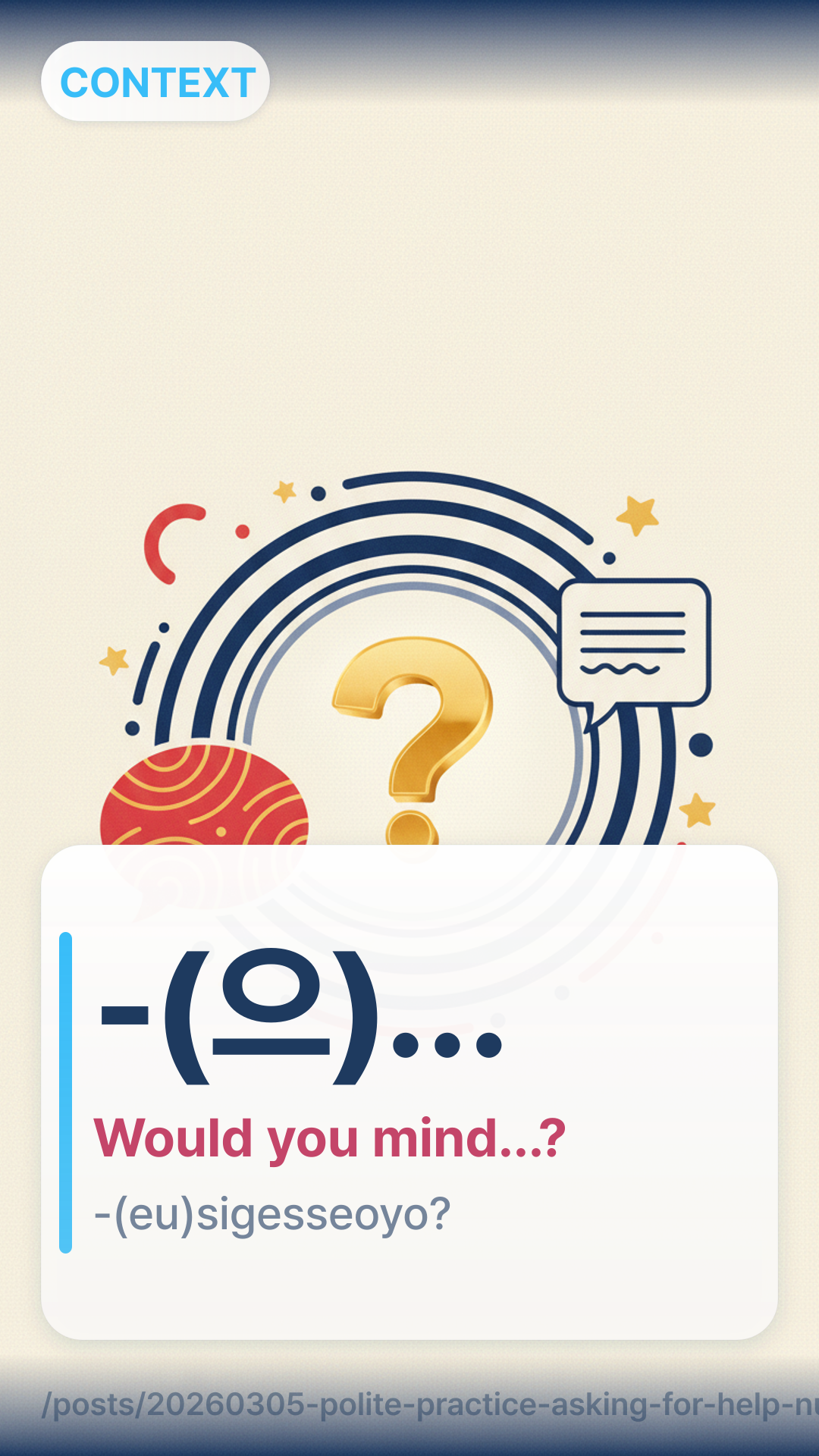
While many beginners rely heavily on -주세요-juseyo (Please give/do), this can often sound like a direct command in professional or sensitive settings. -(으)시겠어요?-(eu)sigesseoyo? shifts the focus from what you want to the other person's will or capability. It translates roughly to "Would you be willing to...?" or "Do you think you could...?" It is the gold standard for polite nudges and formal requests.
When it sounds rude (and why)
It is rarely "rude," but it can feel overly stiff or distant if used with your best friend or a younger sibling. In those cases, a simple -어 줄래?-eo julrae? is much more natural. Using high-formal grammar in a casual setting can sometimes create an intentional "cold shoulder" vibe.
Do / Don’t checklist
- Do use this when asking a stranger for directions or a waiter for a menu.
- Do use this in work emails when nudging a teammate for a late response.
- Don't use this if you are actually the boss giving a mandatory instruction; it might sound sarcastic.
- Don't forget the
시si honorific; it is essential for the polite "nudge" effect.
Rewrite drill (same message, 3 tones)
- Casual:
이것 좀 봐 줄래?igeot jom bwa julrae? — Can you look at this? - Standard Polite:
이것 좀 봐 주세요.igeot jom bwa juseyo. — Please look at this. - High-Polite Nudge:
이것 좀 봐 주시겠어요?igeot jom bwa jusigesseoyo? — Would you mind taking a look at this?
Examples
잠시만 기다려 주시겠어요?jamsiman gidaryeo jusigesseoyo? — Would you mind waiting for just a moment?메뉴판 좀 보여 주시겠어요?menyupan jom boyeo jusigesseoyo? — Could you please show me the menu?다시 한번 설명해 주시겠어요?dasi hanbeon seolmyeonghae jusigesseoyo? — Would you mind explaining that one more time?
The Trap: The "-주세요" Over-reliance
Many learners use 주세요juseyo for everything. While grammatically correct, saying 리포트 보내 주세요ripoteu bonae juseyo (Please send the report) to a senior colleague can feel like a demand. To fix this, add the "nudge" ending: 리포트 보내 주시겠어요?ripoteu bonae jusigesseoyo?. This small change acknowledges their busy schedule and makes you sound much more professional.
Copy/paste mini-dialogues (with EN)
Next steps
Try replacing one -주세요-juseyo with -(으)시겠어요?-(eu)sigesseoyo? today. Whether you are at a cafe or texting a language partner, notice how the softer tone changes the interaction. It’s the easiest way to level up from "tourist Korean" to "respectful communicator."