Master 주무시다, 드시다 & 계시다: Korean Honorific Verbs
Learn essential Korean honorific verbs like 주무시다 and 드시다. Master polite speech with our tone ladder and rewrite drills. Start speaking naturally!
Learn essential Korean honorific verbs like 주무시다 and 드시다. Master polite speech with our tone ladder and rewrite drills. Start speaking naturally!
Using the wrong verb when speaking to your boss or your partner's parents can make a simple sentence feel accidentally blunt. How do you switch from standard polite to the high-respect honorific forms without overthinking it?
Quick cheat sheet
Expressions in this post
What it actually implies
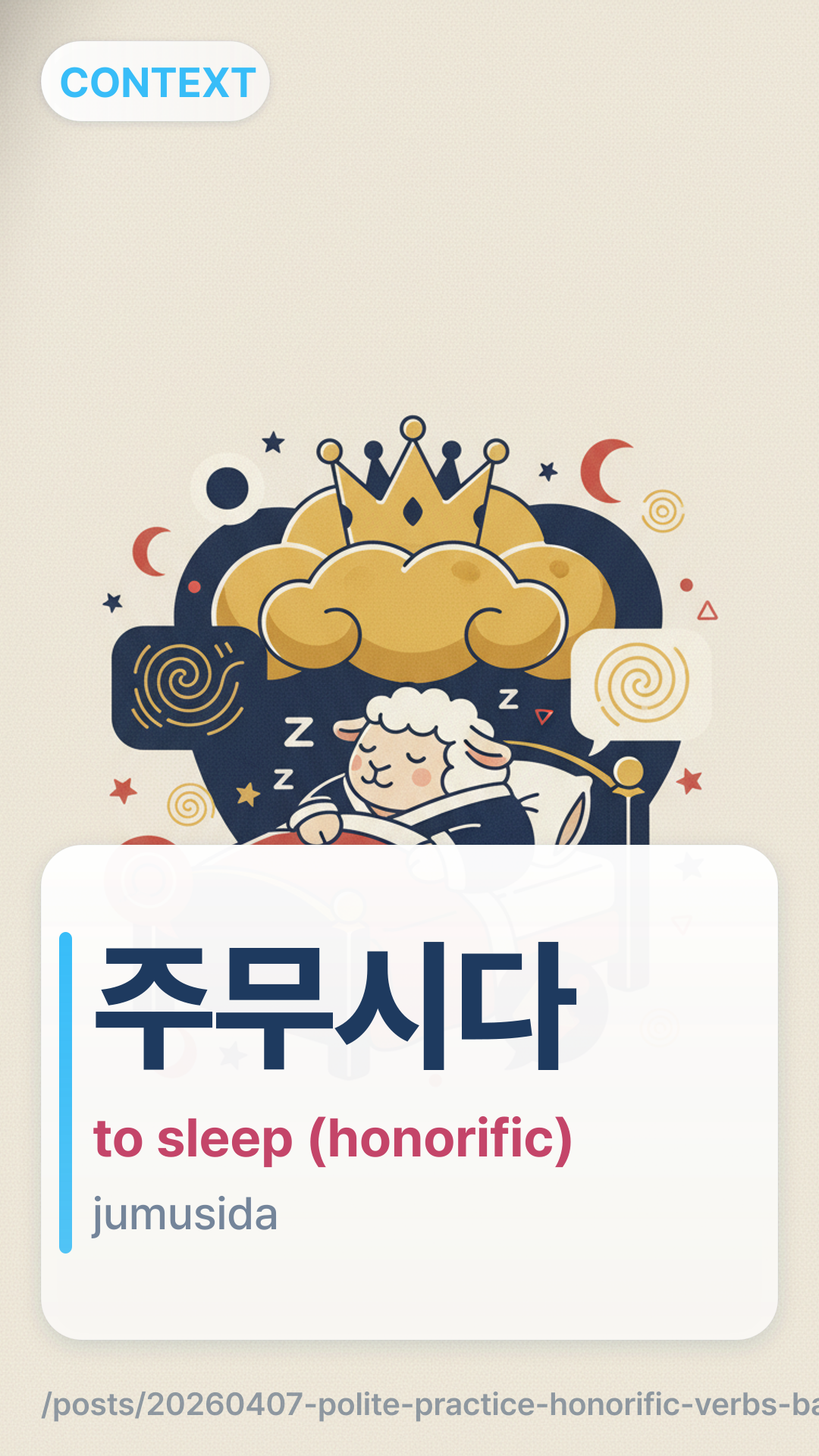
주무시다jumusida is the honorific version of 자다jada (to sleep). In Korean culture, showing respect to elders or people of higher status involves changing the entire verb root, not just the ending. Using 자요jayo for a grandfather sounds like you are treating him like a peer, which can be perceived as a lack of upbringing.
When it sounds rude (and why)
It sounds rude when you don't use it for someone older. Conversely, never use 주무시다jumusida to describe yourself. Saying "제가 주무셨어요" (I slept - honorific) makes you sound incredibly arrogant or confused about your own status.
Do / Don’t checklist
- Do use it for grandparents, parents, and senior bosses.
- Do use the form
안녕히 주무세요annyeonghi jumuseyo for "Goodnight." - Don't use it for your younger brother or a close friend.
- Don't use it for yourself in any context.
Rewrite drill (same message, 3 tones)
- Casual:
잘 자.jal ja. — Sleep well. - Polite:
잘 자요.jal jayo. — Sleep well (standard polite). - Honorific:
안녕히 주무세요.annyeonghi jumuseyo. — Sleep well (highly respectful).
Examples
할머니는 방에서 주무시고 계세요.halmeonineun bangeseo jumusigo gyeseyo. — Grandmother is sleeping in the room.어제 잘 주무셨어요?eoje jal jumusyeosseoyo? — Did you sleep well? (to an elder)
Honorific Decision Tree
When deciding which verb to use, ask: Is the subject of the sentence someone I need to show high respect to?
- Is the subject ME? -> Use standard verbs (
자다jada,먹다meokda,있다itda). - Is the subject a peer/younger? -> Use standard verbs.
- Is the subject an elder/superior? -> Use Honorifics (
주무시다jumusida,드시다deusida,계시다gyesida).
Copy/paste mini-dialogues (with EN)
Next steps
Try replacing one standard verb today. Instead of asking an elder 식사했어요?siksahaesseoyo?, try using 진지 드셨어요?jinji deusyeosseoyo?. It’s a small change that makes a massive impression on native speakers.