안녕하십니까? Master Formal Korean for Beginners
Learn essential formal Korean phrases like 안녕하십니까 and master the politeness ladder to navigate social situations with confidence.
Learn essential formal Korean phrases like 안녕하십니까 and master the politeness ladder to navigate social situations with confidence.
Learn how to navigate the jump from casual to formal Korean without the social awkwardness of using the wrong honorifics.
You’ve just walked into a job interview or a high-end restaurant in Seoul. Do you stick with a simple 'Hello' or do you need something more? Knowing when to switch from standard polite to high-formal can be the difference between looking like a tourist and looking like a pro.
Quick cheat sheet
Expressions in this post
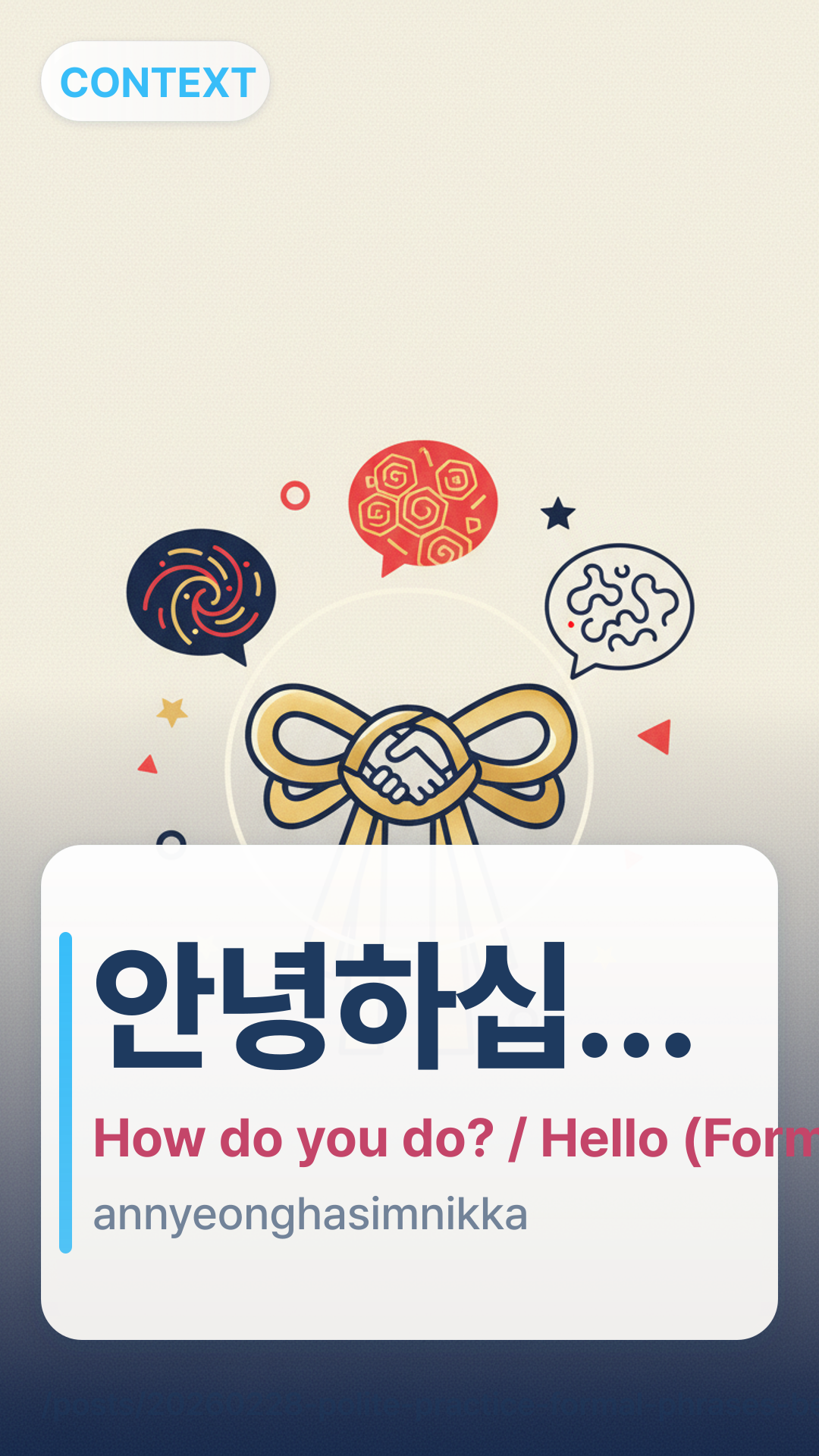
What it actually implies
This is the highest level of 'Hello' in Korean (Hapsyo-che). While 안녕하세요annyeonghaseyo is perfectly fine for daily life, 안녕하십니까annyeonghasipnikka signals deep respect, professionalism, or a formal announcement. It literally asks, "Are you at peace?" in a highly disciplined grammatical form.
When it sounds rude (and why)
It is rarely 'rude' in terms of being offensive, but it can be 'socially tone-deaf.' If you say this to a close friend at a bar, they might ask if you're filming a historical drama or if you're mad at them. It creates a 'wall' of formality that can feel cold in intimate settings.
Do / Don’t checklist
- DO use it when meeting a CEO or an elder for the first time.
- DO use it when giving a public speech or presentation.
- DON’T use it with people younger than you in a casual setting.
- DON’T use it with your language exchange partner unless you are joking.
Rewrite drill (same message, 3 tones)
- Casual:
안녕?annyeong? — Hi! - Polite:
안녕하세요?annyeonghaseyo? — Hello. - Formal:
안녕하십니까?annyeonghasipnikka? — Good day / How do you do?
Examples
처음 뵙겠습니다. 안녕하십니까?cheoeum boepgetseupnida. annyeonghasipnikka? — Nice to meet you. How do you do?안녕하십니까? 오늘 발표를 맡은 김철수입니다.annyeonghasipnikka? oneul balpyoreul mateun gimcheolsuipnida. — Hello. I am Chul-soo Kim, in charge of today's presentation.
The Politeness Ladder
In Korean, the verb ending changes based on who you are talking to.
- Level 1 (Ban-mal):
해hae - Used with friends. - Level 2 (Haeyo-che):
해요haeyo - The 'standard' polite way for most adults. - Level 3 (Hapsyo-che):
합니다hapnida - The formal way used in the military, news, and business.
Common Wrong vs. Right: Honorifics
- Wrong:
선생님이 밥을 먹어요.seonsaengnimi babeul meogeoyo. (Too casual for a teacher) - Right:
선생님이 진지를 드세요.seonsaengnimi jinjireul deuseyo. (Using the honorific word for meal and the honorific verb ending)
Copy/paste mini-dialogues (with EN)
Next steps
Try saying 안녕하십니까annyeonghasipnikka the next time you enter a formal business meeting or a very traditional Korean restaurant. Notice the difference in how people respond to your level of discipline!