반말 vs 존댓말: How to Avoid Upsetting Koreans
Stop accidentally offending locals! Master the shift from casual to polite Korean with our essential tone ladder and rewrite drills.
Stop accidentally offending locals! Master the shift from casual to polite Korean with our essential tone ladder and rewrite drills.
You just met someone your age at a cafe and used a friendly '안녕!' only to receive a cold stare. In Korean culture, age and social hierarchy aren't just concepts—they are baked into every verb ending. How can you tell when it's safe to drop the formalities without causing a social disaster?
Quick cheat sheet
Expressions in this post
What it actually implies
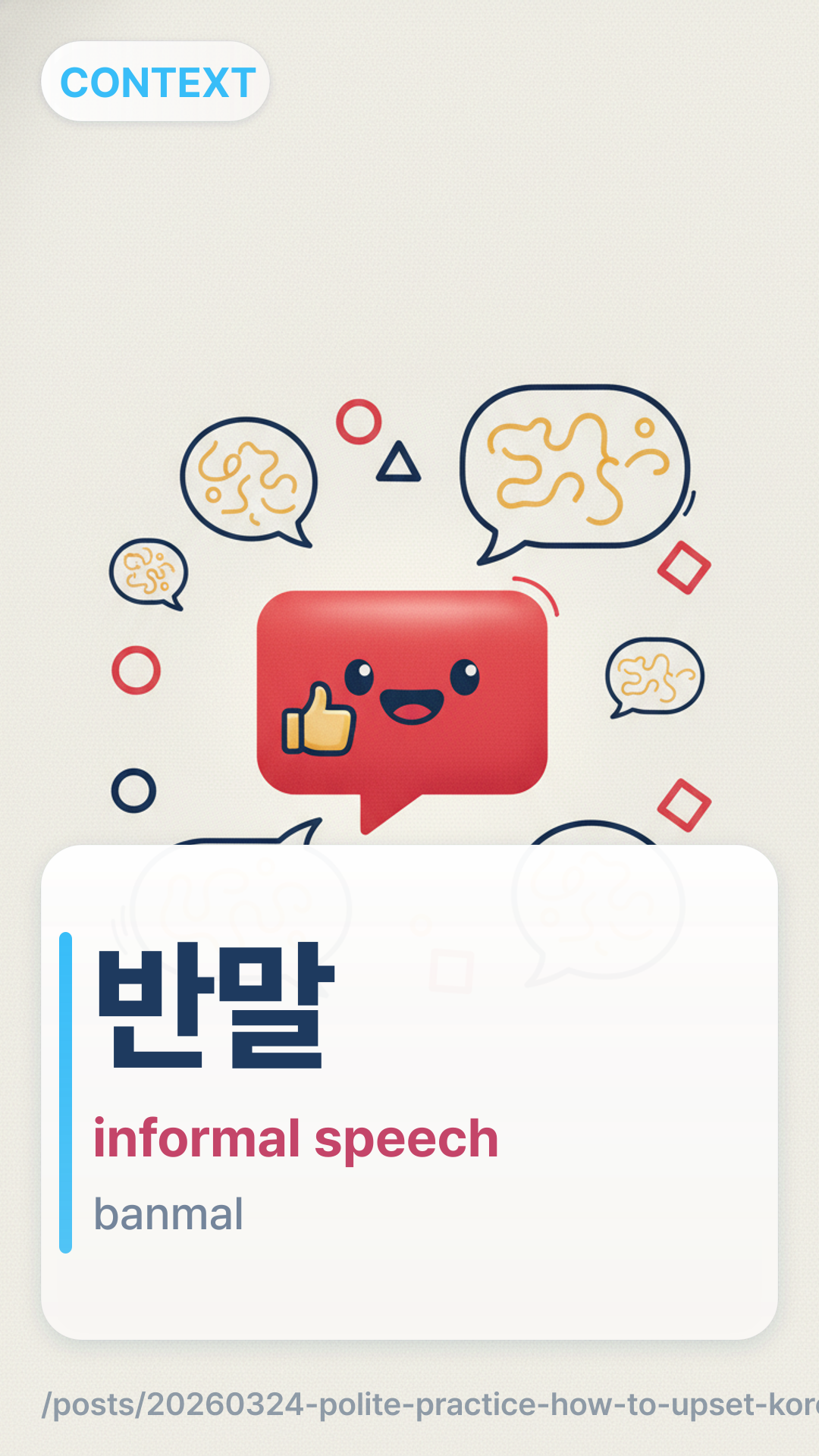
반말banmal (Banmal) literally translates to 'half-speech.' It is the informal register of the Korean language. Using it implies a high level of intimacy, a lack of social distance, or a clear hierarchical superiority (like a parent to a child). When used correctly, it feels warm and close; when used incorrectly, it feels like a deliberate slap in the face to the listener's status.
When it sounds rude (and why)
Using 반말banmal to a stranger, an elder, or a colleague without a 'mutual agreement' is known as '말을 놓다' (dropping the words). To a Korean, this feels like you are looking down on them or ignoring the social contract of respect. Even if you are the same age, starting with 반말banmal before being invited to do so is considered highly aggressive or uneducated.
Do / Don’t checklist
- Do: Use
존댓말jondaetmal (polite speech) by default for everyone you don't know intimately. - Do: Ask '말 놓으셔도 돼요' (You can speak casually) if you want to bridge the gap.
- Don’t: Assume that because someone is a 'friend' in the Western sense, you can immediately use
반말banmal. - Don’t: Use
반말banmal to service workers (waiters, taxi drivers) regardless of their age.
Rewrite drill (same message, 3 tones)
- Formal (Business):
식사하셨습니까?siksahasyeotseupnikka? — Have you eaten? (Very stiff/polite) - Polite (Standard):
밥 먹었어요?bap meogeosseoyo? — Have you eaten? (Safe for most situations) - Casual (Banmal):
밥 먹었어?bap meogeosseo? — Eaten? (Only for close friends)
Examples
처음 뵙겠습니다. 잘 부탁드립니다.cheoeum boepgetseupnida. jal butakdeuripnida. — Nice to meet you. Please look after me.야! 너 뭐해?ya! neo mwohae? — Hey! What are you doing? (Strictly for close friends)
Copy/paste mini-dialogues (with EN)
Next steps
Try this today: Next time you watch a K-drama, listen for the exact moment characters switch from -요-yo endings to 반말banmal. Usually, there is a specific conversation where they 'agree' to lower the language barrier. Until you have that talk in real life, stick to the safe -요-yo zone!