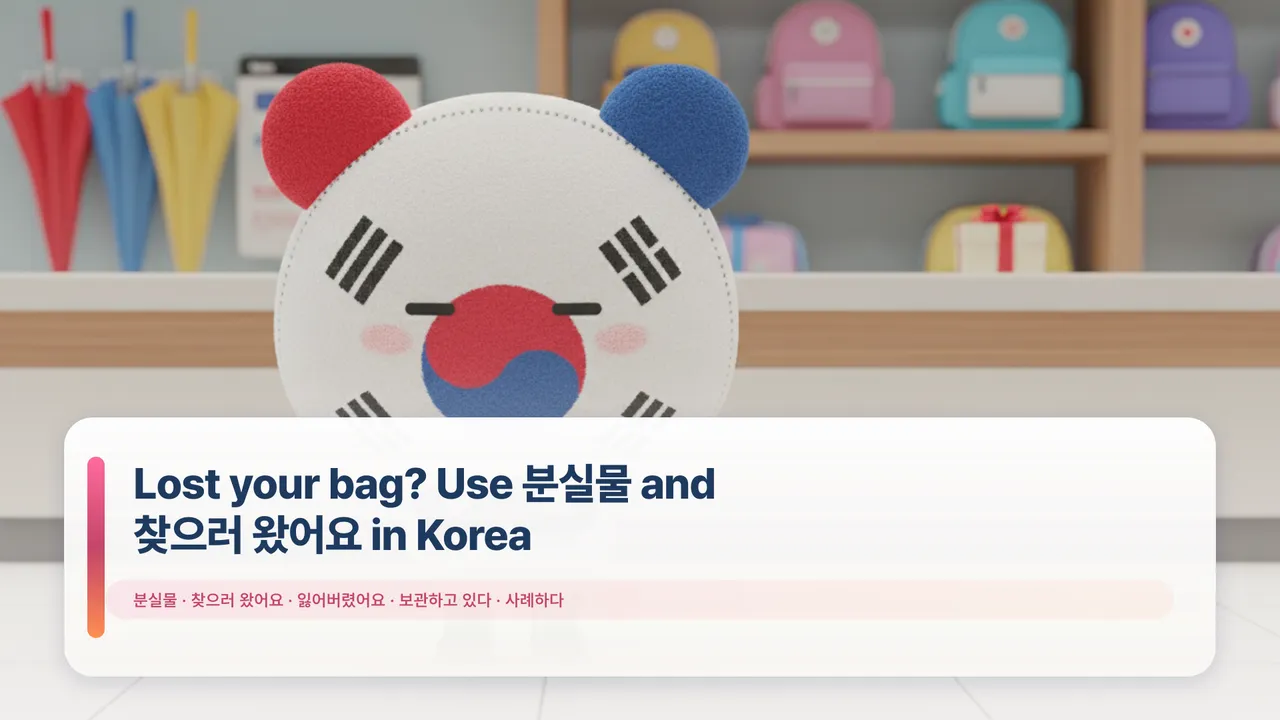
Lost your bag? Use 분실물 and 찾으러 왔어요 in Korea
Lost something in Korea? Master 분실물, 찾으러 왔어요, and more to navigate lost and found centers with ease. Learn essential travel Korean!
Lost something in Korea? Master 분실물, 찾으러 왔어요, and more to navigate lost and found centers with ease. Learn essential travel Korean!
Navigate Korean lost and found centers confidently with a simple decision tree and essential phrases for retrieving your items.
Situation (what’s happening)
You realize your bag is missing after getting off the KTX at Seoul Station. You head to the information desk to ask for help and eventually visit the storage office.
Traveler: 저기요, 혹시 분실물 센터가 어디예요? — Excuse me, where is the lost and found center?
Staff: 2층 끝에 있어요. 뭐 잃어버리셨어요? — It is at the end of the 2nd floor. What did you lose?
Traveler: 검은색 가방요. 안에 지갑이 들어있어요. — A black bag. There is a wallet inside.
Staff: 아, 아까 접수된 게 있네요. — Ah, something was turned in earlier.
Traveler: 정말요? 그거 찾으러 왔어요! — Really? I came to pick that up!
Staff: 본인 확인이 필요합니다. 성함이 어떻게 되세요? — We need to verify your identity. What is your name?
Traveler: 김철수입니다. 사례하고 싶은데 방법이 있을까요? — I am Kim Cheol-su. I'd like to offer a reward, is there a way?
Staff: 아니요, 괜찮습니다. 여기 서명해 주세요. — No, it is fine. Please sign here.
Quick cheat sheet
Expressions in this post
Why this fits the scene
This is the formal and most common term for any "lost property." You will see this on signs at airports, subway stations, and malls.
Safer alternative
유실물yusilmul is also used officially (as in 유실물 센터), but 분실물bunsilmul is more common in daily speech.
Example line (from the script)
저기요, 혹시 분실물 센터가 어디예요?jeogiyo, hoksi bunsilmul senteoga eodiyeyo? — Excuse me, where is the lost and found center?

Why this fits the scene
When you arrive at a desk knowing they have your item, this is the most natural way to state your purpose. It literally means "I came to find/get it."
Safer alternative
수령하러 왔어요suryeonghareo wasseoyo is more formal (I am here to receive it), often used in official documents.
Example line (from the script)
정말요? 그거 찾으러 왔어요!jeongmaryo? geugeo chajeureo wasseoyo! — Really? I came to pick that up!
Why this fits the scene
This is the standard past-tense verb to explain that you have lost something. It is polite and clear for any service situation.
Safer alternative
분실했어요bunsilhaesseoyo is the more formal, Sino-Korean version often used in written reports.
Example line (from the script)
뭐 잃어버리셨어요?mwo ilheobeorisyeosseoyo? — What did you lose?

Why this fits the scene
This is what the staff will say when they have your item in their possession. It implies the item is being kept safely for the owner.
Safer alternative
맡고 있다matgo itda is more casual, like a friend holding your bag for a moment.
Example line (from the script)
아, 아까 접수된 게 있네요.a, akka jeopsudoen ge itneyo. (Note: The script uses 접수된jeopsudoen for "turned in", but staff often say 저희가 보관하고 있습니다jeohuiga bogwanhago itseupnida — We are holding it.)

Why this fits the scene
In Korea, it is a nice gesture to offer a small reward (usually 5-20% of the value) if someone finds a valuable item. This verb covers the act of giving a reward or token of thanks.
Safer alternative
보답하다bodaphada is a more general term for returning a favor or kindness.
Example line (from the script)
사례하고 싶은데 방법이 있을까요?saryehago sipeunde bangbeobi isseulkkayo? — I'd like to offer a reward, is there a way?
Decision Tree: Identifying Your Item
When the staff asks 어떤 물건인가요?eotteon mulgeoningayo? (What kind of item is it?), follow this flow:
- Category:
지갑jigap (Wallet) /가방gabang (Bag) /휴대폰hyudaepon (Phone) - Color:
검은색geomeunsaek (Black) /하얀색hayansaek (White) /빨간색ppalgansaek (Red) - Brand/Detail:
[Brand Name] 제품이에요[Brand Name] jepumieyo (It is a [Brand] product) /안에 [Item]이 들어있어요ane [Item]i deureoisseoyo (There is [Item] inside).
Rewrite drill
Rewrite: 가방 찾으러 왔어요.gabang chajeureo wasseoyo. (I came to find my bag.)
- Casual:
가방 찾으러 왔어.gabang chajeureo wasseo. - Neutral:
가방 찾으러 왔습니다.gabang chajeureo watseupnida. - Polite:
가방을 찾으러 왔는데요.gabangeul chajeureo watneundeyo.
Copy/paste mini-dialogues (with EN)
Mini quiz (2 minutes)
Notes:
- Q1:
잃어버렸어요ilheobeoryeosseoyo is the past tense verb used to state that you lost an item. - Q2:
찾으러 왔어요chajeureo wasseoyo is the standard phrase used when you arrive at a location to retrieve a specific item. - Q3:
분실물bunsilmul (lost item) combines with 센터 (center) to form the common term for a lost and found office.
Next steps
If you lose something on a bus or subway in Korea, check the 'LOST112' website (the national police lost and found portal). Most items are uploaded there with photos within 24 hours!