깎아주세요 & 얼마예요: Shop Namdaemun Market Like a Local
Master 깎아주세요, 얼마예요 & more to navigate Namdaemun Market. Learn price negotiation, street food counters, and payment tips. Shop like a pro!
Master 깎아주세요, 얼마예요 & more to navigate Namdaemun Market. Learn price negotiation, street food counters, and payment tips. Shop like a pro!
Navigate Seoul's oldest traditional market with confidence using these essential bargaining and ordering phrases.
Situation (what’s happening)
You are exploring Namdaemun Market with a friend. You stop at a clothing stall to look at socks and then head to a street food cart for some hotteok. Here is how the conversation flows:
- A: 사장님, 이 양말
얼마예요eolmayeyo? — Boss, how much are these socks? - B: 한 묶음에 만 원이에요. — 10,000 won for one bundle.
- A: 조금만
깎아주세요kkakkajuseyo. 세 묶음 살게요. — Please give me a discount. I'll buy three bundles. - B: 그래요, 그럼 이만 오천 원에 가져가요. — Okay, take them for 25,000 won then.
- A: 감사합니다!
현금hyeongeum으로 드릴게요. — Thank you! I'll pay with cash. - B: 고마워요. 옆에 호떡도 맛있으니까
하나hana 드셔보세요. — Thanks. The hotteok next door is tasty, try one. - A: 네, 호떡
두 개du gae 주세요! — Yes, please give me two hotteoks!
Quick cheat sheet
Expressions in this post
Why this fits the scene
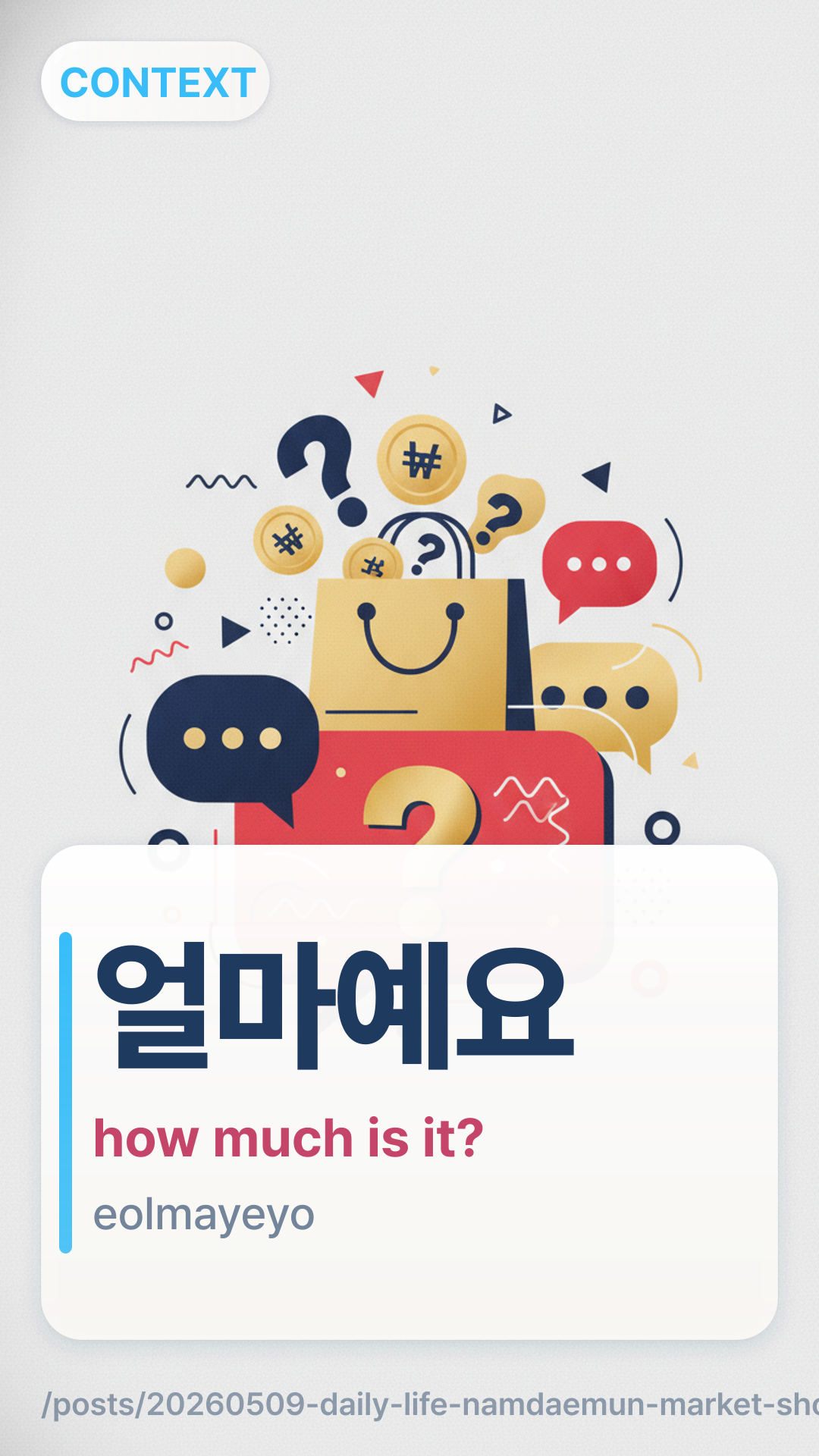
This is the universal starter for any transaction. In Namdaemun, many items don't have price tags, so you'll be saying this constantly to the stall owners (Sajang-nim).
Safer alternative
이거 가격이 어떻게 돼요?igeo gagyeogi eotteotge dwaeyo? — What is the price of this? (More formal/polite)
Example line (from the script)
사장님, 이 양말 얼마예요?sajangnim, i yangmal eolmayeyo? — Boss, how much are these socks?
Why this fits the scene
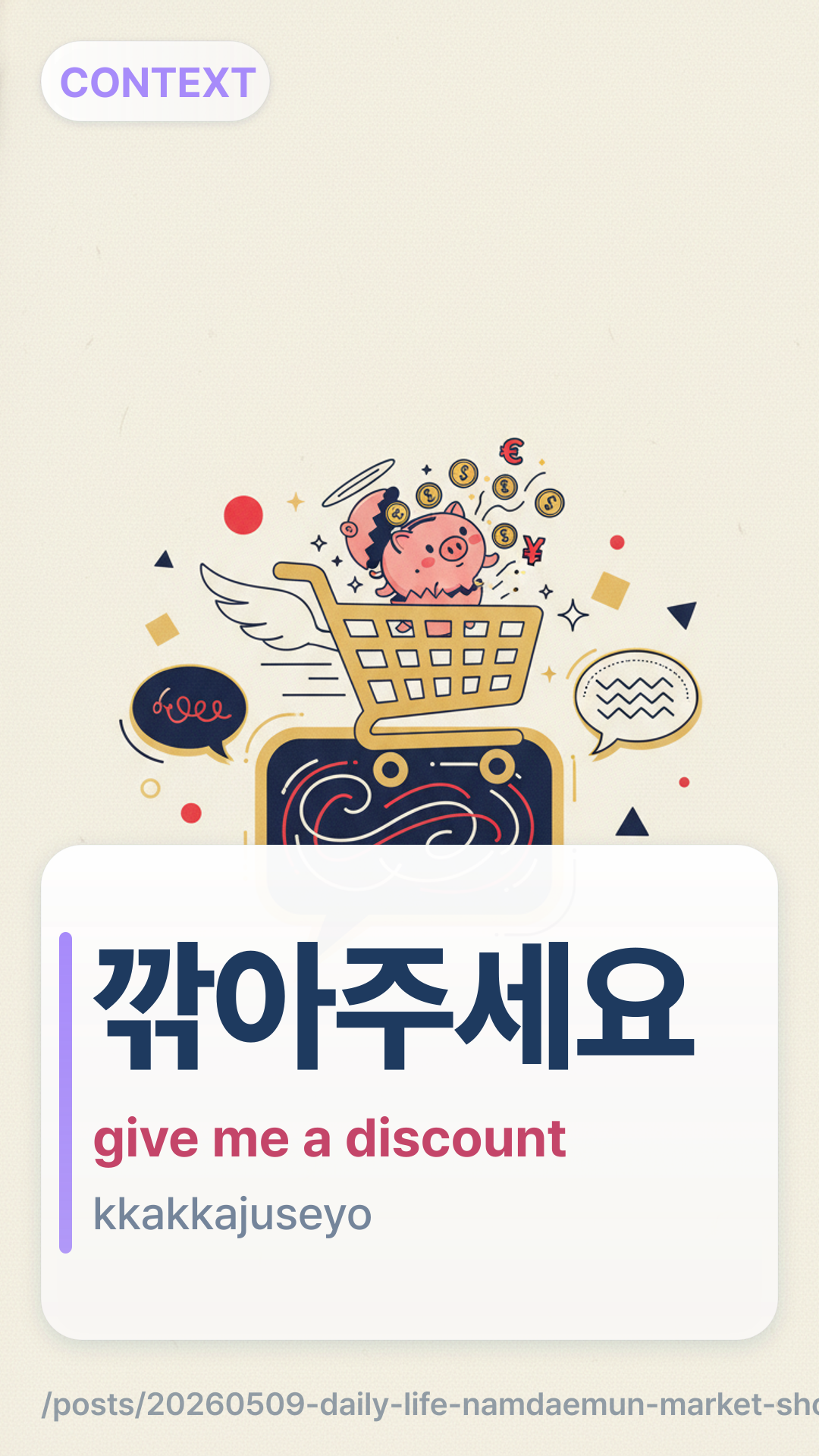
Bargaining is part of the culture in traditional markets. Use this when buying multiple items or if you feel the price is a bit high. It’s a friendly request, not a demand.
Safer alternative
조금만 더 잘 해주세요jogeumman deo jal haejuseyo — Please give me a better deal (Very common and polite)
Example line (from the script)
조금만 깎아주세요. 세 묶음 살게요.jogeumman kkakkajuseyo. se mukkeum salgeyo. — Please give me a discount. I'll buy three bundles.
Why this fits the scene
While most big shops take cards, small market stalls often prefer cash or bank transfers. Mentioning cash can sometimes help you get that discount you just asked for.
Safer alternative
계좌이체gyejwaiche — Bank transfer (Common if you run out of physical cash)
Example line (from the script)
현금으로 드릴게요.hyeongeumeuro deurilgeyo. — I'll pay with cash.
Why this fits the scene
When ordering street food like hotteok or mandu, you use Native Korean numbers. 하나hana is the base form for "one."
Safer alternative
한 개han gae — One piece (More specific when using a counter)
Example line (from the script)
하나 드셔보세요.hana deusyeoboseyo. — Try one.
Why this fits the scene
This is the "Right" way to use counters. You change 둘dul (two) to 두du when followed by the counter 개gae (item). A common mistake is saying 둘 개dul gae, which sounds unnatural.
Safer alternative
두 명du myeong — Two people (Only use this if you are counting humans!)
Example line (from the script)
네, 호떡 두 개 주세요!ne, hotteok du gae juseyo! — Yes, please give me two hotteoks!
Politeness Ladder: Bargaining
- Extremely Polite:
혹시 조금만 깎아주실 수 있으세요?hoksi jogeumman kkakkajusil su isseuseyo? (Could you possibly give me a small discount?) - Standard/Polite:
좀 깎아주세요.jom kkakkajuseyo. (Please give me a discount.) - Casual-Friendly:
사장님~ 좀만 깎아주세요!sajangnim~ jomman kkakkajuseyo! (Boss~ give me a little discount! - use with a smile)
Common Wrong vs. Right: Street Food Counters
- Wrong:
호떡 두 명 주세요hotteok du myeong juseyo (Give me two people of hotteok - Unless you are a cannibal, don't use 'myeong' for food!) - Right:
호떡 두 개 주세요hotteok du gae juseyo (Give me two hotteoks) - Wrong:
만두 둘 개 주세요mandu dul gae juseyo (Give me two-item dumplings) - Right:
만두 두 개 주세요mandu du gae juseyo (Give me two dumplings)
Decision Tree: Cash vs. Card
- Is it a permanent building with a door? -> Card is usually fine.
- Is it a street cart with wheels? -> Cash is better.
- Are you asking for a discount? -> Cash is mandatory.
Rewrite drill
Rewrite: 조금만 깎아주세요.jogeumman kkakkajuseyo. (Please give me a discount.)
- Casual:
좀만 깎아줘~jomman kkakkajwo~ - Neutral:
조금만 깎아주세요.jogeumman kkakkajuseyo. - Polite:
혹시 조금만 깎아주실 수 있나요?hoksi jogeumman kkakkajusil su itnayo?
Copy/paste mini-dialogues (with EN)
Mini quiz (2 minutes)
Notes:
- Q1:
깎아주세요kkakkajuseyo is used when the price is too high (비싸요). - Q2:
얼마예요eolmayeyo is the standard question for asking a price. - Q3:
현금hyeongeum is the logical opposite of a card (카드). - Q4:
두 개du gae is used when you are sharing with a friend (친구랑).
Next steps
When you visit Namdaemun, watch how locals interact. They often call the sellers 사장님sajangnim (Sajang-nim) or 이모imo (Imo - Auntie) to build rapport before asking for a discount. Don't be afraid to walk away if the price is too high—sometimes that's when the real discount happens!