물가, 폭등, 상승: Decoding Korean Weather & Economy News
Master Korean economy terms like 물가 and 폭등. Learn how weather impacts prices with our TOPIK-style news decode and grammar drills.
Master Korean economy terms like 물가 and 폭등. Learn how weather impacts prices with our TOPIK-style news decode and grammar drills.
Learn how to distinguish between price surges and steady rises while mastering the grammar of cause and effect in economic news.
Summary
Recent reports from the Korea Meteorological Administration and agricultural monitors show a troubling trend. Extreme weather conditions, including unexpected cold snaps and heavy rainfall, have severely disrupted the harvest cycles of essential greens like lettuce and green onions.
As a result, the cost of living is feeling the pressure. When supply drops due to these climate factors, the market reacts instantly. You will often see headlines using intense vocabulary to describe how quickly these prices are changing at local grocery stores.
For TOPIK learners, understanding the nuance between a 'rise' and a 'surge' is critical. News anchors use specific Hanja-based terms to convey the severity of the economic situation, often pairing them with grammatical structures that highlight the external cause of the change.
This guide breaks down the essential vocabulary found in these 'Price Emergency' (물가 비상) reports. We will look at how to identify the root cause of price hikes and how to describe these shifts using professional, news-style Korean.
Quick cheat sheet
Expressions in this post
Context note
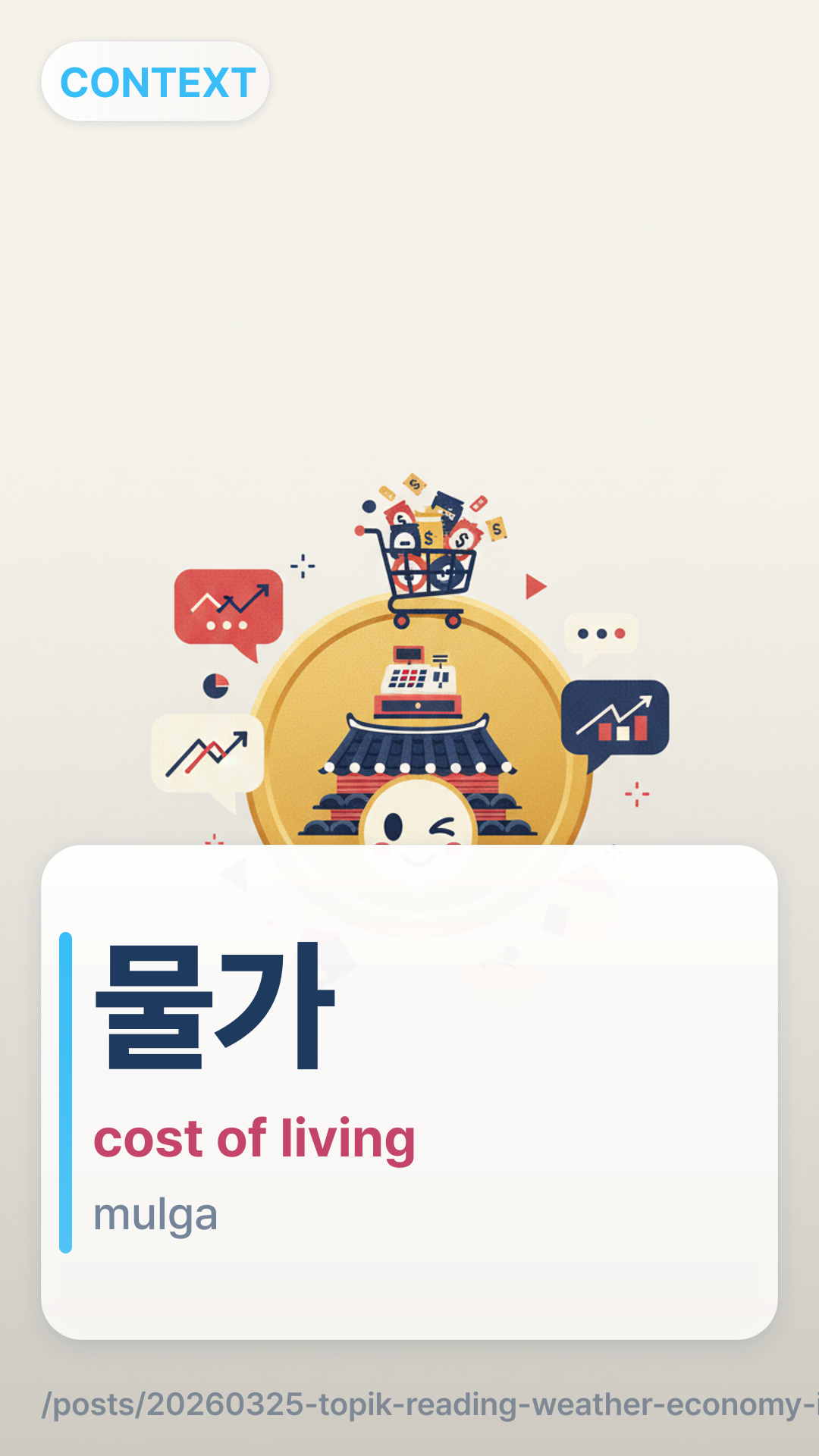
물가mulga refers to the general level of prices for goods and services. In news reports, you will almost always see it paired with words like 비상bisang (emergency), 안정anjeong (stabilization), or 하락harak (drop). It is a macro term; you wouldn't use it to talk about the price of a single specific apple, but rather the general cost of groceries this month.
Common pairing
물가 상승률mulga sangseungryul — Inflation rate
장바구니 물가jangbaguni mulga — Basket prices (the cost of everyday groceries)
Context note
This is a high-intensity word. The character 폭pok (explosive) combined with 등deung (rise) creates the meaning of a sudden, sharp increase. Use this when prices double or triple overnight due to a disaster or shortage. In TOPIK reading passages, this word signals a crisis or a significant market disruption.
Common pairing
가격 폭등gagyeok pokdeung — Price explosion
채소값 폭등chaesogap pokdeung — Vegetable price surge
Context note
상승sangseung is the standard, neutral term for any upward movement. While 폭등pokdeung is an emergency, 상승sangseung can be a steady, expected, or even slight increase. It is used in both formal reports and academic settings to describe trends in data, temperatures, or prices.
Common pairing
지속적인 상승jisokjeogin sangseung — Continuous rise
기온 상승gion sangseung — Temperature rise
Decision Tree: Choosing the Right Word
When describing a price change, follow this logic:
- Is the increase steady and gradual? -> Use
상승sangseung. - Is the increase sudden, extreme, and causing a 'crisis' feel? -> Use
폭등pokdeung. - Is the price returning to a normal level or staying flat? -> Use
안정anjeong.
Rewrite Drill: The -는 바람에 Pattern
In news headlines, nouns are often stacked: 기상 악화로 인한 채소값 폭등gisang akhwaro inhan chaesogap pokdeung (Vegetable price surge due to worsening weather). To explain this in a full sentence, use the -는 바람에-neun barame pattern to indicate an unexpected negative cause.
- Headline:
한파로 인한 배추 가격 상승hanparo inhan baechu gagyeok sangseung (Napa cabbage price rise due to cold wave) - Sentence:
갑자기 한파가 찾아오는 바람에 배추 가격이 상승했어요.gapjagi hanpaga chajaoneun barame baechu gagyeogi sangseunghaesseoyo. (Because a cold wave suddenly arrived, the cabbage prices rose.)
Next steps
To master these terms, try these 5 practice sentences in your study journal:
- Translate: "The cost of living (물가) is too high these days."
- Translate: "Vegetable prices skyrocketed (폭등) because of the heavy rain."
- Translate: "The temperature is rising (상승) every year."
- Use the
-는 바람에-neun barame pattern to explain why you were late today. - Write a short headline about a 'Price Emergency' (물가 비상) using the word
상승sangseung.