고유가 지원금: Decoding Korean Oil Subsidy News
Master 고유가, 지원금, and 보조금 to decode Korean economic news about oil subsidies. Learn the difference between grants and allowances.
Master 고유가, 지원금, and 보조금 to decode Korean economic news about oil subsidies. Learn the difference between grants and allowances.
Learn to distinguish between different types of government funding while mastering formal economic vocabulary found in TOPIK reading and news headlines.
Summary (4 short paragraphs)
Global energy markets often face volatility, leading to what Korean media calls high oil price cycles. When fuel costs rise sharply, the Korean government frequently intervenes to stabilize the economy and support vulnerable sectors like logistics and transportation.
To understand these news reports, you must recognize specific terminology used for financial aid. The government uses different words depending on whether the money is a general support fund, a targeted subsidy for a specific industry, or a regular allowance.
Reading economic headlines requires a shift from casual daily Korean to formal Hanja-based vocabulary. For example, instead of saying 'the government is giving money,' news outlets use concise nouns to describe the policy action and the intended recipients.
This guide breaks down the essential terms found in recent 'High Oil Price Subsidy' announcements. By understanding these nuances, you can better navigate TOPIK II reading passages and real-world Korean economic briefings.
Quick cheat sheet
Expressions in this post
Context note
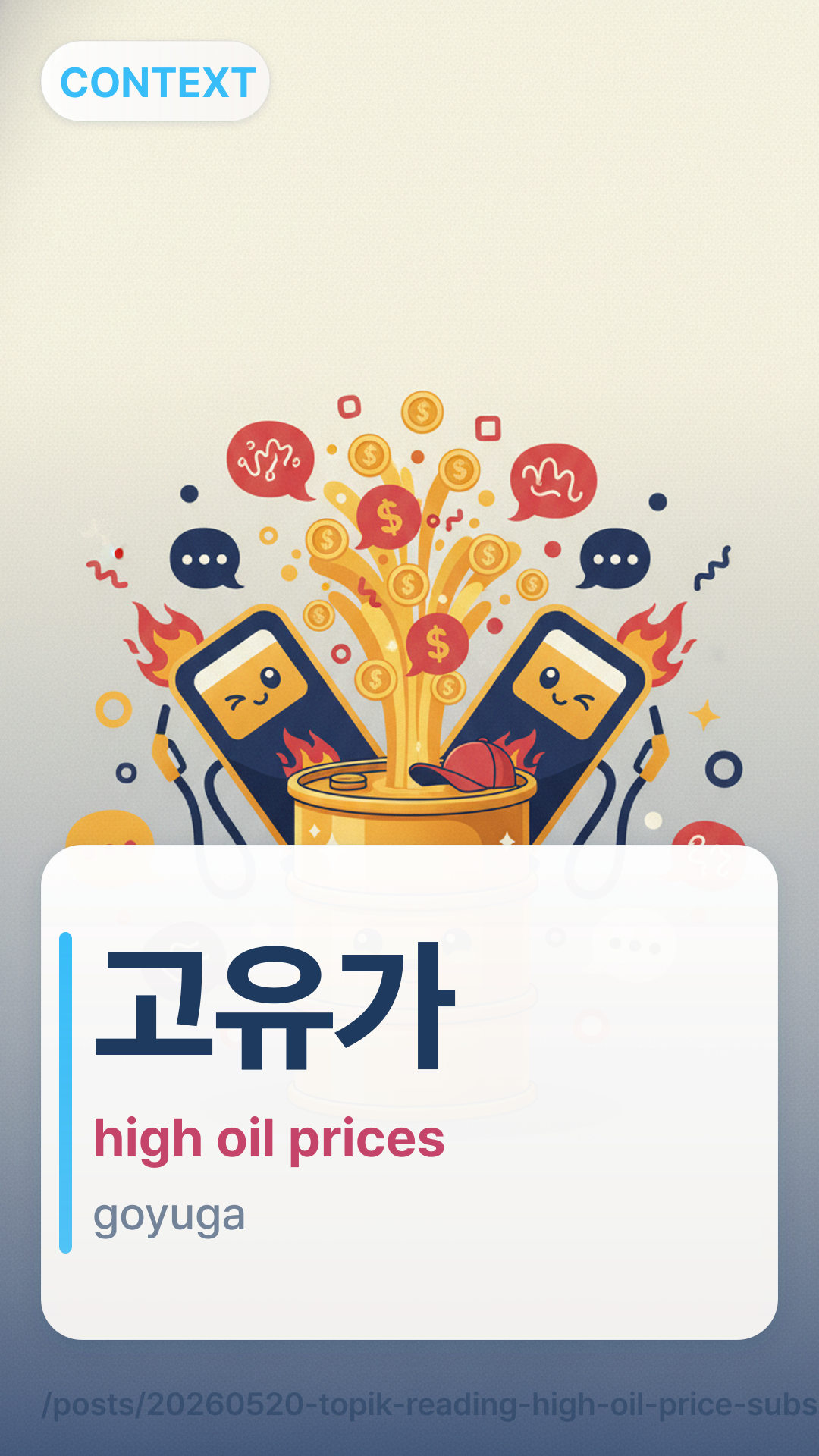
This term combines '고' (high), '유' (oil), and '가' (price). It is the standard way news anchors describe periods when gasoline and diesel prices soar. You will rarely hear '비싼 기름값' in a formal news report; instead, they use this compact Hanja term to save space in headlines.
Common pairing
고유가 시대goyuga sidae — The era of high oil prices
고유가 대책goyuga daechaek — Countermeasures for high oil prices
Context note
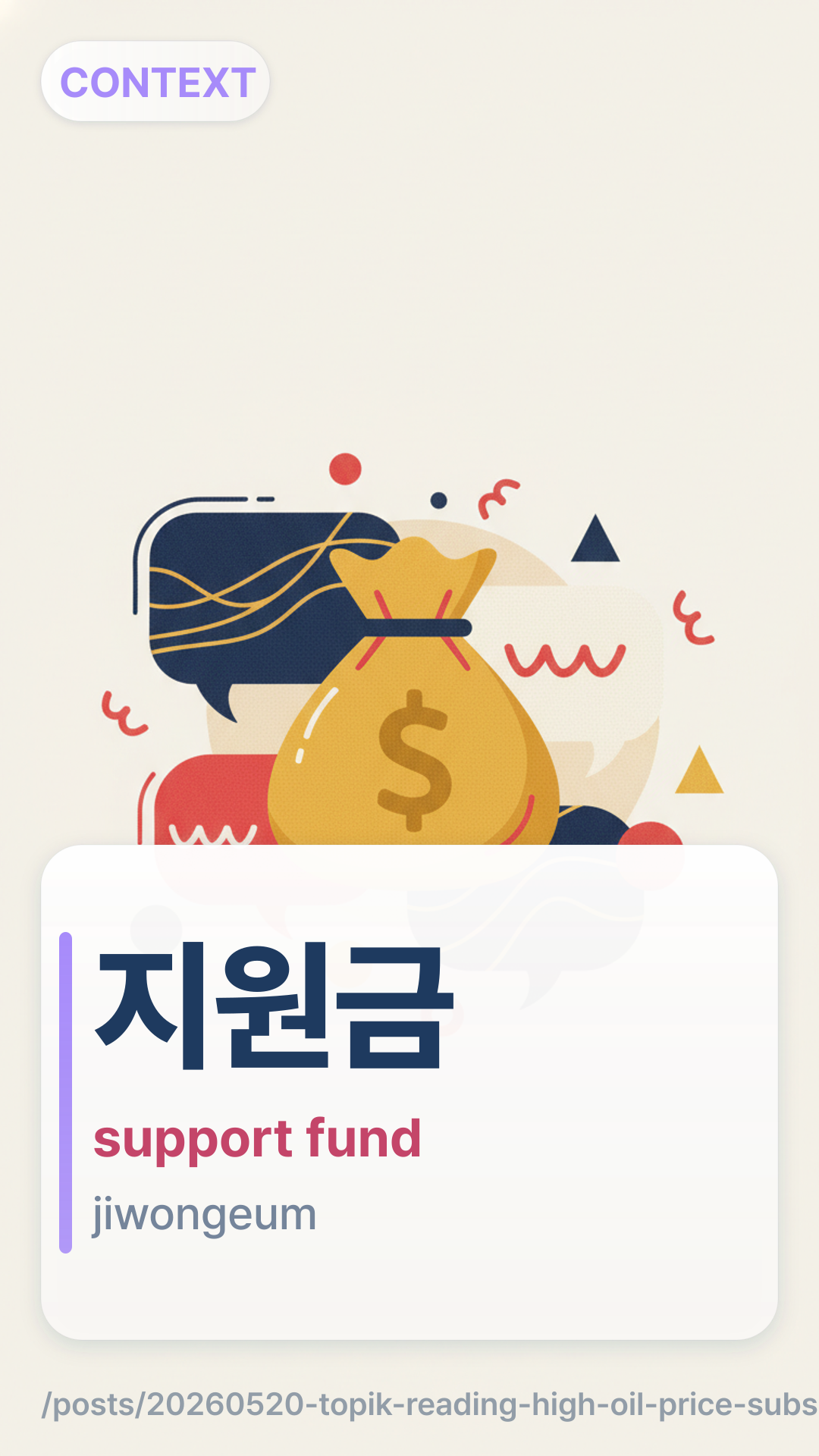
This is a broad, positive term for money provided to help a specific group or cause. It is often used for emergency relief or general welfare support. If the government wants to emphasize that they are 'supporting' the citizens' livelihood, they choose this word.
Common pairing
긴급 지원금gingeup jiwongeum — Emergency support fund
대상자daesangja — Eligible recipient
Context note
While similar to support funds, this term specifically refers to money given by the state or a public body to encourage a specific industry or offset costs. In the context of oil, it usually refers to the 'Fuel Price-Linked Subsidy' (유가연동보조금) given to truck drivers and bus companies.
Common pairing
보조금 지급bojogeum jigeup — Payment of subsidies
부정 수급bujeong sugeup — Illegal receipt of subsidies
Decision Tree: Which 'Money' is it?
Use this logic to choose the right term for your writing or to understand the news intent:
- Is it for a specific industry to offset a cost? -> Use
보조금bojogeum (Grant/Subsidy). - Is it general help for people's welfare? -> Use
지원금jiwongeum (Support fund). - Is it a fixed, regular payment (like a salary supplement)? -> Use
수당sudang (Allowance).
Rewrite Drill: Casual to News Headline
Transform your daily Korean into a TOPIK-style headline:
- Casual:
기름값이 너무 올라서 정부가 돈을 준대요.gireumgapsi neomu olraseo jeongbuga doneul jundaeyo. - News:
고유가 지속에 따른 정부 지원금 지급 안내goyuga jisoge ttareun jeongbu jiwongeum jigeup annae
Next steps
Spot the keyword in these simulated headlines:
고유가goyuga 여파로 인한 물가 상승 우려- 화물차 운전자 대상
보조금bojogeum 확대 - 저소득층 에너지
지원금jiwongeum 신청 방법 고유가goyuga 시대의 에너지 절약 수칙- 정부, 유가 연동
보조금bojogeum 지급 기한 연장