전년 대비, 전월 대비: Decode CPI Headlines
By Yijun Kim, Native Korean speaker and creator of Korean TokTokPublished December 30, 2025
Decode 전년 대비 & 전월 대비 in CPI headlines with a simple flowchart, collocations, and number drills—master

TL;DR
Decode 전년 대비 & 전월 대비 in CPI headlines with a simple flowchart, collocations, and number drills—master
Use a ‘what’s being measured?’ flowchart to decode CPI·근원물가·PPI headlines and drill MoM/YoY phrasing so numbers don’t flip.
Today’s numbers (example)
Here are made-up headline-style numbers you’ll see in Korean.
소비자물가 3.1% 상승(전년 대비)sobijamulga 3.1% sangseung(jeonnyeon daebi) — CPI up 3.1% year-on-year.전월 대비 0.2% 상승jeonwol daebi 0.2% sangseung — up 0.2% month-on-month (not “this month vs last year”).전기요금 1만5천 원 인상jeongiyogeum 1man5cheon won insang — electricity bill up 15,000 won.
Reading tip: keep the comparison phrase glued to the number.
3.1%is read as삼 점 일 퍼센트sam jeom il peosenteu.0.2%is read as영 점 이 퍼센트yeong jeom i peosenteu.1만5천 원1man5cheon won is read as만오천 원manocheon won.
Quick cheat sheet
Expressions in this post

#1economyLv 3
전년 대비
jeonnyeon daebi
year-on-year (YoY)
Common collocations
전년 대비 상승jeonnyeon daebi sangseung — up vs the same month last year전년 대비 하락jeonnyeon daebi harak — down vs the same month last year전년 대비 증가율/상승률jeonnyeon daebi jeunggayul/sangseungryul — YoY growth/increase rate전년 대비 둔화/가속jeonnyeon daebi dunhwa/gasok — YoY pace slows/speeds up전년 동월 대비jeonnyeon dongwol daebi — same meaning, headline-friendly
Example sentences
소비자물가가 전년 대비 3.1% 상승했다.sobijamulgaga jeonnyeon daebi 3.1% sangseunghaetda. — CPI rose 3.1% year-on-year.전년 대비로 보면 오르긴 했지만 상승률은 둔화됐다.jeonnyeon daebiro bomyeon oreugin haetjiman sangseungryureun dunhwadwaetda. — It’s up YoY, but the pace slowed.전년 대비 수치만 보고 이번 달 흐름을 단정하긴 어렵다.jeonnyeon daebi suchiman bogo ibeon dal heureumeul danjeonghagin eoryeopda. — You can’t conclude this month’s trend from YoY alone.
소비자물가가 전년 대비 3.1% 상승했다.
sobijamulgaga jeonnyeon daebi 3.1% sangseunghaetda.
CPI rose 3.1% year-on-year.
전년 대비 상승률은 둔화됐지만, 전월 대비로는 소폭 올랐다.
jeonnyeon daebi sangseungryureun dunhwadwaetjiman, jeonwol daebironeun sopok olratda.
The YoY pace slowed, but on a MoM basis it ticked up.
전년 동월 대비 수치만 보면 착시가 생길 수 있다.
jeonnyeon dongwol daebi suchiman bomyeon chaksiga saenggil su itda.
Looking only at the YoY number can create a false impression.

#2economyLv 3
전월 대비
jeonwol daebi
month-on-month (MoM)
Common collocations
전월 대비 상승/하락jeonwol daebi sangseung/harak — up/down vs last month전월 대비 변동jeonwol daebi byeondong — month-to-month change전월 대비 보합jeonwol daebi bohap — flat vs last month전월 대비 기준으로jeonwol daebi gijuneuro — on a MoM basis계절조정 후 전월 대비gyejeoljojeong hu jeonwol daebi — seasonally adjusted MoM
Example sentences
전월 대비 0.2% 상승으로 집계됐다.jeonwol daebi 0.2% sangseungeuro jipgyedwaetda. — It was recorded as up 0.2% month-on-month.전월 대비는 작아 보여도 전년 대비는 클 수 있다.jeonwol daebineun jaga boyeodo jeonnyeon daebineun keul su itda. — MoM can look small while YoY is large.전월 대비 하락은 ‘이번 달이 지난달보다 싸졌다’는 뜻이다.jeonwol daebi harageun ‘ibeon dari jinandalboda ssajyeotda’neun tteusida. — A MoM drop means this month is cheaper than last month.
전월 대비 0.2% 상승으로 집계됐다.
jeonwol daebi 0.2% sangseungeuro jipgyedwaetda.
It was tallied as up 0.2% month-on-month.
전월 대비 보합이면 지난달과 거의 같다는 뜻이다.
jeonwol daebi bohabimyeon jinandalgwa geoui gatdaneun tteusida.
“Flat MoM” means it’s nearly the same as last month.
전월 대비 수치만 보면 방향은 보이지만, 맥락은 더 확인해야 한다.
jeonwol daebi suchiman bomyeon banghyangeun boijiman, maekrageun deo hwaginhaeya handa.
MoM can show direction, but you still need more context.
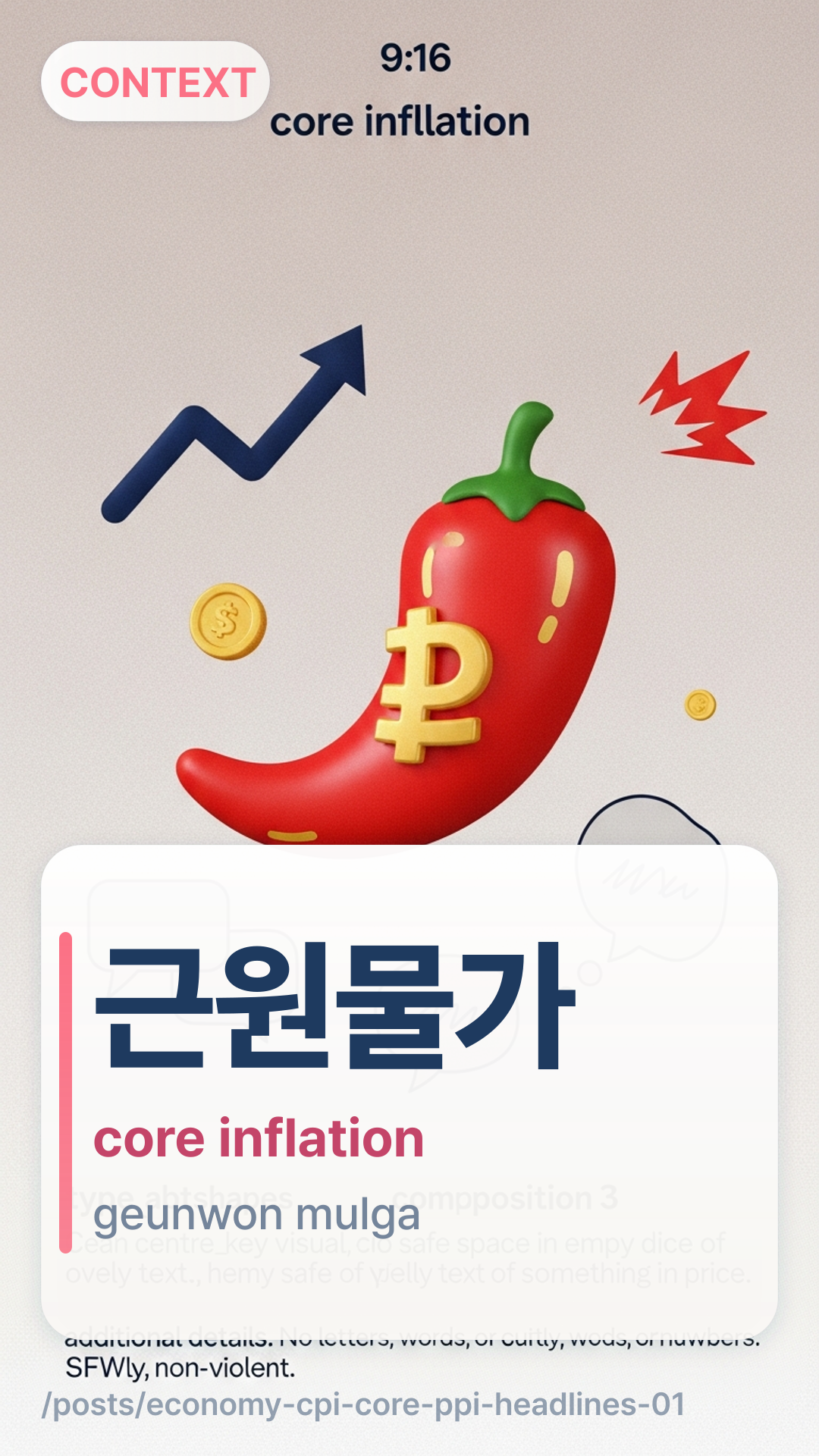
#3economyLv 5
근원물가
geunwonmulga
core inflation
Common collocations
근원물가 상승률geunwonmulga sangseungryul — core inflation rate근원물가가 둔화되다/가속하다geunwonmulgaga dunhwadoeda/gasokhada — core inflation slows/speeds up근원물가 압력geunwonmulga apryeok — core inflation pressure근원물가 흐름/추세geunwonmulga heureum/chuse — core inflation trend근원물가 지표geunwonmulga jipyo — core inflation indicator
Example sentences
근원물가는 변동성이 큰 품목을 덜 반영한 지표로 자주 언급된다.geunwonmulganeun byeondongseongi keun pummogeul deol banyeonghan jipyoro jaju eongeupdoenda. — Core inflation is often cited as an indicator that reflects volatile items less.근원물가가 높게 나오면 ‘기조’에 대한 해석이 붙는 경우가 많다.geunwonmulgaga nopge naomyeon ‘gijo’e daehan haeseogi butneun gyeonguga manda. — When core prints high, headlines often add an “underlying trend” interpretation.근원물가가 낮다고 해서 체감물가가 낮다는 뜻은 아니다.geunwonmulgaga natdago haeseo chegammulgaga natdaneun tteuseun anida. — A low core figure doesn’t mean people feel prices are low.
근원물가 상승률은 전년 대비 2.4%로 나타났다.
geunwonmulga sangseungryureun jeonnyeon daebi 2.4%ro natanatda.
Core inflation came in at 2.4% year-on-year.
근원물가가 높게 나오면 기조가 강하다는 해석이 붙기도 한다.
geunwonmulgaga nopge naomyeon gijoga ganghadaneun haeseogi butgido handa.
A high core print may be framed as a stronger underlying trend.
근원물가가 낮아도 일부 품목은 체감상 비쌀 수 있다.
geunwonmulgaga najado ilbu pummogeun chegamsang bissal su itda.
Even if core is low, some items can still feel expensive.
Collocation table
| Keyword | Verb/adjective it pairs with | Example |
|---|---|---|
전년 대비jeonnyeon daebi | 상승하다/하락하다sangseunghada/harakhada | 전년 대비 2.0% 상승jeonnyeon daebi 2.0% sangseung |
전월 대비jeonwol daebi | 보합이다/변동하다bohabida/byeondonghada | 전월 대비 보합jeonwol daebi bohap |
상승률sangseungryul | 둔화되다/가속하다dunhwadoeda/gasokhada | 상승률이 둔화됐다sangseungryuri dunhwadwaetda |
%p | 확대되다/축소되다hwakdaedoeda/chuksodoeda | 격차가 0.3%p 확대gyeokchaga 0.3%p hwakdae |
근원물가geunwonmulga | 높다/낮다nopda/natda | 근원물가가 높게 나왔다geunwonmulgaga nopge nawatda |
생산자물가(PPI)saengsanjamulga(PPI) | 오르다/내리다oreuda/naerida | 생산자물가가 전월 대비 하락saengsanjamulgaga jeonwol daebi harak |
Numbers drill
Read these out loud in Korean, then say what they mean in English.
3.1%—삼 점 일 퍼센트sam jeom il peosenteu — 3.1 percent0.2%—영 점 이 퍼센트yeong jeom i peosenteu — 0.2 percent-0.1%—마이너스 영 점 일 퍼센트maineoseu yeong jeom il peosenteu — minus 0.1 percent0.5%p—영 점 오 퍼센트포인트yeong jeom o peosenteupointeu — 0.5 percentage points15,000원15,000won —만오천 원manocheon won — 15,000 won
Next steps
- Take 10 real headlines from a Korean news app (I usually screenshot them on the subway), and underline only the comparator:
전년 대비jeonnyeon daebi vs전월 대비jeonwol daebi. - For each headline, label the basket in one word: CPI (
소비자물가sobijamulga), core (근원물가geunwonmulga), or PPI (생산자물가saengsanjamulga). If it’s missing, treat the headline as incomplete. - Do a “unit check” every time you see a number:
%(percent change) vs%p(percentage points). - Practice rewriting: turn one headline into two sentences—one for YoY and one for MoM—so you stop mixing the timelines.
Spaced Review
Rate each card to schedule your next review. Cards you find hard come back sooner.
Review: flashcards & quiz
Flashcards1 / 3
전년 대비
jeonnyeon daebi
Tap to reveal meaning →
Click to flip