은/는 vs 이/가: Topic vs Subject (Beginner)
Confused by 은/는 vs 이/가? Use a decision tree, 10 minimal pairs, and a rewrite drill to master
Confused by 은/는 vs 이/가? Use a decision tree, 10 minimal pairs, and a rewrite drill to master
Teach 은/는 vs 이/가 with a quick decision tree + minimal pairs and a rewrite drill that forces topic/subject shifts.
Quick answer
은/는eun/neun sets what you’re talking about (the topic), while 이/가i/ga marks who/what is doing or being something (the subject).
Quick cheat sheet
Expressions in this post

When it’s the right choice
Use 은/는eun/neun when you want to set the topic of the conversation (“as for X…”) or contrast X with something else.
A common trap: if someone is clearly asking “who?” or “what?”, answering with 은/는eun/neun can sound like you’re switching topics instead of giving the requested information.
Minimal pairs (vs 이/가)
저는 학생이에요.jeoneun haksaengieyo. — As for me, I’m a student.제가 학생이에요.jega haksaengieyo. — I’m the one who is a student.민수는 학교에 가요.minsuneun hakgyoe gayo. — As for Minsu, he goes to school.민수가 학교에 가요.minsuga hakgyoe gayo. — Minsu is the one who goes to school.커피는 맛있어요.keopineun masisseoyo. — Coffee is tasty (coffee vs other drinks).커피가 맛있어요.keopiga masisseoyo. — Coffee is tasty (coffee is what’s tasty).저는 집에 가요.jeoneun jibe gayo. — As for me, I’m going home.제가 집에 가요.jega jibe gayo. — I’m the one going home.엄마는 와요.eommaneun wayo. — As for mom, she’s coming.엄마가 와요.eommaga wayo. — Mom is coming (mom, not someone else).
Examples
저는 커피 마셔요.jeoneun keopi masyeoyo. — As for me, I drink coffee.
저는 커피 좋아해요. 차는 안 좋아해요.jeoneun keopi johahaeyo. chaneun an johahaeyo. — I like coffee. As for tea, I don’t like it.
If someone asks 누가 가요?nuga gayo? (“Who’s going?”), 저는 가요jeoneun gayo can feel like “As for me…”; 제가 가요jega gayo sounds like a direct answer: “I am.”
When it’s the right choice
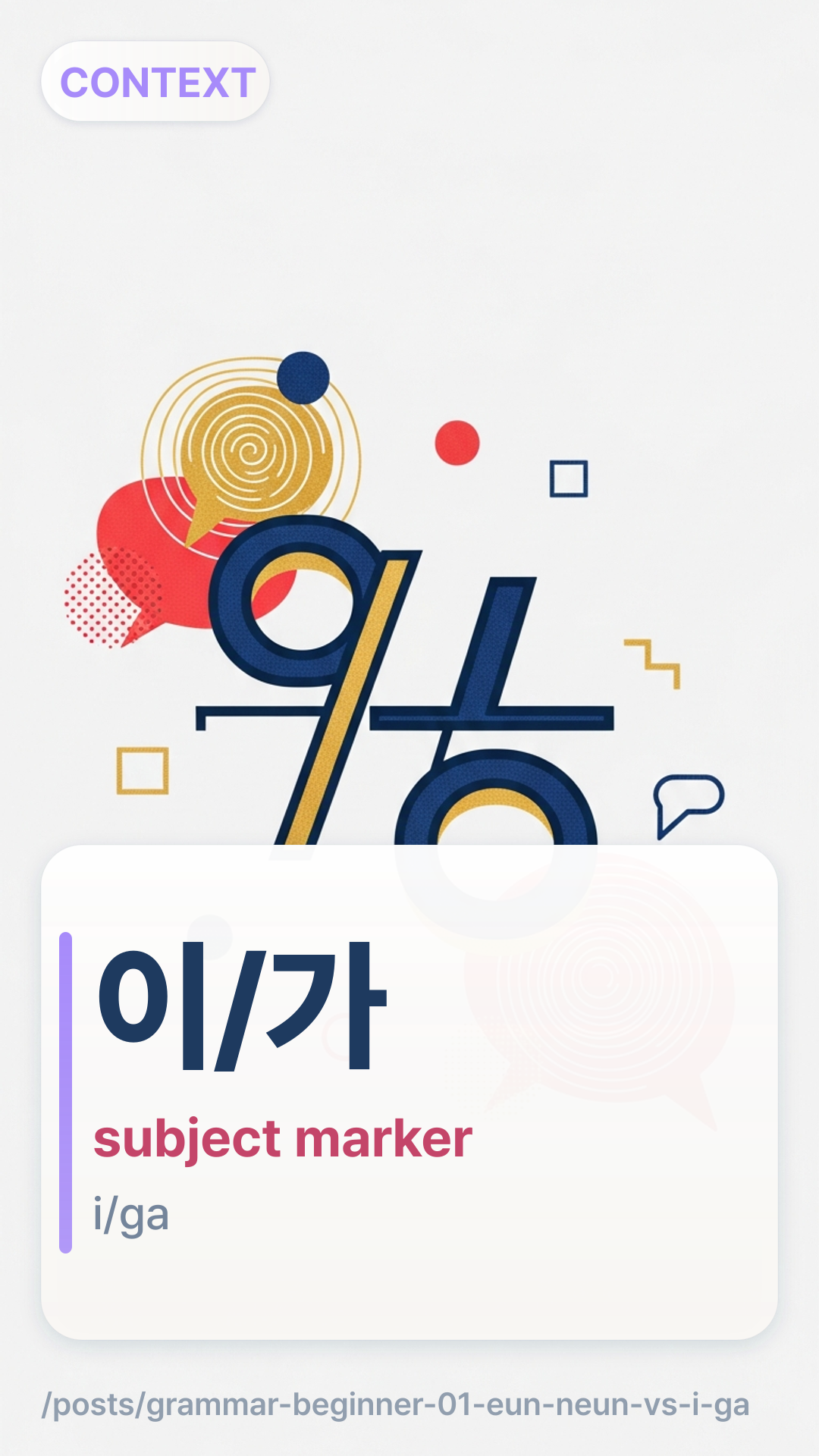
Use 이/가i/ga when you’re giving new information, answering “who/what?”, or emphasizing the subject (“X is the one…”).
It’s especially natural in short answers and corrections (when there are multiple possible subjects).
Minimal pairs (vs 은/는)
친구는 왔어요.chinguneun wasseoyo. — As for my friend, they came.친구가 왔어요.chinguga wasseoyo. — My friend came (it was my friend).밥은 있어요.babeun isseoyo. — As for rice, there is some (implies contrast).밥이 있어요.babi isseoyo. — There is rice.여기는 조용해요.yeogineun joyonghaeyo. — As for here, it’s quiet.여기가 조용해요.yeogiga joyonghaeyo. — This place is quiet (this one).고양이는 밥 먹어요.goyangineun bap meogeoyo. — As for the cat, it eats.고양이가 밥 먹어요.goyangiga bap meogeoyo. — The cat is the one eating.민수는 해요.minsuneun haeyo. — As for Minsu, he’ll do it.민수가 해요.minsuga haeyo. — Minsu will do it (Minsu, not someone else).
Examples
누가 와요? 엄마가 와요.nuga wayo? eommaga wayo. — Who’s coming? Mom is coming.
여기가 조용해요.yeogiga joyonghaeyo. — This place is quiet.
제가 해요.jega haeyo. — I’ll do it. (Me.)
Tip: 저 + 가jeo + ga becomes 제가jega, and 나 + 가na + ga becomes 내가naega.
Comparison table
| 은/는 | 이/가 | |
|---|---|---|
| Core job | Topic (“as for…”) / contrast | Subject (“who/what…”) / emphasis |
| Typical use | Framing a statement; comparing X vs Y | Giving new info; answering “who/what?”; correcting |
| Good for… | “As for X…”, “X (but not Y)” | “X is/does…”, “It’s X (not Y)” |
| Common mistake | Using it to answer a “who/what?” question | Using it when you meant “as for…” contrast |
Decision tree
If you’re setting the topic or contrasting (“as for X…”, “X vs Y”) → use 은/는eun/neun. If you’re answering “who/what?” or stressing the subject (“X is the one…”) → use 이/가i/ga.
Next steps
- Rewrite drill (5 sentences): rewrite each sentence so it matches the goal.
저는 학교에 가요.jeoneun hakgyoe gayo. (Goal: Answer “Who is going?”)제가 커피 마셔요.jega keopi masyeoyo. (Goal: Contrast yourself with someone else)커피가 맛있어요.keopiga masisseoyo. (Goal: Make coffee the topic, not the surprise)엄마는 와요.eommaneun wayo. (Goal: Give a direct “who?” answer)여기가 조용해요.yeogiga joyonghaeyo. (Goal: Set “here” as the topic of the chat)
- Copy/paste mini-dialogues (speaker lines + translations)
Dialogue A
A: 누가 와요?nuga wayo? — Who’s coming?
B: 엄마가 와요.eommaga wayo. — Mom is coming.
A: 민수도 와요?minsudo wayo? — Is Minsu coming too?
B: 민수는 안 와요.minsuneun an wayo. — As for Minsu, he’s not coming.
Dialogue B
A: 커피는 맛있어요.keopineun masisseoyo. — As for coffee, it’s tasty.
B: 차는요?chaneunyo? — How about tea?
A: 차는 안 좋아해요.chaneun an johahaeyo. — As for tea, I don’t like it.
B: 그럼 뭐가 좋아요?geureom mwoga johayo? — Then what do you like?
A: 커피가 좋아요.keopiga johayo. — Coffee is what I like.
- Mini quiz: pick the best topic/subject form.
- Write the missing form in each blank.
- For pronouns, write the natural combined form (e.g.,
저 + 가jeo + ga →제가jega,나 + 가na + ga →내가naega).
- “Who is coming?” →
엄마__ 와요.eomma__ wayo. - “As for today…” →
오늘__ 비가 와요.oneul__ biga wayo. - “There is rice (in the fridge).” →
밥__ 있어요.bap__ isseoyo. - “As for coffee, it’s tasty.” →
커피__ 맛있어요.keopi__ masisseoyo. - “I’ll do it (not you).” →
___ 해요.___ haeyo.
Answers:
가ga은eun이i는neun제가jega
Notes:
- Q1:
엄마가 와요eommaga wayo answers a “who?” question, so the subject marker이/가i/ga is the natural choice. - Q2:
오늘은oneureun frames “today” as the topic, while비가biga keeps “rain” as the grammatical subject of the clause. - Q3:
밥이 있어요babi isseoyo is a neutral existence statement;밥은 있어요babeun isseoyo usually implies contrast (“rice exists, but …”). - Q4: The prompt already says “as for coffee”, so
커피는keopineun matches that topic framing. - Q5: With the polite ending
해요haeyo,제가jega is the natural subject form for “I” in this register;내가naega is typically paired with casual endings like해hae/할게halge.