-(으)ㄹ 수밖에 없다 뜻: Economy Headline Drills
Master -(으)ㄹ 수밖에 없다 vs -(으)ㄹ 수 없다 with micro-headlines, a decision tree, and rewrite drills—sound inevitable, learn
Master -(으)ㄹ 수밖에 없다 vs -(으)ㄹ 수 없다 with micro-headlines, a decision tree, and rewrite drills—sound inevitable, learn
Economy-style micro-headlines plus a constraint-vs-ability decision tree makes -(으)ㄹ 수밖에 없다 sound inevitable, not merely impossible.
The 3 verbs you’ll see everywhere
인상하다insanghada — to raise (prices, fees, rates). In headlines you’ll also see the noun인상insang (“an increase”).하락하다harakhada — to fall / go down (prices, demand, sales).불가피하다bulgapihada — “unavoidable,” often implying a constraint-driven decision (a good match for-(으)ㄹ 수밖에 없다-(eu)ㄹ subakke eopda).
Quick cheat sheet
Expressions in this post
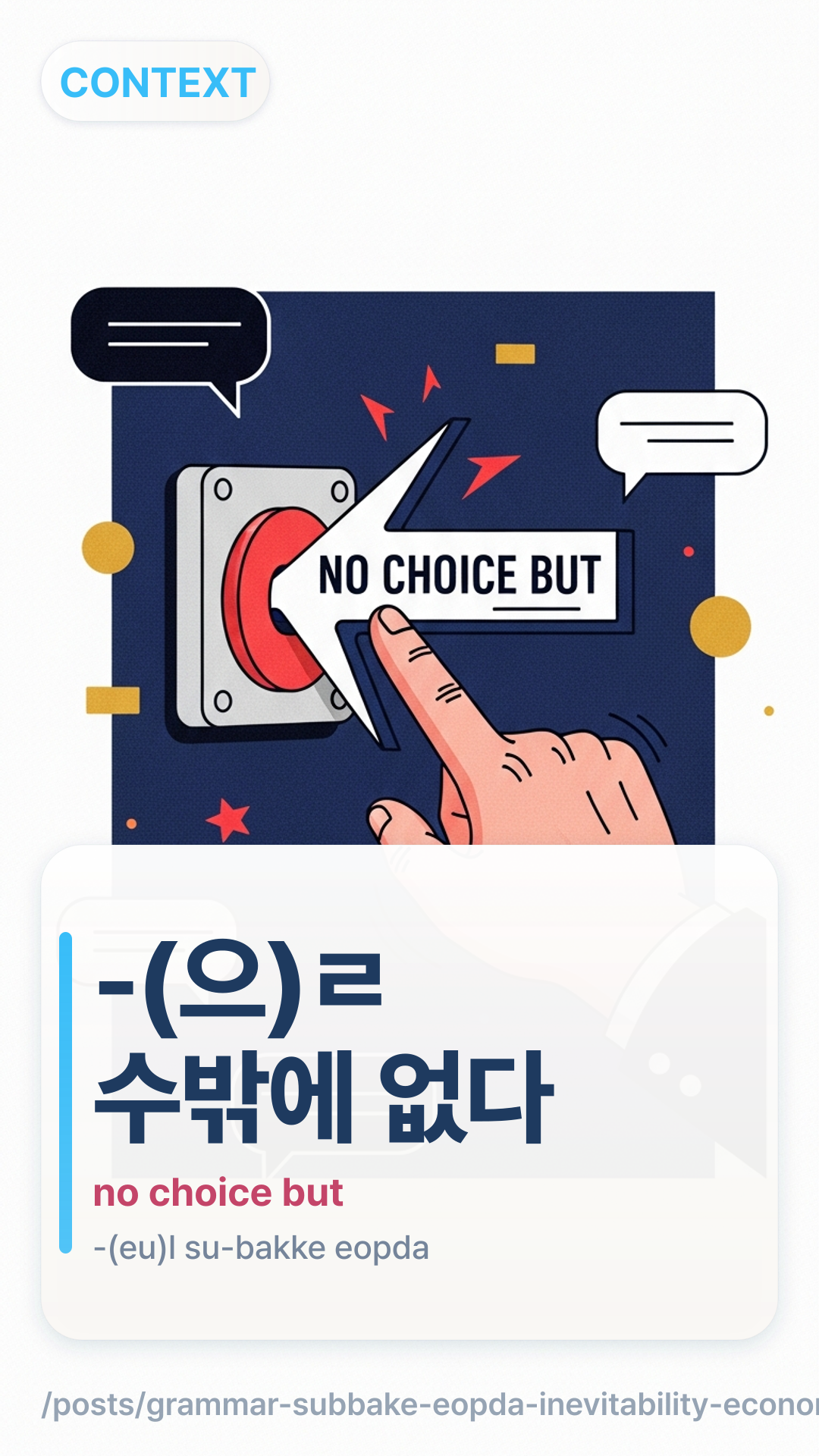
-(으)ㄹ 수밖에 없다-(eu)ㄹ subakke eopda means “have no choice but to…” because a constraint pushes you into one outcome.
A common trap: using it when you only mean “I can’t” (ability). For example, “I can’t speak Korean” is not a “no choice” situation.
Typical headline pattern
원인(상황) + (으)ㄹ 수밖에 없다wonin(sanghwang) + (eu)ㄹ subakke eopda…불가피 → …(으)ㄹ 수밖에 없다…bulgapi → …(eu)ㄹ subakke eopda부담/압박 + 커지다 → 조정/인상(하)다 + (으)ㄹ 수밖에 없다budam/apbak + keojida → jojeong/insang(ha)da + (eu)ㄹ subakke eopda
Rewrite drill (headline → plain Korean)
Headline to plain Korean
원가 상승…가격 인상 불가피wonga sangseung…gagyeok insang bulgapi →원가가 올라서 가격을 올릴 수밖에 없어요.wongaga olraseo gagyeogeul olril subakke eopseoyo. — Costs went up, so we have no choice but to raise the price.원자재 부족…생산 조정wonjajae bujok…saengsan jojeong →원자재가 부족해서 생산을 조정할 수밖에 없어요.wonjajaega bujokhaeseo saengsaneul jojeonghal subakke eopseoyo. — Materials are short, so we have no choice but to adjust production.
Wrong → Right (1–4)
가격이 비싸서 살 수밖에 없어요.gagyeogi bissaseo sal subakke eopseoyo. →가격이 비싸서 살 수 없어요.gagyeogi bissaseo sal su eopseoyo. — “Expensive” is not a constraint that forces buying.시간이 없어서 갈 수밖에 없어요.sigani eopseoseo gal subakke eopseoyo. →시간이 없어서 갈 수 없어요.sigani eopseoseo gal su eopseoyo. — No time = impossible, not “no choice.”환율이 올라서 가격을 올릴 수 없어요.hwanyuri olraseo gagyeogeul olril su eopseoyo. →환율이 올라서 가격을 올릴 수밖에 없어요.hwanyuri olraseo gagyeogeul olril subakke eopseoyo. — Here the idea is “forced to raise,” not “can’t raise.”할인을 더 하고 싶지만 할 수밖에 없어요.harineul deo hago sipjiman hal subakke eopseoyo. →할인을 더 하고 싶지만 할 수 없어요.harineul deo hago sipjiman hal su eopseoyo. — Wanting is not a forcing constraint.
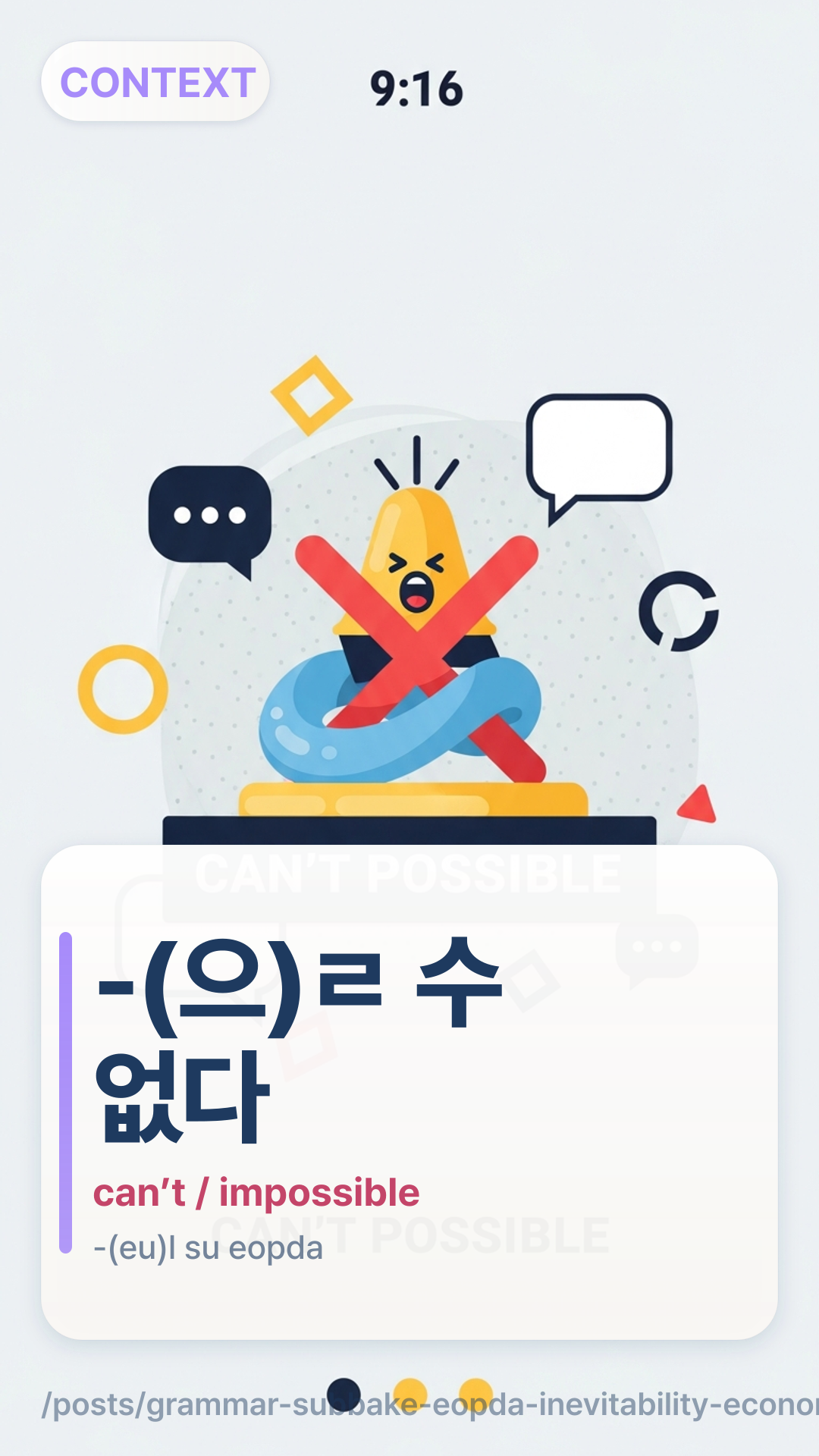
-(으)ㄹ 수 없다-(eu)ㄹ su eopda is the clean, basic “can’t.” It’s about ability or possibility.
Useful beginner shortcut: if you can add “because it’s impossible” in English, -(으)ㄹ 수 없다-(eu)ㄹ su eopda is usually right.
Typical headline pattern
…할 수 없다…hal su eopda (rare in super-short headlines, but common in full sentences)불가능/어렵다bulganeung/eoryeopda often maps to-(으)ㄹ 수 없다-(eu)ㄹ su eopda in plain Korean
Rewrite drill (headline → plain Korean)
Headline to plain Korean
재고 부족…오늘 발송 어려워jaego bujok…oneul balsong eoryeowo →재고가 부족해서 오늘 발송할 수 없어요.jaegoga bujokhaeseo oneul balsonghal su eopseoyo. — Stock is low, so we can’t ship today.시스템 점검…결제 불가siseutem jeomgeom…gyeolje bulga →시스템 점검이라서 지금 결제할 수 없어요.siseutem jeomgeomiraseo jigeum gyeoljehal su eopseoyo. — It’s maintenance time, so we can’t pay right now.
Wrong → Right (5–8)
5) 원가가 올라서 가격을 올릴 수 없어요.wongaga olraseo gagyeogeul olril su eopseoyo. → 원가가 올라서 가격을 올릴 수밖에 없어요.wongaga olraseo gagyeogeul olril subakke eopseoyo. — Rising costs usually push you to raise, not block raising.
6) 회의가 있어서 지금 통화할 수밖에 없어요.hoeuiga isseoseo jigeum tonghwahal subakke eopseoyo. → 회의가 있어서 지금 통화할 수 없어요.hoeuiga isseoseo jigeum tonghwahal su eopseoyo. — Meeting = you can’t call (ability/possibility).
7) 너무 피곤해서 안 잘 수 없어요.neomu pigonhaeseo an jal su eopseoyo. → 너무 피곤해서 깨어 있을 수 없어요.neomu pigonhaeseo kkaeeo isseul su eopseoyo. — This is a plain “can’t” (unable to stay awake). If you mean “I end up sleeping,” 안 잘 수 없어요an jal su eopseoyo is the “can’t not” idea.
8) 원자재가 없어서 생산을 조정할 수 없어요.wonjajaega eopseoseo saengsaneul jojeonghal su eopseoyo. → 원자재가 없어서 생산을 조정할 수밖에 없어요.wonjajaega eopseoseo saengsaneul jojeonghal subakke eopseoyo. — No materials forces adjustment.
-지 않을 수 없다-ji anheul su eopda means “can’t not…”: you end up doing it because your feeling/choice is strong.
This is not the same as “forced by the market.” It can appear in commentary lines like “consumers can’t not check prices.”
Typical headline pattern
…지 않을 수 없다…ji anheul su eopda (more common in commentary than in ultra-short headlines)체감/우려/관심chegam/uryeo/gwansim contexts often match this
Rewrite drill (headline → plain Korean)
Headline to plain Korean
물가 오름세…지출 관리 관심mulga oreumse…jichul gwanri gwansim →물가가 오르니까 지출을 관리하지 않을 수 없어요.mulgaga oreunikka jichureul gwanrihaji anheul su eopseoyo. — Prices are rising, so you can’t not manage spending.가격표 확인 필수gagyeokpyo hwagin pilsu →가격표를 확인하지 않을 수 없어요.gagyeokpyoreul hwaginhaji anheul su eopseoyo. — You can’t not check the price tag.
Wrong → Right (9–12)
9) 가격이 올라서 지출을 줄일 수밖에 없어요.gagyeogi olraseo jichureul juril subakke eopseoyo. → 가격이 올라서 지출을 줄일 수밖에 없어요.gagyeogi olraseo jichureul juril subakke eopseoyo. — Correct as-is: outside constraint forces the choice.
10) 가격이 올라서 지출을 줄이지 않을 수 없어요.gagyeogi olraseo jichureul juriji anheul su eopseoyo. → 가격이 올라서 지출을 줄일 수밖에 없어요.gagyeogi olraseo jichureul juril subakke eopseoyo. — This is usually a forced constraint, not just a strong personal pull.
11) 요금이 올라서 부담이 커질 수 없어요.yogeumi olraseo budami keojil su eopseoyo. → 요금이 올라서 부담이 커질 수밖에 없어요.yogeumi olraseo budami keojil subakke eopseoyo. — The natural meaning is “burden inevitably increases.”
12) 시간이 없어서 확인하지 않을 수 없어요.sigani eopseoseo hwaginhaji anheul su eopseoyo. → 시간이 없어서 확인할 수 없어요.sigani eopseoseo hwaginhal su eopseoyo. — No time = can’t (impossible), not “can’t not.”
Numbers drill
Focus on %, points, and won. These are made-up practice numbers.
Read it out loud (you don’t need perfect news-style reading yet)
3.2%— three point two percent0.5%p— zero point five percentage points1,200원1,200won — one thousand two hundred won2만 원2man won — twenty thousand won
Collocation + number practice (인상/하락/부담/불가피)
수수료 1,200원 인상…susuryo 1,200won insang… → Make a plain sentence with-(으)ㄹ 수밖에 없다-(eu)ㄹ subakke eopda.가격 3.2% 하락…gagyeok 3.2% harak… → Make a plain sentence (avoid forcing-(으)ㄹ 수 없다-(eu)ㄹ su eopda).0.5%p 인상 부담…0.5%p insang budam… → Make one sentence using부담budam and one of the three grammar points.원가 상승, 가격 조정 불가피…wonga sangseung, gagyeok jojeong bulgapi… → Rewrite using-(으)ㄹ 수밖에 없다-(eu)ㄹ subakke eopda.
Copy/paste mini-dialogues (KR + EN on each line)
A: 원가가 올라서 가격을 올릴 수밖에 없어요.wongaga olraseo gagyeogeul olril subakke eopseoyo. — Costs went up, so we have no choice but to raise the price.
B: 그럼 오늘은 못 사겠네요.geureom oneureun mot sagetneyo. — Then I can’t buy it today.
A: 시스템 점검이라서 지금 결제할 수 없어요.siseutem jeomgeomiraseo jigeum gyeoljehal su eopseoyo. — It’s maintenance time, so we can’t pay right now.
B: 그럼 나중에 다시 할게요.geureom najunge dasi halgeyo. — Then I’ll try again later.
A: 요즘 물가가 올라서 가격표를 확인하지 않을 수 없어요.yojeum mulgaga olraseo gagyeokpyoreul hwaginhaji anheul su eopseoyo. — These days prices are up, so I can’t not check price tags.
B: 맞아요. 저도 그래요.majayo. jeodo geuraeyo. — Same. Me too.
Mini quiz (constraint vs ability vs “can’t not”)
- Stock is low, so we can’t ship today. Which grammar fits best?
- Costs rose, so we have no choice but to raise the fee. Which grammar fits best?
- After hearing another
인상insang rumor, I can’t help checking convenience-store prices. Which grammar fits best? - The policy changed, so we have no choice but to end free shipping. Which grammar fits best?
Answers:
-(으)ㄹ 수 없다-(eu)ㄹ su eopda-(으)ㄹ 수밖에 없다-(eu)ㄹ subakke eopda-지 않을 수 없다-ji anheul su eopda-(으)ㄹ 수밖에 없다-(eu)ㄹ subakke eopda
Notes:
- Q1:
-(으)ㄹ 수 없다-(eu)ㄹ su eopda matches impossibility (no stock → shipping isn’t possible). - Q2:
-(으)ㄹ 수밖에 없다-(eu)ㄹ subakke eopda expresses a constraint-driven decision (costs push the outcome). - Q3:
-지 않을 수 없다-ji anheul su eopda is the “can’t help it” meaning driven by the speaker’s feeling/habit. - Q4:
-(으)ㄹ 수밖에 없다-(eu)ㄹ subakke eopda fits an external constraint (policy) leaving no alternative.
Next steps (to sound natural)
- When you see
불가피bulgapi, try rewriting once with-(으)ㄹ 수밖에 없다-(eu)ㄹ subakke eopda. - When you mean “impossible,” keep it simple with
-(으)ㄹ 수 없다-(eu)ㄹ su eopda. - Use
-지 않을 수 없다-ji anheul su eopda for “I can’t not (do it)” moments like checking prices at a convenience store after hearing인상insang.