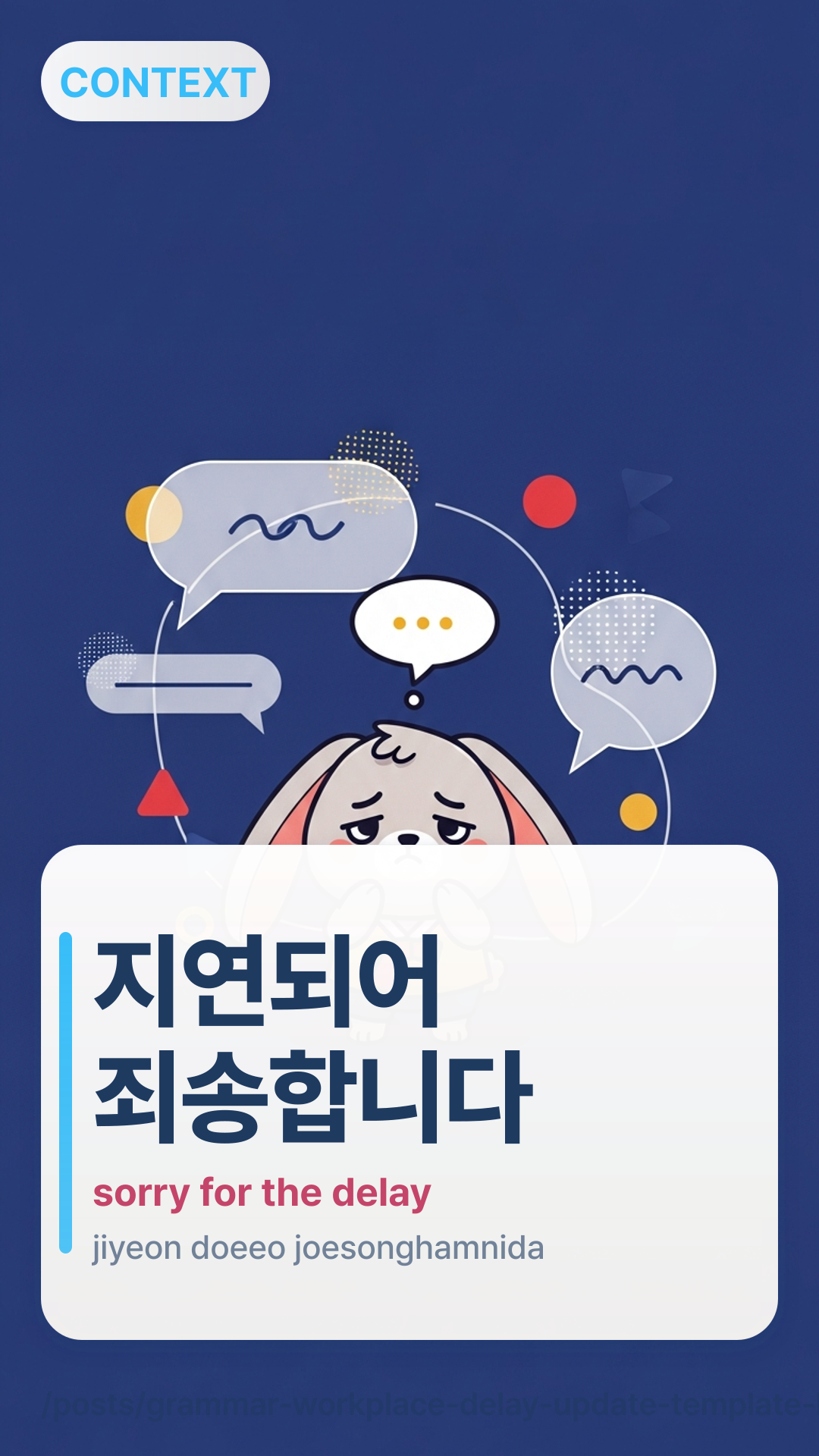
지연되어 죄송합니다 · -까지 공유드리겠습니다 뜻
Use 지연되어 죄송합니다 and -까지 공유드리겠습니다 to give clear delay updates with concrete ETAs at work—master

Use 지연되어 죄송합니다 and -까지 공유드리겠습니다 to give clear delay updates with concrete ETAs at work—master
Teach delay updates with an apology→plan→ETA template that prevents blamey excuses and forces concrete time phrases (까지/전/내).
The safe default sentence
지연되어 죄송합니다. 오늘 5시까지 공유드리겠습니다.jiyeondoeeo joesonghapnida. oneul 5sikkaji gongyudeurigetseupnida. — Sorry for the delay. I’ll share it by 5pm today.
Quick cheat sheet
Expressions in this post
Template (apology → status → next step):
지연되어 죄송합니다. {현재 상태} 중이며 {다음 액션} 후 {시간}까지 공유드리겠습니다.jiyeondoeeo joesonghapnida. {hyeonjae sangtae} jungimyeo {daeum aeksyeon} hu {sigan}kkaji gongyudeurigetseupnida. — Sorry for the delay. I’m {status} and will share by {time} after {next action}.
Examples you can paste:
지연되어 죄송합니다. 현재 검토 중이며 수정 반영 후 오늘 5시까지 공유드리겠습니다.jiyeondoeeo joesonghapnida. hyeonjae geomto jungimyeo sujeong banyeong hu oneul 5sikkaji gongyudeurigetseupnida. — Sorry for the delay. I’m reviewing now and will apply edits and share by 5pm today.지연되어 죄송합니다. 확인이 필요해 조금 더 점검 중입니다. 내일 오전 10시까지 업데이트드리겠습니다.jiyeondoeeo joesonghapnida. hwagini piryohae jogeum deo jeomgeom jungipnida. naeil ojeon 10sikkaji eopdeiteudeurigetseupnida. — Sorry for the delay. I need to verify a few things and am checking a bit more. I’ll update you by 10am tomorrow.
Good vs too direct
Good (takes ownership, stays neutral):
지연되어 죄송합니다. 확인 후 오늘 5시까지 공유드리겠습니다.jiyeondoeeo joesonghapnida. hwagin hu oneul 5sikkaji gongyudeurigetseupnida. — Sorry for the delay. After confirming, I’ll share by 5pm today.
Too direct / risky (sounds casual or defensive):
지금 바빠서요. 나중에 드릴게요.jigeum bappaseoyo. najunge deurilgeyo. — I’m busy right now. I’ll give it to you later.제가 잘못한 건 아닌데요.jega jalmothan geon anindeyo. — It’s not really my fault though.
Rewrite drill
Rewrite these to be workplace-safe and concrete (notice tone + particles + tense).
- Wrong:
좀 늦을 듯요. 곧 드릴게요.jom neujeul deusyo. got deurilgeyo. → Right:지연되어 죄송합니다. 오늘 5시까지 공유드리겠습니다.jiyeondoeeo joesonghapnida. oneul 5sikkaji gongyudeurigetseupnida. — Replace vague “soon” with a deadline. - Wrong:
클라이언트가 안 줘서 못 했어요.keulraieonteuga an jwoseo mot haesseoyo. → Right:지연되어 죄송합니다. 필요한 자료 확인 중이며 받는 대로 오늘 내로 공유드리겠습니다.jiyeondoeeo joesonghapnida. piryohan jaryo hwagin jungimyeo batneun daero oneul naero gongyudeurigetseupnida. — Remove blame; keep facts. - Wrong:
다 됐는데 마지막에만요.da dwaetneunde majimagemanyo. → Right:지연되어 죄송합니다. 최종 확인 후 30분 내 공유드리겠습니다.jiyeondoeeo joesonghapnida. choejong hwagin hu 30bun nae gongyudeurigetseupnida. — Add a time window. - Wrong:
내일 오전에까지 드릴게요.naeil ojeonekkaji deurilgeyo. → Right:내일 오전 10시까지 공유드리겠습니다.naeil ojeon 10sikkaji gongyudeurigetseupnida. — Use까지kkaji without에e and pick a specific time. - Wrong:
검토 했고요, 문제 없을 듯.geomto haetgoyo, munje eopseul deut. → Right:검토 중이며 확인 후 공유드리겠습니다.geomto jungimyeo hwagin hu gongyudeurigetseupnida. — Fix tense (in progress vs finished) and soften certainty.
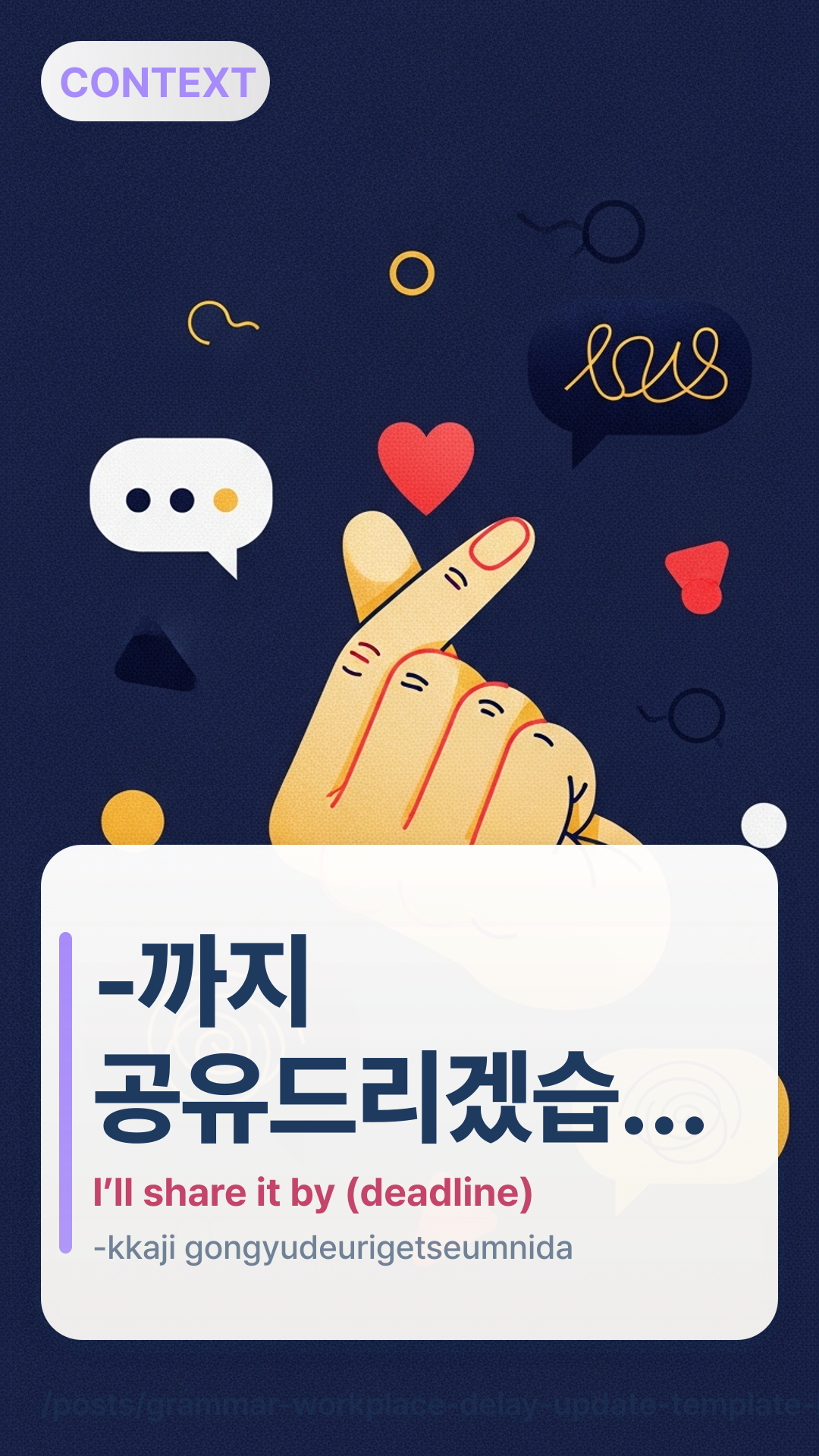
Core idea: attach a deadline phrase right before 까지kkaji, then promise the action.
오늘 3시까지 공유드리겠습니다.oneul 3sikkaji gongyudeurigetseupnida. — I’ll share by 3pm today.금요일 EOD까지 공유드리겠습니다.geumyoil EODkkaji gongyudeurigetseupnida. — I’ll share by Friday EOD.
Template (new plan + ETA):
({다음 액션}) 후 {시간}까지 공유드리겠습니다.({daeum aeksyeon}) hu {sigan}kkaji gongyudeurigetseupnida. — After {next action}, I’ll share by {time}.
Cultural note (why this sounds “adult” at work): in Korean offices, a clear 까지kkaji deadline often reads as accountability; “later” language can feel like you’re pushing the burden onto the other person.
Good vs too direct
Good (deadline + plan):
수정 반영 후 내일 오전 10시까지 공유드리겠습니다.sujeong banyeong hu naeil ojeon 10sikkaji gongyudeurigetseupnida. — I’ll apply the edits and share by 10am tomorrow.
Too direct / unhelpful (either too vague or too commanding):
기다리세요. 금방 줌.gidariseyo. geumbang jum. — Wait. I’ll give it soon.제가 바쁘니까 다음 주에요.jega bappeunikka daeum jueyo. — I’m busy so it’s next week.
Rewrite drill
Make each line specific using 까지/전/내kkaji/jeon/nae and a real plan.
6) Wrong: 오늘 중으로요.oneul jungeuroyo. → Right: 오늘 6시까지 공유드리겠습니다.oneul 6sikkaji gongyudeurigetseupnida. — Replace “sometime today” with a cutoff.
7) Wrong: 금요일까지에 보내겠습니다.geumyoilkkajie bonaegetseupnida. → Right: 금요일 EOD까지 공유드리겠습니다.geumyoil EODkkaji gongyudeurigetseupnida. — Avoid 까지에kkajie; add a standard workplace label.
8) Wrong: 회의 전에 줄게요.hoeui jeone julgeyo. → Right: 회의 전까지 공유드리겠습니다.hoeui jeonkkaji gongyudeurigetseupnida. — Use 전까지jeonkkaji to mark “by before.”
9) Wrong: 조금만 더 시간 주세요.jogeumman deo sigan juseyo. → Right: 2~3시간 더 점검 후 오늘 5시까지 공유드리겠습니다.2~3sigan deo jeomgeom hu oneul 5sikkaji gongyudeurigetseupnida. — Add an amount + a deadline.
10) Wrong: 내일 업데이트할게요.naeil eopdeiteuhalgeyo. → Right: 내일 오전 10시까지 업데이트드리겠습니다.naeil ojeon 10sikkaji eopdeiteudeurigetseupnida. — Upgrade casual -할게요-halgeyo to polite -드리겠습니다-deurigetseupnida + time.
Next steps
- Pick the decision-tree branch first; don’t mix apology + excuses + vague time in one message.
- Always include one concrete time phrase:
까지kkaji (by),전jeon (before), or내nae (within). - Add one action verb that shows a plan:
확인hwagin,점검jeomgeom,수정 반영sujeong banyeong,정리jeongri,검토geomto. - Use polite future tense for workplace:
공유드리겠습니다gongyudeurigetseupnida,업데이트드리겠습니다eopdeiteudeurigetseupnida. - Before sending, check: is the ETA specific enough that someone could put it on their calendar?