Oppa vs. Sunbae: How to Use Korean Honorifics Like a Pro
Master the evolution of 오빠 (Oppa) and 선배 (Sunbae). Learn when to use these terms in dating vs. the workplace with our guide and quiz. Master Korean now!
Master the evolution of 오빠 (Oppa) and 선배 (Sunbae). Learn when to use these terms in dating vs. the workplace with our guide and quiz. Master Korean now!
Beyond the K-drama romance, calling someone 'Oppa' in a Seoul office can lead to a very awkward HR meeting if you miss the nuance.
You probably first heard 'Oppa' screamed at a concert or whispered in a romantic scene on Netflix. But in reality, these terms are linguistic landmines. Using the wrong one doesn't just make you sound like a foreigner; it can signal an intimacy that isn't there or a hierarchy you're accidentally disrespecting.
Quick cheat sheet
Expressions in this post
Quick meaning
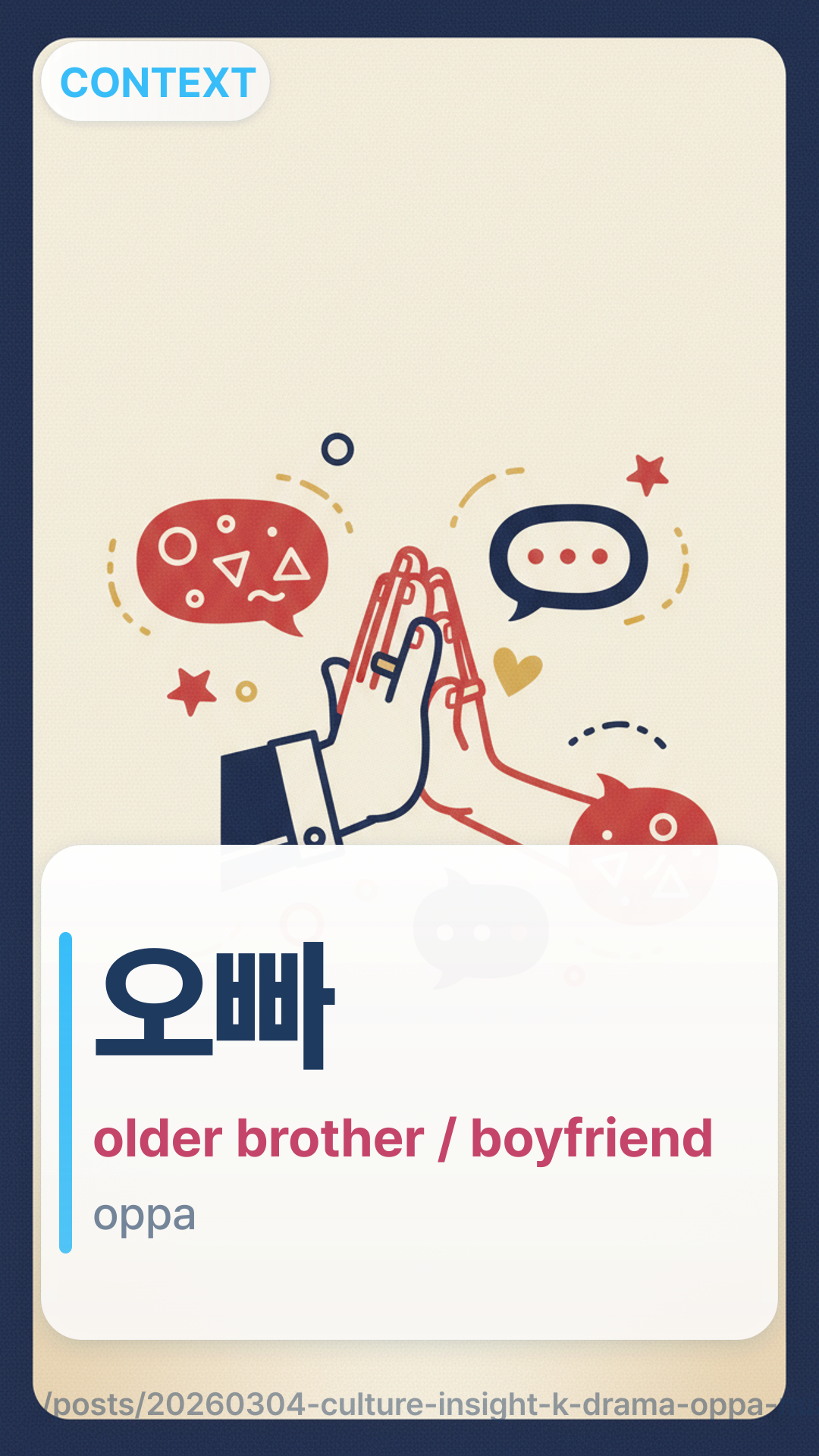
Literally 'older brother' for a female speaker, but widely used for older male friends and romantic partners.
Nuance (how it feels)
It feels warm, close, and sometimes flirtatious. It removes the 'wall' of formal titles. However, using it too early can feel 'burdensome' (부담스럽다) to the guy if he doesn't feel that close to you yet.
Common trap (misunderstanding)
Many learners think 'Oppa' is a universal replacement for 'you'. It is not. Never use it for a man younger than you, and never use it for a stranger (like a waiter) unless you want to sound extremely strange.
Tone ladder (risky → safer)
오빠oppa (Casual/Intimate) - Use with boyfriends.[Name] 오빠[Name] oppa (Friendly) - Use with close older male friends.[Name] 씨[Name] ssi (Polite/Neutral) - The safest way to address a male colleague.
Minimal pairs (A vs B)
오빠oppa (Oppa) vs형hyeong (Hyung): Both mean older brother, but 'Oppa' is only used by females, while 'Hyung' is only used by males.
Examples (chat)
오빠, 오늘 시간 돼?oppa, oneul sigan dwae? — Oppa, do you have time today?우리 오빠는 진짜 친절해.uri oppaneun jinjja chinjeolhae. — My (older) brother is really kind.
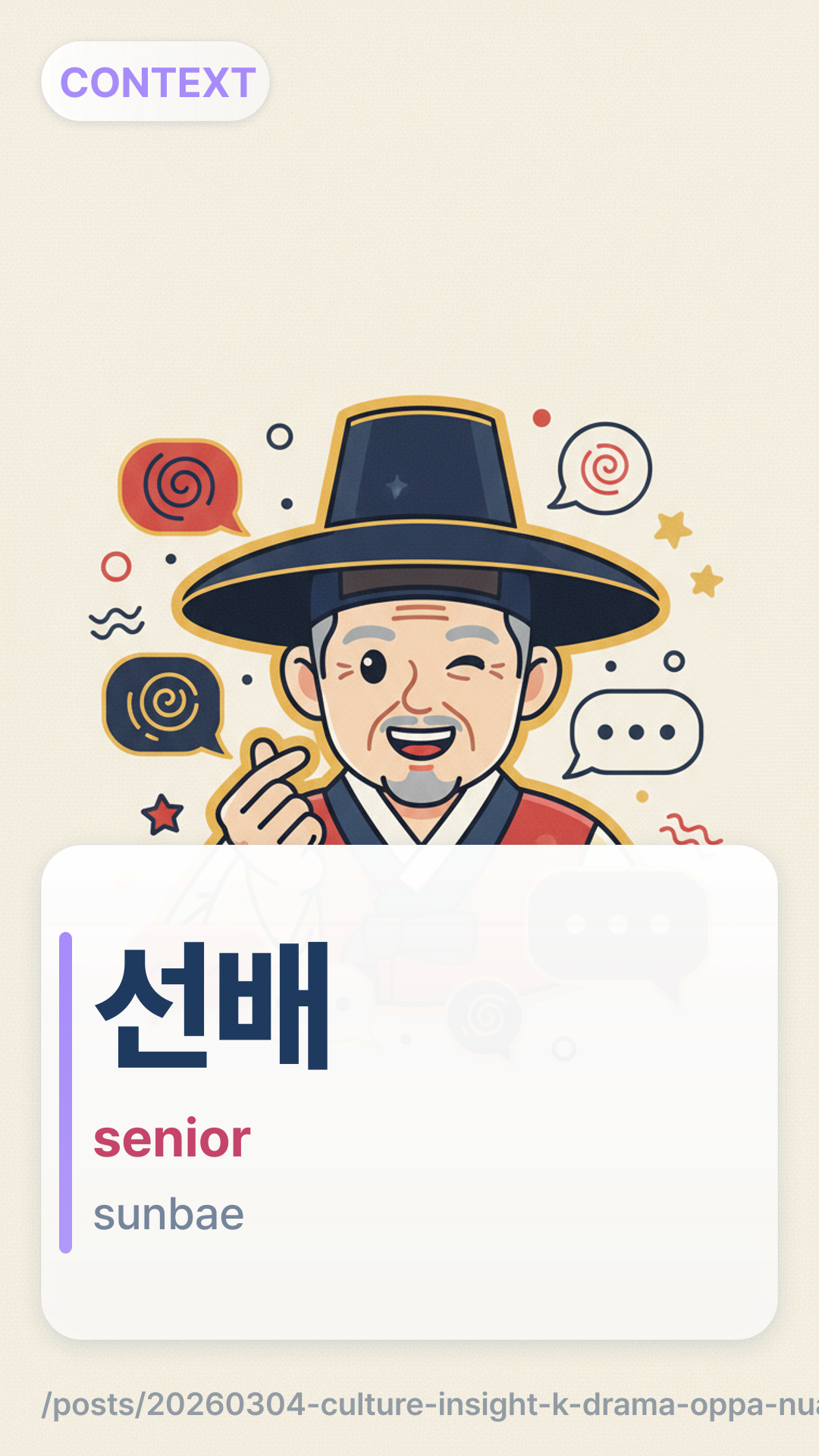
Quick meaning
Senior. A person who started at a school or company before you did.
Nuance (how it feels)
It is respectful and professional. It acknowledges their experience without the heavy emotional baggage of 'Oppa'. It creates a comfortable distance while still being friendly.
Common trap (misunderstanding)
Don't stop using 'Sunbae' just because you become friends. In Korea, the 'Sunbae-Hoobae' (Senior-Junior) relationship often lasts a lifetime, even if you grab drinks every weekend.
Tone ladder (risky → safer)
선배seonbae (Casual among friends) - "Hey, Senior!"선배님seonbaenim (Polite/Standard) - The most common and safest version.[Name] 선배님[Name] seonbaenim (Formal) - Used in very professional settings.
Minimal pairs (A vs B)
선배seonbae (Sunbae) vs선생님seonsaengnim (Seonsaengnim): 'Sunbae' is a senior in your field; 'Seonsaengnim' is a teacher or a much older professional.
Examples (chat)
선배님, 점심 드셨어요?seonbaenim, jeomsim deusyeosseoyo? — Senior, have you had lunch?학교 선배한테 물어볼게요.hakgyo seonbaehante mureobolgeyo. — I will ask a school senior.
The Decision Tree: Oppa or Sunbae?
- Is it a workplace? -> Use
선배님seonbaenim or[Name] 씨[Name] ssi. - Is he older but you aren't close? -> Use
[Name] 씨[Name] ssi. - Is he your boyfriend? -> Use
오빠oppa. - Are you a male? -> Never use
오빠oppa (Use형hyeong or선배seonbae).
Workplace Boundary Crossing: Wrong vs. Right
Copy/paste mini-dialogues (with EN)
Mini quiz (2 minutes)
Notes:
- Q1:
선배seonbae is correct because a university setting requires acknowledging the senior-junior hierarchy, and선배님seonbaenim is the standard polite form. - Q2:
오빠oppa is the natural choice for a romantic relationship where the male is older.
Next steps
- Identify one male friend who is older than you. Decide if your relationship is 'Sunbae' territory or 'Oppa' territory based on your last 3 conversations.
- Watch a workplace drama like 'Misaeng' and count how many times they use titles other than 'Oppa'.