안 돼 (Andwae) Meaning: From 'No' to Dramatic Despair
Master the nuances of 안 돼 (Andwae) in K-dramas. Learn the desperation scale, common traps, and how to sound natural. Discover more!
Master the nuances of 안 돼 (Andwae) in K-dramas. Learn the desperation scale, common traps, and how to sound natural. Discover more!
It’s the climax of the series: the lead character rushes to the hospital, only to find an empty bed. They fall to their knees, crying out a long, guttural "안 돼..." (Andwae...). You've heard it a thousand times, but using it correctly in real life requires more than just mimicking a soap opera.
Quick cheat sheet
Expressions in this post
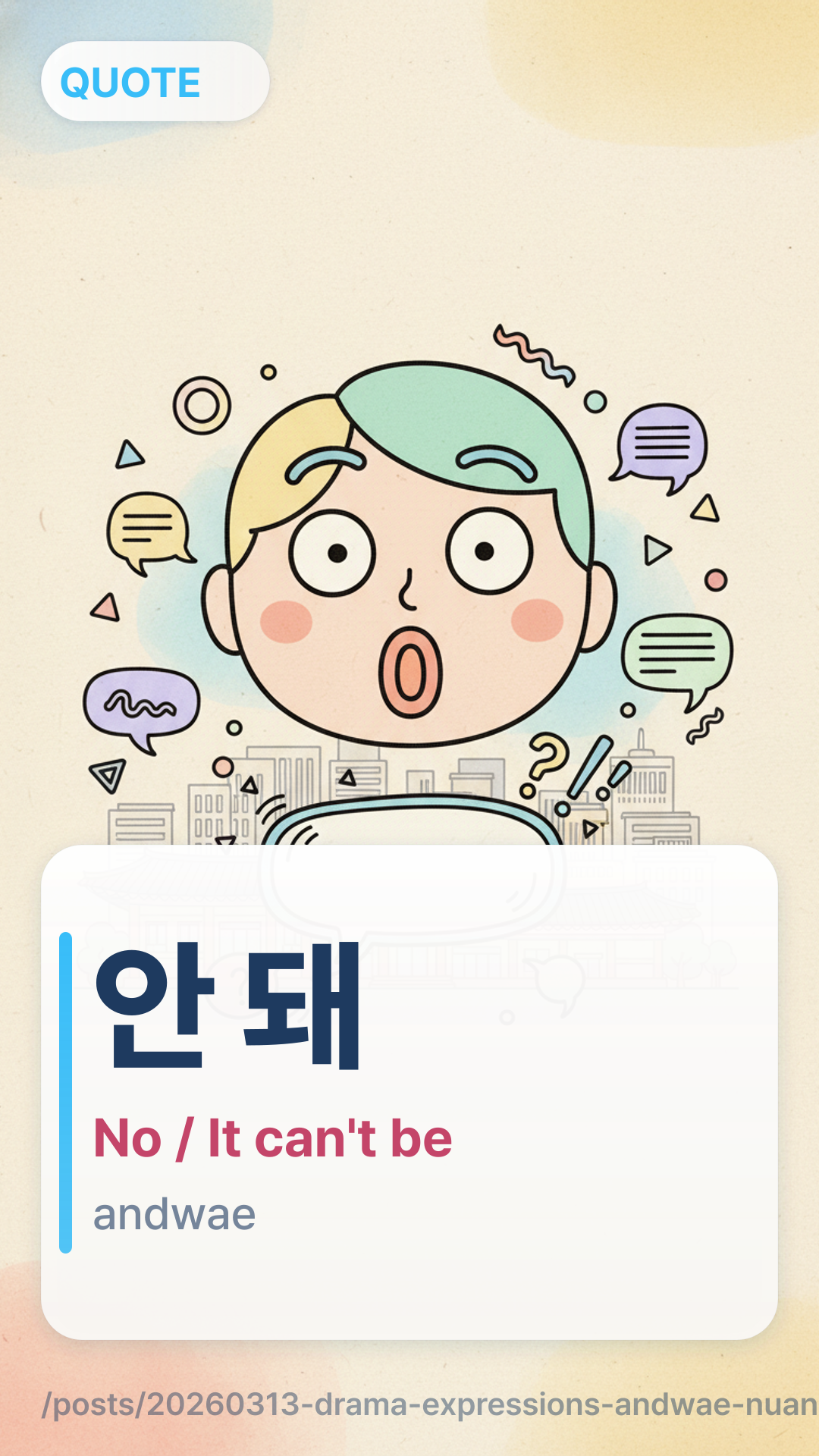
Quick meaning
Literally "it doesn't become," used to say "no," "don't," or "it can't be."
Nuance (how it feels)
In casual speech, it ranges from a simple boundary ("Don't touch that") to a soul-crushing realization of fate. The magic is in the delivery. A short, clipped 안 돼an dwae is a command; a long, shaky 안 돼...an dwae... is a plea to the universe.
Desperation Scale (1–5)
안 돼.an dwae. (Short/Flat): "No, you can't." (e.g., telling a friend not to eat your fries).안 돼~an dwae~ (Slightly elongated): "Aw, come on, don't do that."안 돼! 안 돼!an dwae! an dwae! (Repeated/Sharp): "Stop! Don't!" (Urgent intervention).안 돼...an dwae... (Trailing off): "This can't be happening..." (Shock).아아아아 안 돼!!!aaaa an dwae!!! (Vowel elongation): "NOOOOOO!" (The classic K-drama tragic twist).
Common trap (misunderstanding)
Learners often use 안 돼an dwae to answer "Do you have...?" questions. If someone asks "Do you have a pen?" and you say 안 돼an dwae, it sounds like you are forbidding them from having a pen. Use 없어eopseo (eop-seo) for "I don't have it."
Tone ladder (risky → safer)
안 돼an dwae (Casual/Informal) — Use with friends or younger people.안 돼요an dwaeyo (Polite) — Standard polite rejection.안 됩니다an doepnida (Formal) — Professional/Service context.
Minimal pairs (A vs B)
- A:
안 돼an dwae (Prohibition/Denial of reality) - B:
싫어silheo (Personal dislike/Refusal). Use싫어silheo when you just don't want to do something.
Examples (chat)
나 오늘 못 가. 안 돼.na oneul mot ga. an dwae. — I can't go today. It's not working out.안 돼! 그거 내 케이크야!an dwae! geugeo nae keikeuya! — No! That's my cake!
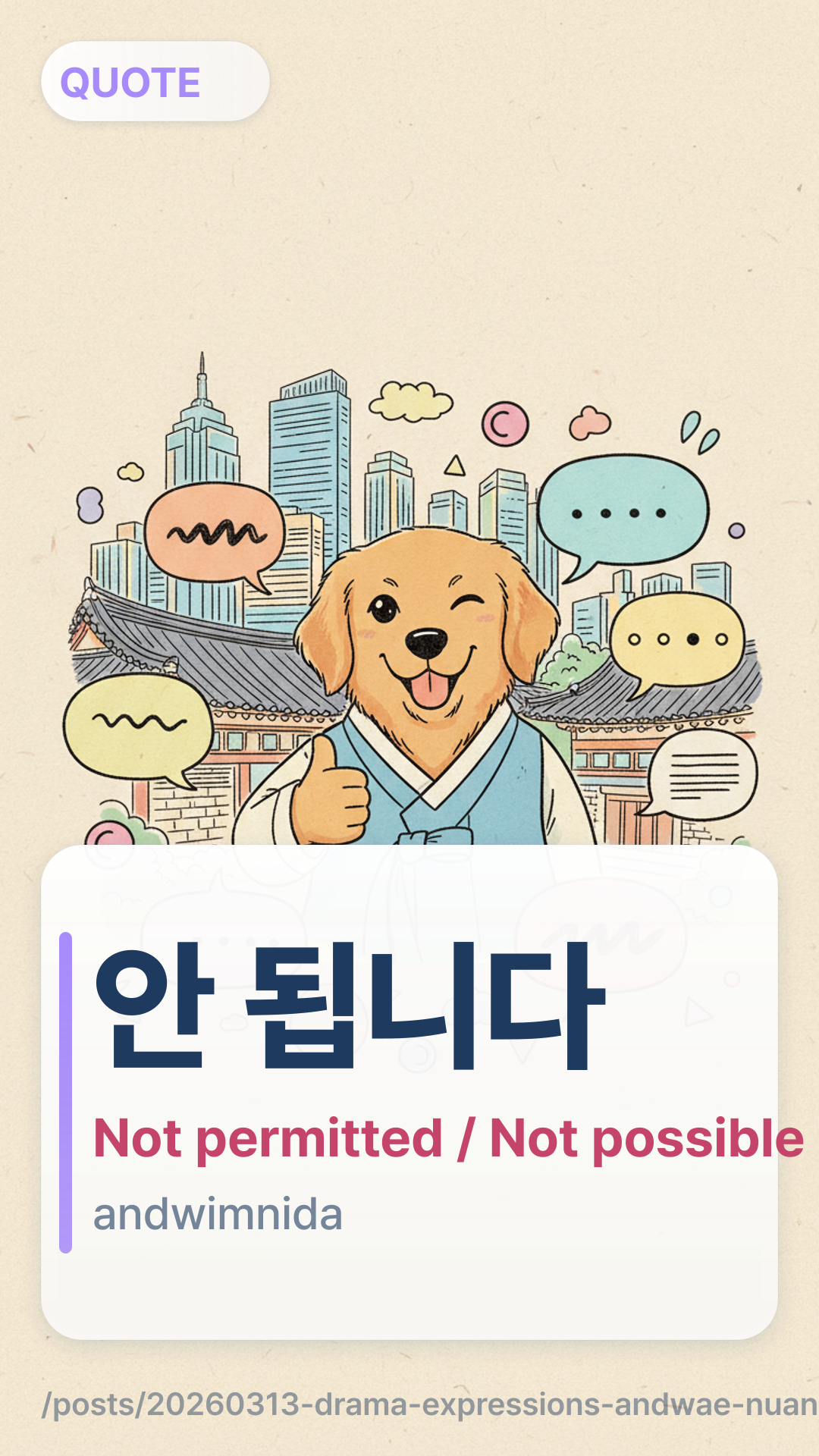
Quick meaning
Formal version of "It is not allowed" or "It is not possible."
Nuance (how it feels)
This is the language of signs, staff members, and official business. It feels final and non-negotiable. If a waiter says this, they aren't being mean; they are stating a rule.
Scene Context
- Romantic Rejection: If a character says
안 돼an dwae to a confession, it often implies a tragic reason (e.g., "We can't be together"). - Service Context: If you try to enter a club with sneakers and the bouncer says
안 됩니다an doepnida, it's a hard rule.
Common trap (misunderstanding)
Using 안 돼an dwae (casual) to a boss or a stranger in a suit. It sounds incredibly rude or overly dramatic, like you're starting a fight or a scene in a play.
Tone ladder (risky → safer)
안 돼an dwae (Risky with strangers)안 돼요an dwaeyo (Safe for daily life)안 됩니다an doepnida (Safest for business/official settings)
Minimal pairs (A vs B)
- A:
안 됩니다an doepnida (Formal rule/impossibility) - B:
죄송합니다joesonghapnida (I'm sorry). In service,죄송하지만 안 됩니다joesonghajiman an doepnida (I'm sorry but it's not possible) is the gold standard.
Examples (chat)
여기서 담배 피우면 안 됩니다.yeogiseo dambae piumyeon an doepnida. — You must not smoke here.죄송합니다, 그건 안 됩니다.joesonghapnida, geugeon an doepnida. — I am sorry, that is not permitted.
Copy/paste mini-dialogues (with EN)
Mini quiz (2 minutes)
Notes:
- Q1:
안 돼an dwae is correct because you are speaking casually to a close friend to stop an action. - Q2:
안 됩니다an doepnida is correct because it is a formal, public notice or rule.
Next steps
- Watch a tragic scene in a drama and count how many seconds they stretch the 'ae' sound in
안 돼an dwae. - Practice saying
안 돼요an dwaeyo (polite) instead of the casual version to ensure you don't accidentally offend someone while setting a boundary.