며느리 & K-Daughter-in-Law: Decoding K-Drama Family Tropes
Master 며느리 and 시댁 to understand the intense family dynamics in K-dramas. Learn the K-myeoneuri meme and honorific traps. Explore now!
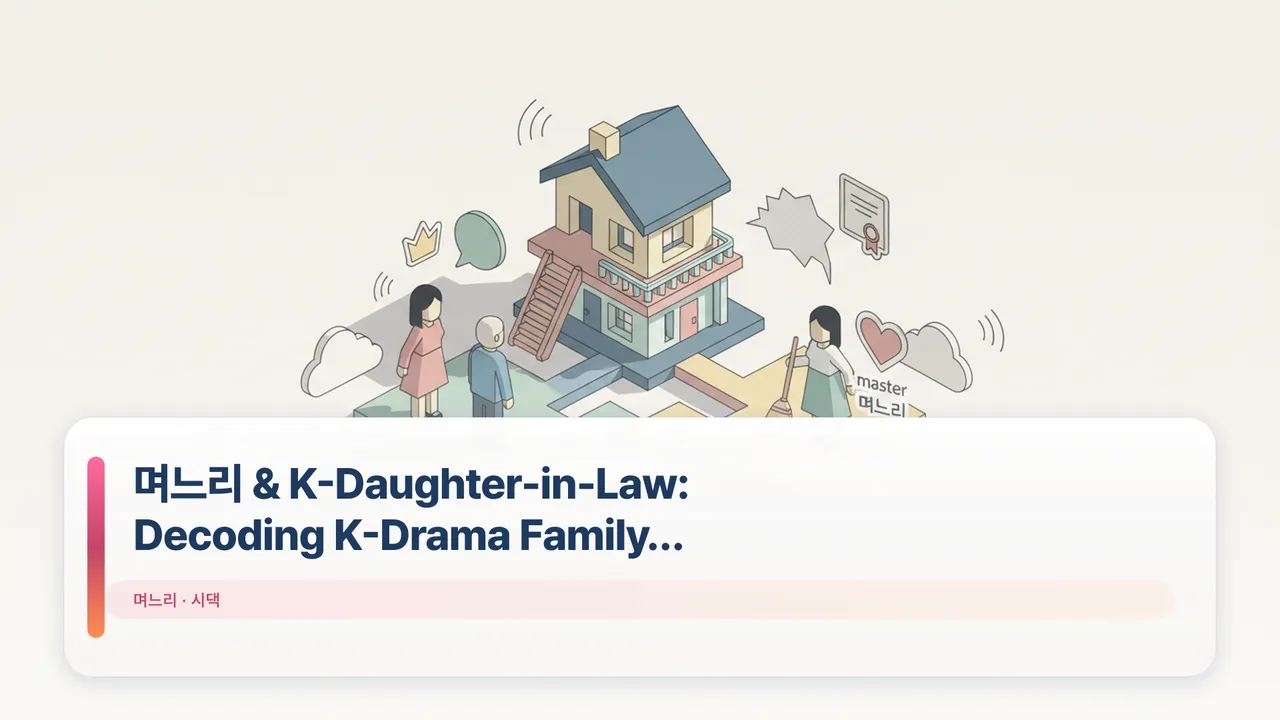
Master 며느리 and 시댁 to understand the intense family dynamics in K-dramas. Learn the K-myeoneuri meme and honorific traps. Explore now!
Explore the complex world of Korean family dynamics through the lens of the 'K-myeoneuri' social meme and the high-stakes honorifics of the 'Siga'.
You’ve seen it in every weekend drama: the daughter-in-law standing in a kitchen full of dishes while her mother-in-law makes a sharp comment about the seasoning. This isn't just a trope; it's a deep-seated cultural archetype that has evolved into the modern 'K-myeoneuri' meme, reflecting the struggle between tradition and modern identity.
Quick cheat sheet
Expressions in this post
Quick meaning
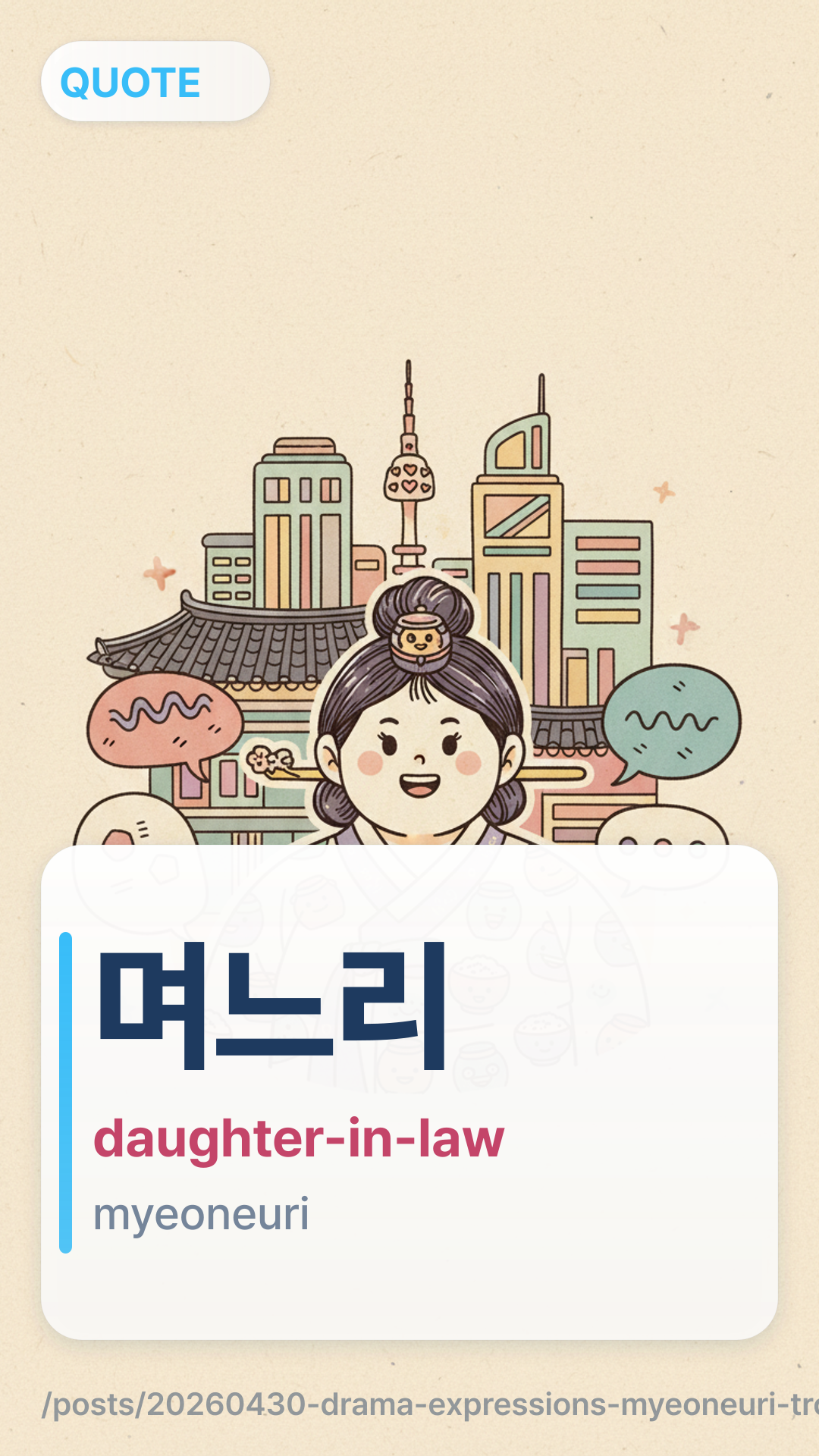
Daughter-in-law.
Nuance (how it feels)
While technically a neutral kinship term, in a drama context, it often carries a weight of expectation and duty. The modern term 'K-myeoneuri' (K-daughter-in-law) is used sarcastically by younger generations to describe the exhausting labor and emotional endurance required during holidays like Chuseok.
Common trap (misunderstanding)
Don't call yourself a 며느리myeoneuri when introduced to your own parents. It is strictly your relationship to your husband's parents. Also, never address your mother-in-law as 며느리myeoneuri—that is what she calls you.
Tone ladder (risky → safer)
- 며느리 (Neutral/Reference)
- 우리 며느리 (Affectionate/Possessive, used by MIL)
- 며느님 (Polite/Formal, often used by service workers or sarcastically)
Minimal pairs (A vs B)
며느리myeoneuri vs사위sawi:며느리myeoneuri is the son's wife;사위sawi is the daughter's husband. The social expectations for a며느리myeoneuri are historically much higher in Korean society.
Examples (chat)
이번 명절에도 K-며느리는 웁니다.ibeon myeongjeoredo K-myeoneurineun upnida. — The K-daughter-in-law cries again this holiday.우리 집 며느리가 최고지.uri jip myeoneuriga choegoji. — Our daughter-in-law is the best.
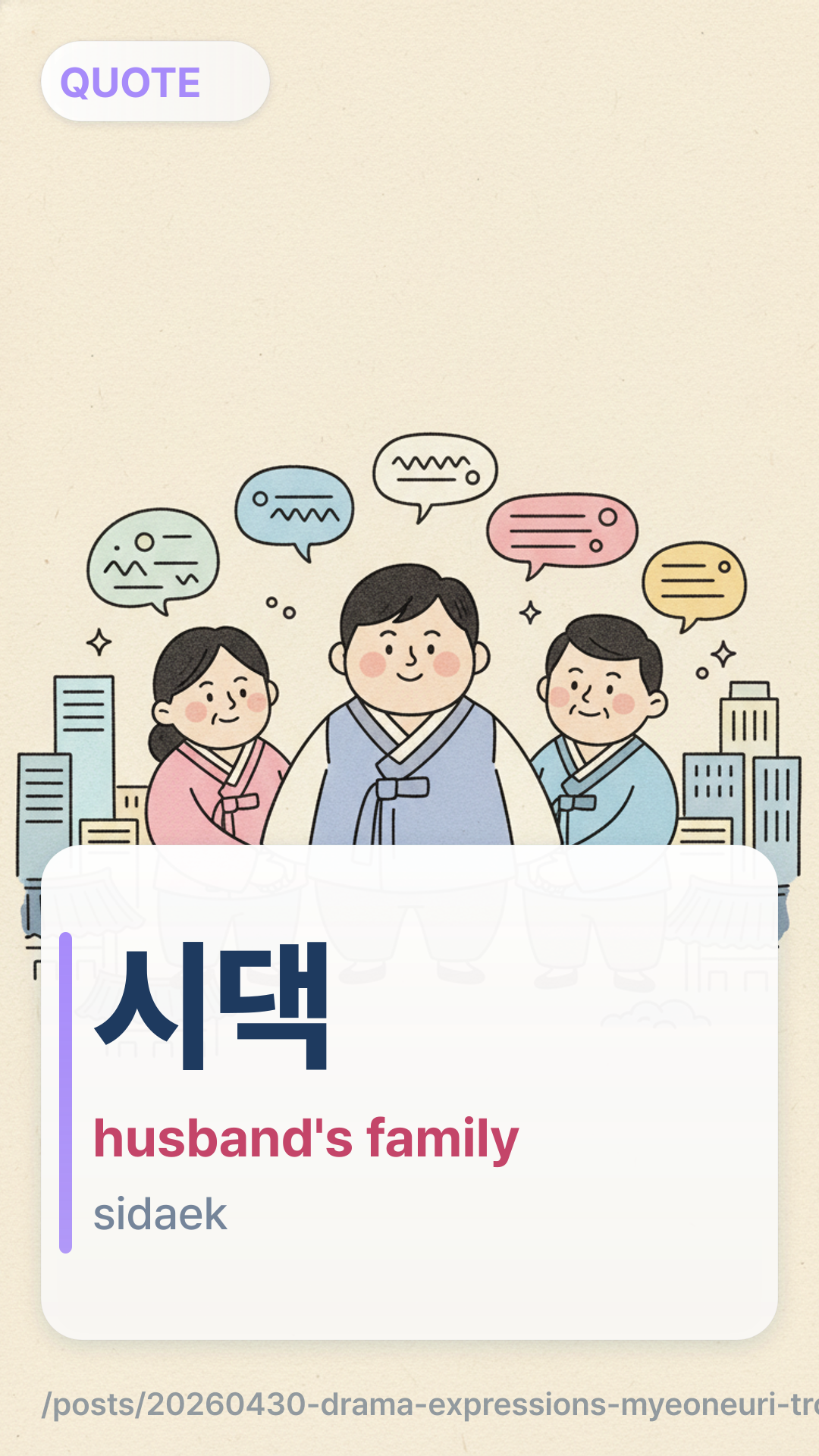
Quick meaning
The husband's family or the husband's parents' home.
Nuance (how it feels)
Adding the suffix -댁-daek (honorific for house) is mandatory. Referring to your husband's family as 시집sijip can sound slightly dated or overly casual. In dramas, 시댁sidaek is often portrayed as a place of high tension where the daughter-in-law must use perfect honorifics.
Common trap (misunderstanding)
When a wife speaks to her husband about his parents, she should still use honorifics. A common mistake is using the husband's name or 'you' when referring to his parents. You must use titles like 아버님abeonim or 어머님eomeonim.
Tone ladder (risky → safer)
- 시집 (Casual/Old-fashioned)
- 시댁 (Standard/Polite)
- 시어른들 (Very formal/Respectful)
Minimal pairs (A vs B)
시댁sidaek vs처가cheoga:시댁sidaek is the husband's side (used by the wife);처가cheoga is the wife's side (used by the husband).
Examples (chat)
내일 시댁 가야 돼.naeil sidaek gaya dwae. — I have to go to my husband's family's house tomorrow.시댁 식구들이랑 식사했어.sidaek sikgudeurirang siksahaesseo. — I had a meal with my husband's family.
Mother-in-Law Tension Scale (1–5)
아가aga (Child/Dear) — Level 1: Relatively affectionate, though still patronizing.얘야yaeya (Hey/Child) — Level 2: Getting serious; usually precedes a lecture.너neo (You) — Level 4: High tension; the mother-in-law has dropped all formalities.너희 친정에서는 그렇게 가르치더냐?neohui chinjeongeseoneun geureotge gareuchideonya? (Did your own family teach you that?) — Level 5: Nuclear war; insulting the daughter-in-law's upbringing.
Wrong vs. Right: Siga Honorifics
Copy/paste mini-dialogues (with EN)
Mini quiz (2 minutes)
Notes:
- Q1:
시댁sidaek is the specific honorific term for the husband's family home. - Q2:
며느리myeoneuri is the standard term used by a mother-in-law to refer to her son's wife.
Next steps
- Watch a clip of the drama 'No, Thank You' (며느라기) to see the 'K-myeoneuri' struggle in action.
- Practice introducing your (real or imaginary) husband's parents using
아버님abeonim and어머님eomeonim instead of their names.