미쳤네 Meaning: From K-Drama Plot Twists to Pure Awe
Master the versatile Korean expression 미쳤네. Learn to distinguish between shock and awe in K-dramas with our intensity scale and usage guide.
Master the versatile Korean expression 미쳤네. Learn to distinguish between shock and awe in K-dramas with our intensity scale and usage guide.
Master the 'Shock-to-Awe' intensity scale to help you distinguish between reacting to a plot betrayal versus a character's incredible talent.
You’re watching the season finale of a revenge thriller. The protagonist’s 'trusted' mentor just walked into the villain’s office and shook hands. You see the live-chat scroll on Viki or Weverse explode with a single word: 미쳤네michyeotne. It’s the universal Korean reaction to anything that breaks the scale of normalcy.
Quick cheat sheet
Expressions in this post
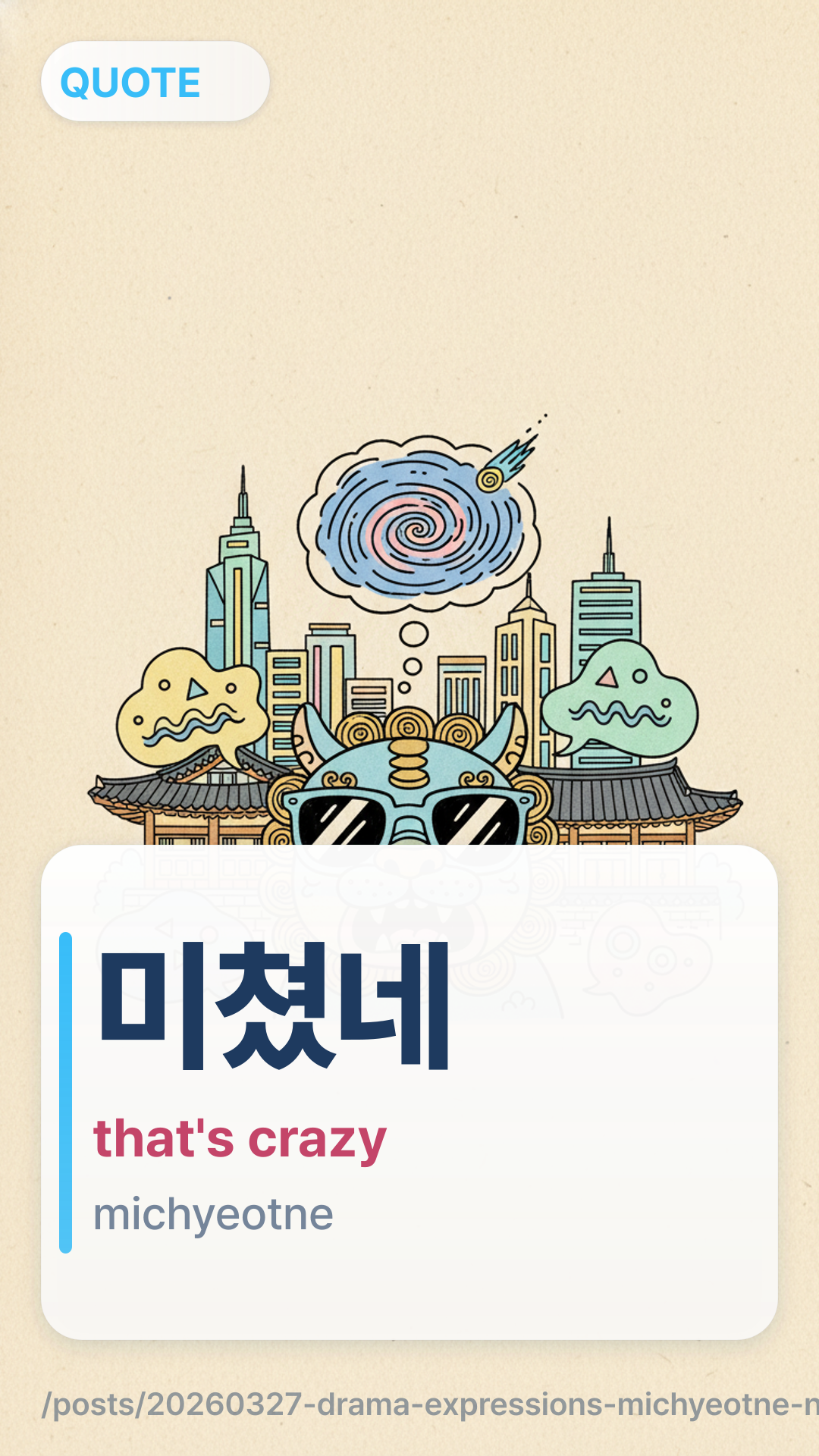
Quick meaning
Literally "It went crazy," but used as "That's insane" or "That's wild."
Nuance (how it feels)
It is a reactive exclamation. While the root word 미치다michida means "to go crazy" or "to be insane," in a drama context, it’s rarely about clinical mental health. It’s about the situation exceeding your expectations. If a character pulls off a genius move, it’s "crazy good." If they commit a senseless crime, it’s "crazy bad."
Common trap (misunderstanding)
Don't use this to your boss or a teacher. Even if their idea is "insanely good," using 미쳤네michyeotne is strictly casual. Using it toward a superior makes it sound like you are questioning their sanity rather than complimenting their genius.
Tone ladder (risky → safer)
미쳤나 봐michyeotna bwa (Risky/Sarcastic) — "Must be out of their mind."미쳤네michyeotne (Casual/Standard) — "That's crazy."진짜 대단하시네요jinjja daedanhasineyo (Safe/Polite) — "That is truly amazing."
Minimal pairs (A vs B)
- A:
대박daebak — General "Wow." Positive and safe. - B:
미쳤네michyeotne — High-intensity shock. Can be negative (betrayal) or positive (insane skill).
Examples (chat)
와, 연기 미쳤네wa, yeongi michyeotne — Wow, the acting is insane.결말 미쳤네 진짜gyeolmal michyeotne jinjja — The ending is seriously crazy.
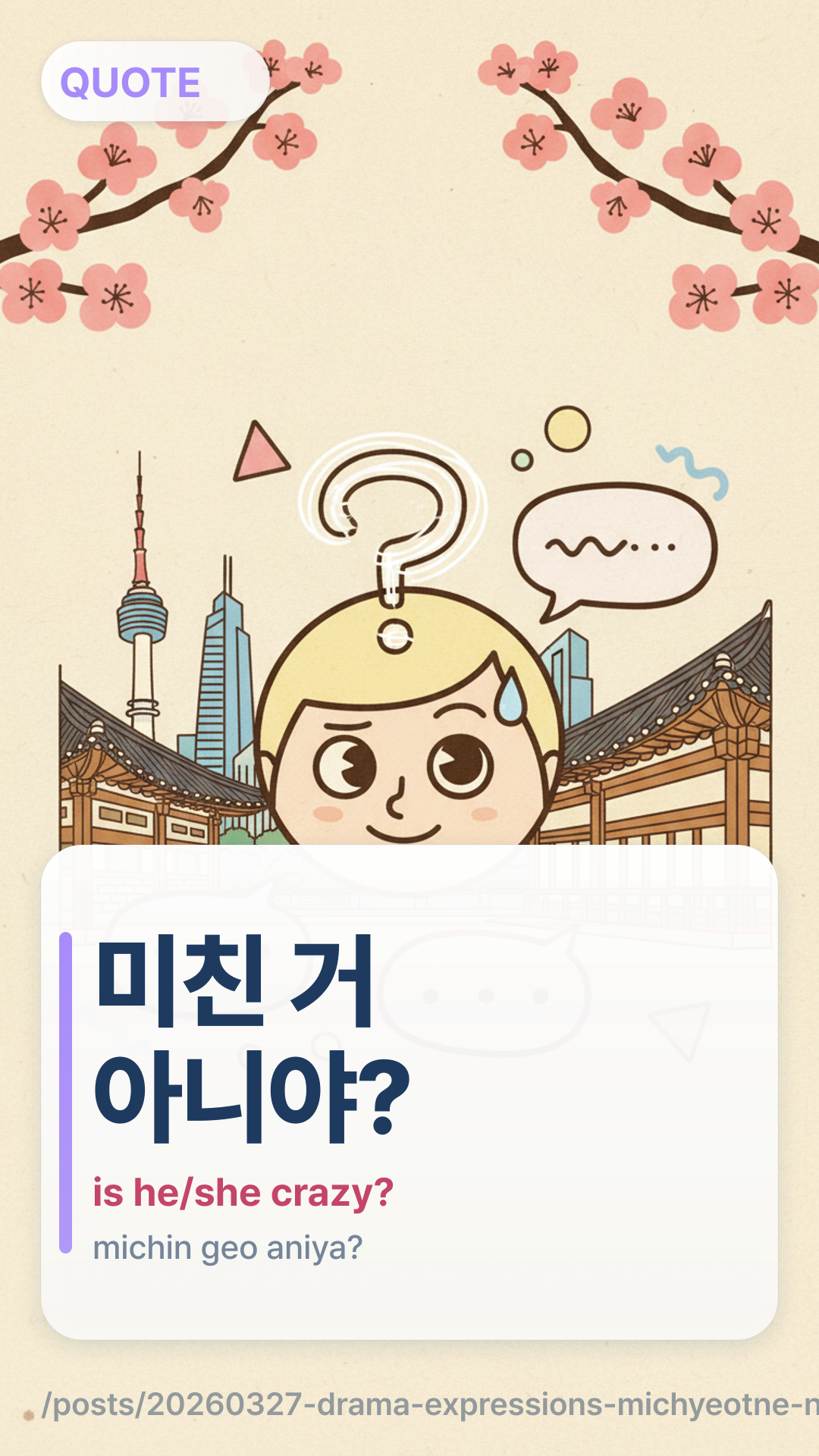
Quick meaning
"Is he/she crazy?" or "Aren't they out of their mind?"
Nuance (how it feels)
This is more aggressive than 미쳤네michyeotne. It’s often used when a character does something morally reprehensible or incredibly risky. It’s the go-to phrase for that moment in a K-drama when the second lead decides to kidnap the protagonist.
Common trap (misunderstanding)
In real life, saying this to a stranger is a direct confrontation. In dramas, characters say it to themselves while watching the news or talking to friends about a third party.
Tone ladder (risky → safer)
미친 거 아냐?michin geo anya? (Aggressive) — "Are they crazy?"제정신이야?jejeongsiniya? (Direct) — "Are you in your right mind?"이건 좀 심한 것 같아요igeon jom simhan geot gatayo (Polite) — "I think this is a bit much."
Minimal pairs (A vs B)
- A:
미친 거 아니야?michin geo aniya? — Focuses on the person's lack of judgment. - B:
말도 안 돼maldo an dwae — "No way." Focuses on the impossibility of the situation.
Examples (chat)
저 사람 미친 거 아니야?jeo saram michin geo aniya? — Is that person crazy?와... 진짜 미친 거 아냐? 소름...wa... jinjja michin geo anya? soreum... — Wow... seriously, aren't they crazy? Goosebumps...
Copy/paste mini-dialogues (with EN)
Mini quiz (2 minutes)
Notes:
- Q1: Both work here.
미친 거 아니야?michin geo aniya? emphasizes the recklessness of the action, while미쳤네michyeotne reacts to the shock of the scene. - Q2:
미쳤네michyeotne is the standard way to praise "insane" quality or beauty.미친 거 아니야?michin geo aniya? would sound like you're angry at the camera work.
Next steps
- Watch a clip of a high-stakes drama (like The Glory or Penthouse) and count how many times characters use these expressions.
- Try writing a comment on a K-pop dance cover using
미쳤네michyeotne to describe the skill level. - Practice the intonation:
미쳤네michyeotne usually has a falling intonation for awe, and a rising one for shock.