가위바위보! Master Korean Game Counters and Numbers
Learn how to count rounds and wins in Rock, Paper, Scissors using Korean counters 판 and 번. Master game grammar and win every match!
Learn how to count rounds and wins in Rock, Paper, Scissors using Korean counters 판 and 번. Master game grammar and win every match!
When playing Rock, Paper, Scissors in Korea, beginners often say 한 개han gae (one thing) or 한 시간han sigan (one hour) when they mean 'one round.' To sound like a local, you need the specific game counters for rounds and repetitions.
Wrong: 가위바위보 한 개 해요!gawibawibo han gae haeyo! (Let's do one 'thing' of rock-paper-scissors!)
Right: 가위바위보 한 판 해요!gawibawibo han pan haeyo! (Let's do one round of rock-paper-scissors!)
Quick cheat sheet
Expressions in this post
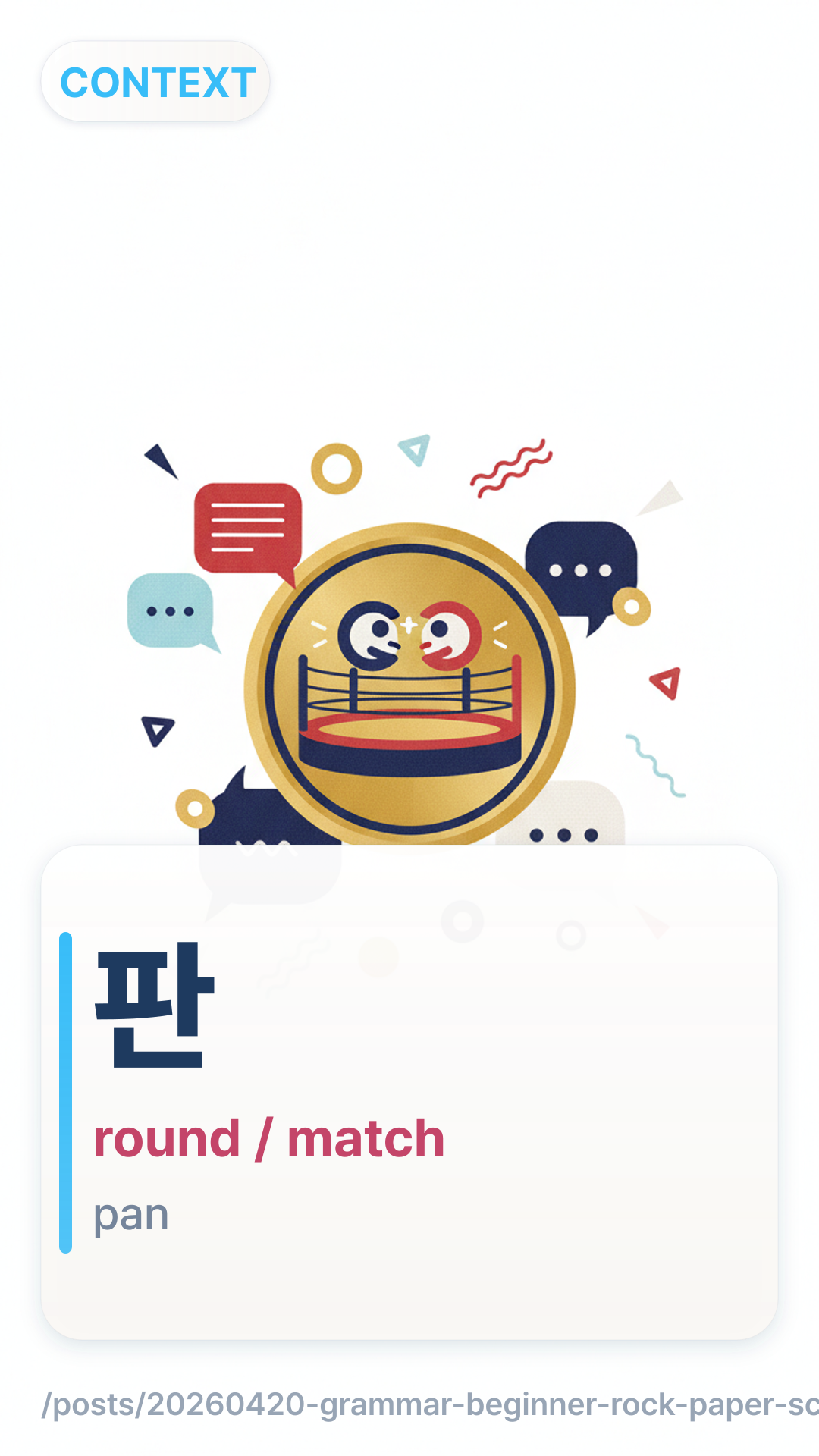
Form (how to attach)
Use Native Korean numbers (하나, 둘, 셋...) before the counter. Note that 1-4 change form: 한 판han pan, 두 판du pan, 세 판se pan, 네 판ne pan.
Meaning range (what it can/can’t mean)
판pan refers to a complete game or a full round from start to finish. It is used for board games, sports matches, or a set of Rock, Paper, Scissors. You cannot use it for abstract 'times' (like 'I went there three times').
Register (neutral/polite)
This is a neutral counter used in both casual play and professional match commentary.
Common mistakes (wrong → right)
Wrong: 일 판il pan (Sino-Korean 1 + pan)
Right: 한 판han pan (Native Korean 1 + pan)
Examples
딱 한 판만 더 하자.ttak han panman deo haja. — Let's do just one more round.세 판 양보할게.se pan yangbohalge. — I'll give you three rounds (head start).이번 판은 내가 이겼어.ibeon paneun naega igyeosseo. — I won this round.마지막 판이야.majimak paniya. — This is the last game.한 판 붙자!han pan butja! — Let's have a match!
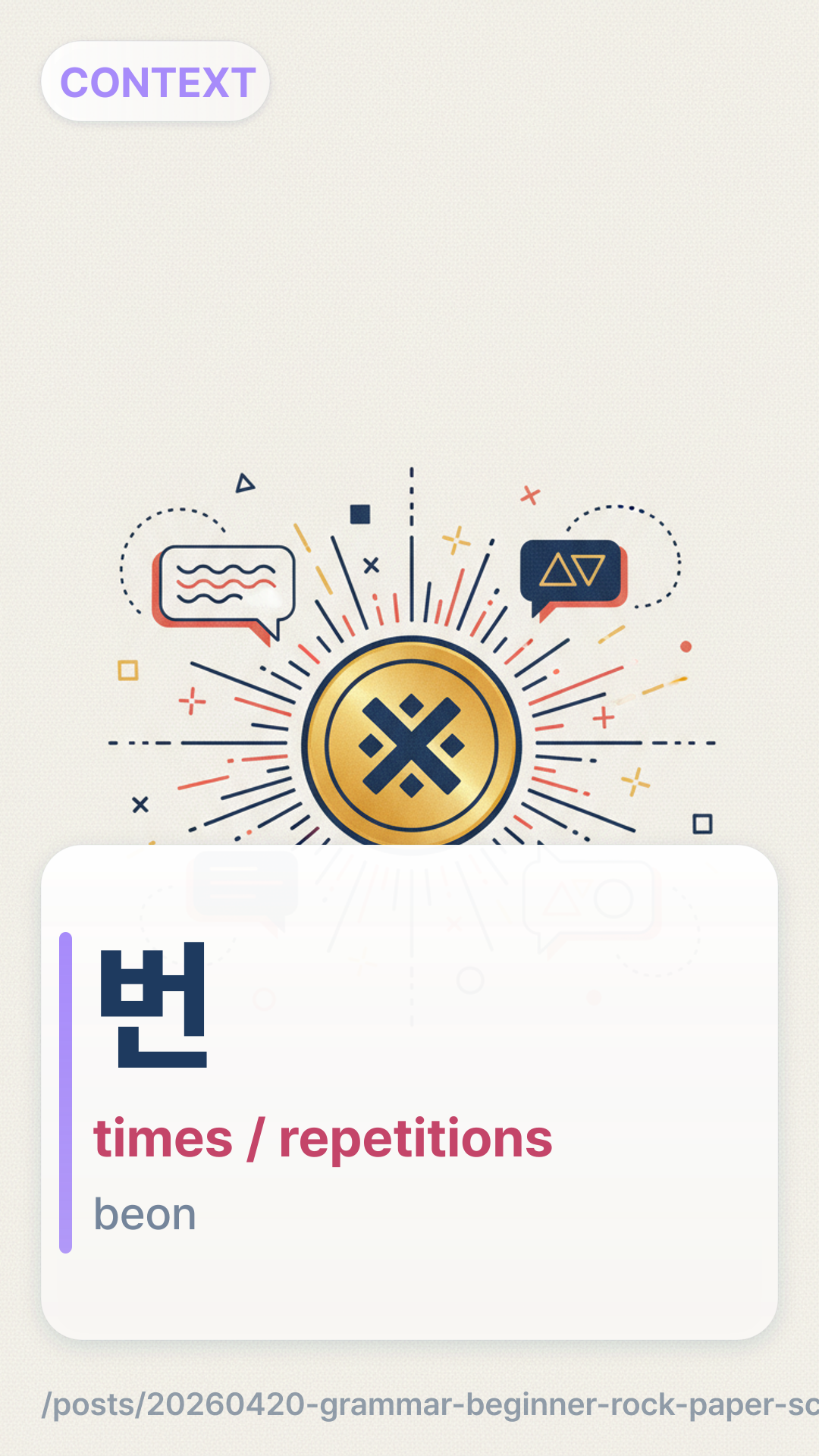
Form (how to attach)
Like 판pan, this uses Native Korean numbers: 한 번han beon, 두 번du beon, 세 번se beon.
Meaning range (what it can/can’t mean)
번beon counts the number of times an action occurs. In games, it refers to how many times you've played or how many times you've won/lost. While 판pan is the 'container' of the game, 번beon is the frequency.
Common mistakes (wrong → right)
Wrong: 가위바위보 세 번 했어요.gawibawibo se beon haesseoyo. (When you mean you played 3 full matches/sets)
Right: 가위바위보 세 판 했어요.gawibawibo se pan haesseoyo. (Use 판pan for the match itself; use 번beon for the frequency of the action).
Examples
벌써 세 번이나 졌어.beolsseo se beonina jyeosseo. — I already lost three times.한 번만 봐주세요.han beonman bwajuseyo. — Please let it slide just once.여러 번 연습했어.yeoreo beon yeonseuphaesseo. — I practiced many times.두 번 다시 안 해.du beon dasi an hae. — I'm never doing it again (twice).가위바위보 한 번 할까?gawibawibo han beon halkka? — Shall we do rock-paper-scissors once?
Decision Tree: Which number system?
When counting games, always follow this logic:
- Are you counting a round/match? Use Native Korean +
판pan. - Are you counting how many times you did it? Use Native Korean +
번beon. - Are you naming a specific round (e.g., Round 1)? Use Sino-Korean +
회hoe (e.g.,제1회je1hoe).
Mini quiz (2 minutes)
Notes:
- Q1:
판pan is correct because Baduk (Go) is a game/match. - Q2:
번beon is correct here to emphasize the frequency (five times) of the activity throughout the day.
Next steps
Convert these 5 English concepts into Korean phrases using the correct counter:
- One round of a game
- Two times (frequency)
- Three matches
- Ten times
- That round (this specific game)