Master Korean Lotto Numbers: Counting and Large Numbers
Learn how to count Korean lotto numbers and master large figures. Understand the difference between Native and Sino-Korean systems with a quiz.
Learn how to count Korean lotto numbers and master large figures. Understand the difference between Native and Sino-Korean systems with a quiz.
Many beginners struggle with when to use Native Korean numbers versus Sino-Korean numbers. A common mistake is saying 하나 번hana beon for 'one time' instead of the correct 한 번han beon. When it comes to the lottery (로또), using the wrong system makes you sound like a complete novice.
Wrong: 로또 번호 일 개rotto beonho il gae (Lotto number one piece)
Right: 로또 번호 한 개rotto beonho han gae (Lotto number one piece)
Quick cheat sheet
Expressions in this post
Form
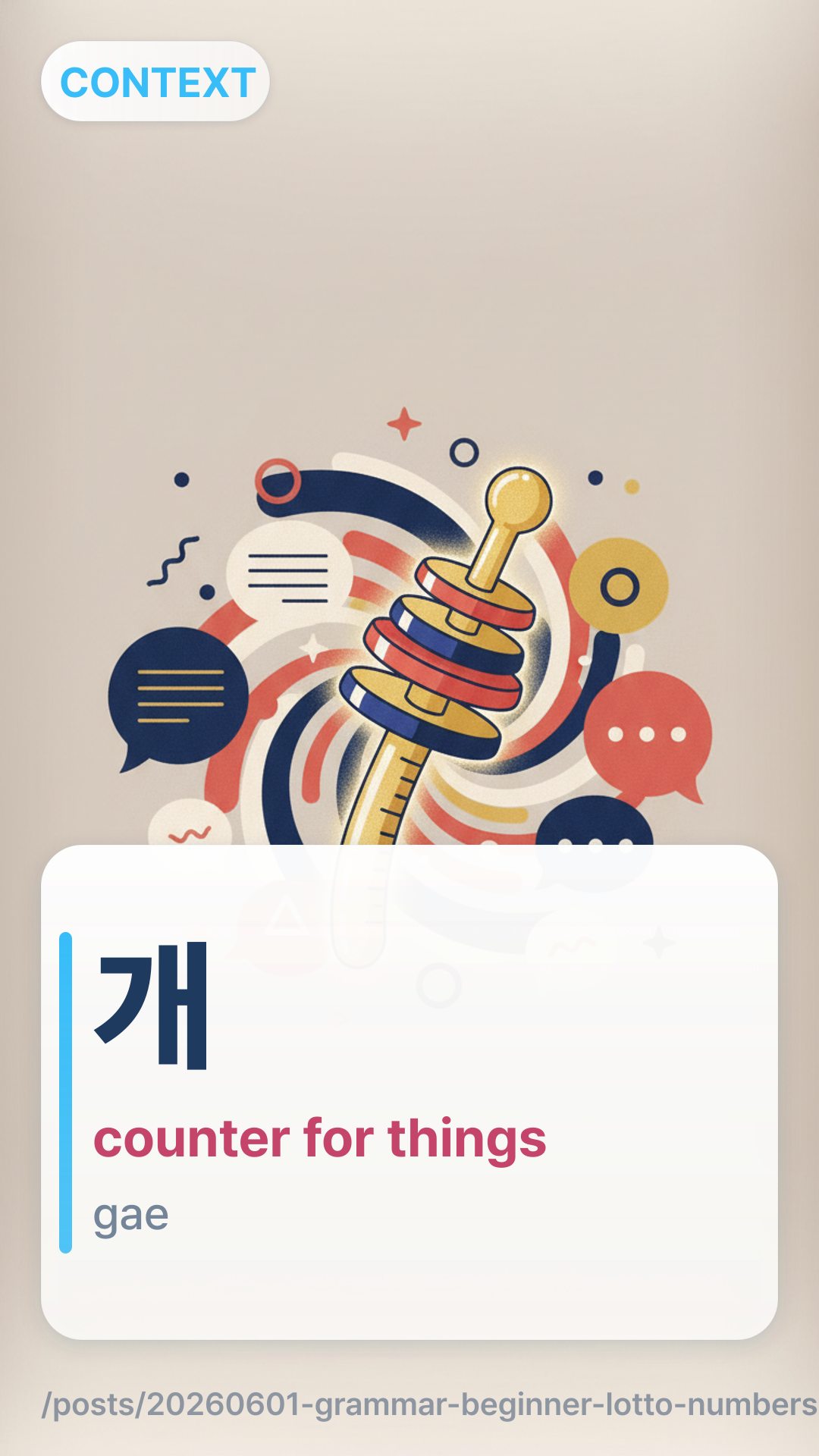
Attach 개gae after a Native Korean number. Note that 하나hana, 둘dul, 셋set, 넷net change to 한han, 두du, 세se, 네ne before a counter.
Meaning range
개gae is the most versatile counter in Korean. In the context of the lottery, it refers to the individual balls or numbers selected. While numbers on the ball themselves are Sino-Korean (1 is 일il), when you count how many numbers you got right, you use 개gae.
Register
Neutral and essential for daily life.
Common mistakes
Don't use Sino-Korean numbers with 개gae.
Wrong: 일 개il gae
Right: 한 개han gae
Examples
로또 번호 세 개 맞았어요.rotto beonho se gae majasseoyo. — I got three lotto numbers right.사과 한 개 주세요.sagwa han gae juseyo. — Please give me one apple.지우개 두 개 있어요.jiugae du gae isseoyo. — I have two erasers.몇 개 필요해요?myeot gae piryohaeyo? — How many (pieces) do you need?여섯 개 다 맞으면 1등이에요.yeoseot gae da majeumyeon 1deungieyo. — If you get all six right, it's first place.
Form
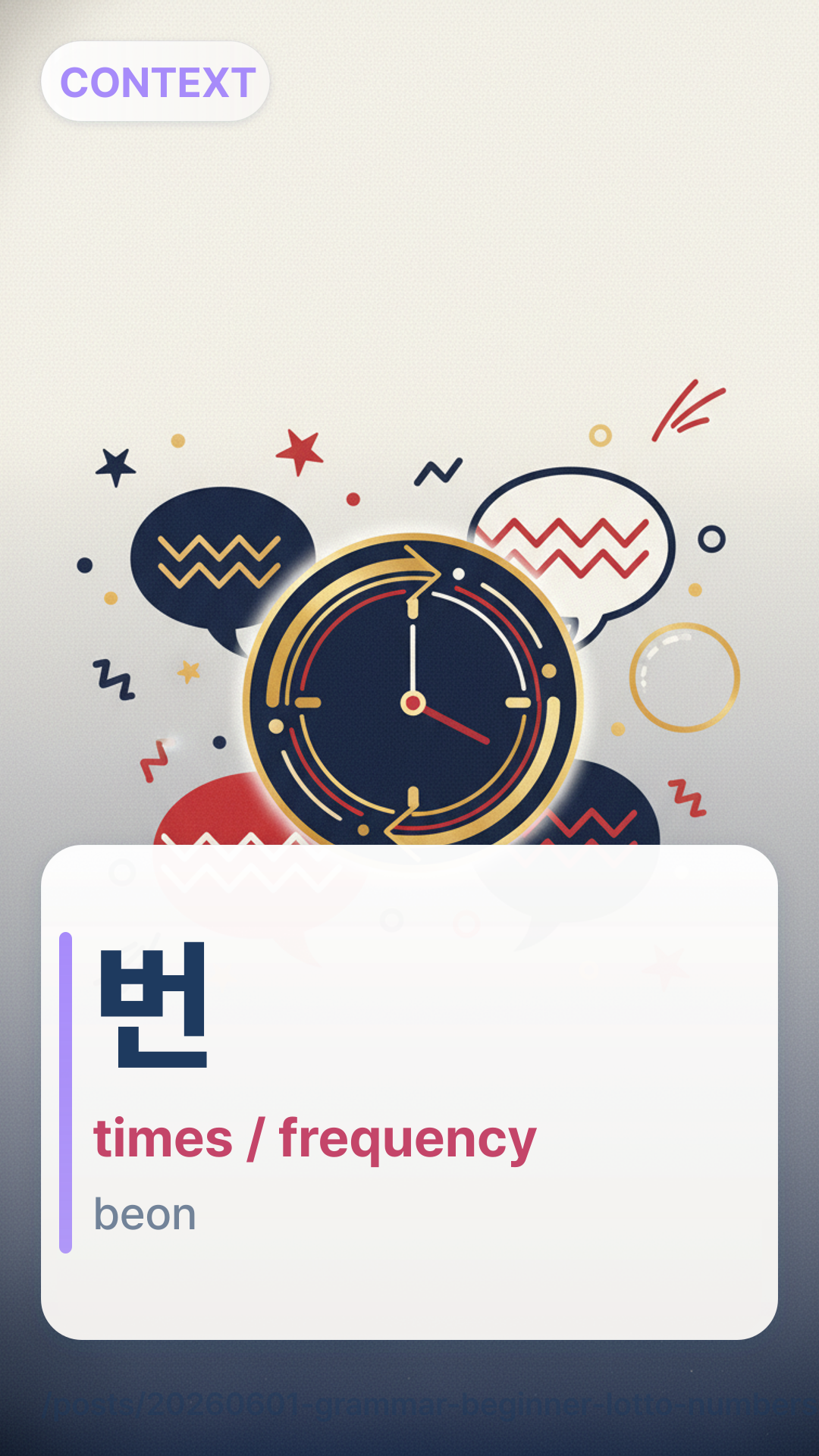
Attach 번beon after a Native Korean number. Like 개gae, the first four numbers change their form (한han, 두du, 세se, 네ne).
Meaning range
번beon counts the number of times an action occurs. In the lottery context, it's used for how many times you've played or how many times a certain number has appeared in history.
Common mistakes
Learners often confuse 번beon (times) with 번호beonho (number). 1번1beon (Number 1) uses Sino-Korean, but 한 번han beon (One time) uses Native Korean.
Examples
로또를 한 번도 안 사봤어요.rottoreul han beondo an sabwasseoyo. — I've never bought a lotto ticket even once.이번 주에 두 번 샀어요.ibeon jue du beon sasseoyo. — I bought it twice this week.세 번 시도했어요.se beon sidohaesseoyo. — I tried three times.여러 번 확인했어요.yeoreo beon hwaginhaesseoyo. — I checked it many times.한 번만 더 설명해 주세요.han beonman deo seolmyeonghae juseyo. — Please explain it one more time.
3-Step Decision Tree: Which Number System?
- Is it a sequence/label? (e.g., Room 101, Phone number, Bus 702) -> Use Sino-Korean (
일, 이, 삼...il, i, sam...). - Are you counting items or times? (e.g., 3 apples, 2 times) -> Use Native Korean (
하나, 둘, 셋...hana, dul, set...) + Counter. - Is it a large currency/math figure? (e.g., 50,000 won) -> Use Sino-Korean.
The Zero Trap: 공 vs 영
- Use
공gong (Gong) for phone numbers and lottery ball sequences (like a code). - Use
영yeong (Yeong) for math, temperature, and points (0-0 score).
Mini quiz (2 minutes)
Notes:
- Q1: Use
한 번han beon because it refers to the frequency of the action (buying). - Q2: Use
일 번il beon because it is a label/sequence number (Number 1). - Q3: Use
한 개han gae because you are counting the quantity of numbers you matched.
Next steps
Practice by converting these 5 sentences into Korean using the correct number system:
- I have four lottery tickets.
- I checked the numbers five times.
- Please give me two numbers.
- I won the lottery one time.
- I need six numbers to win.