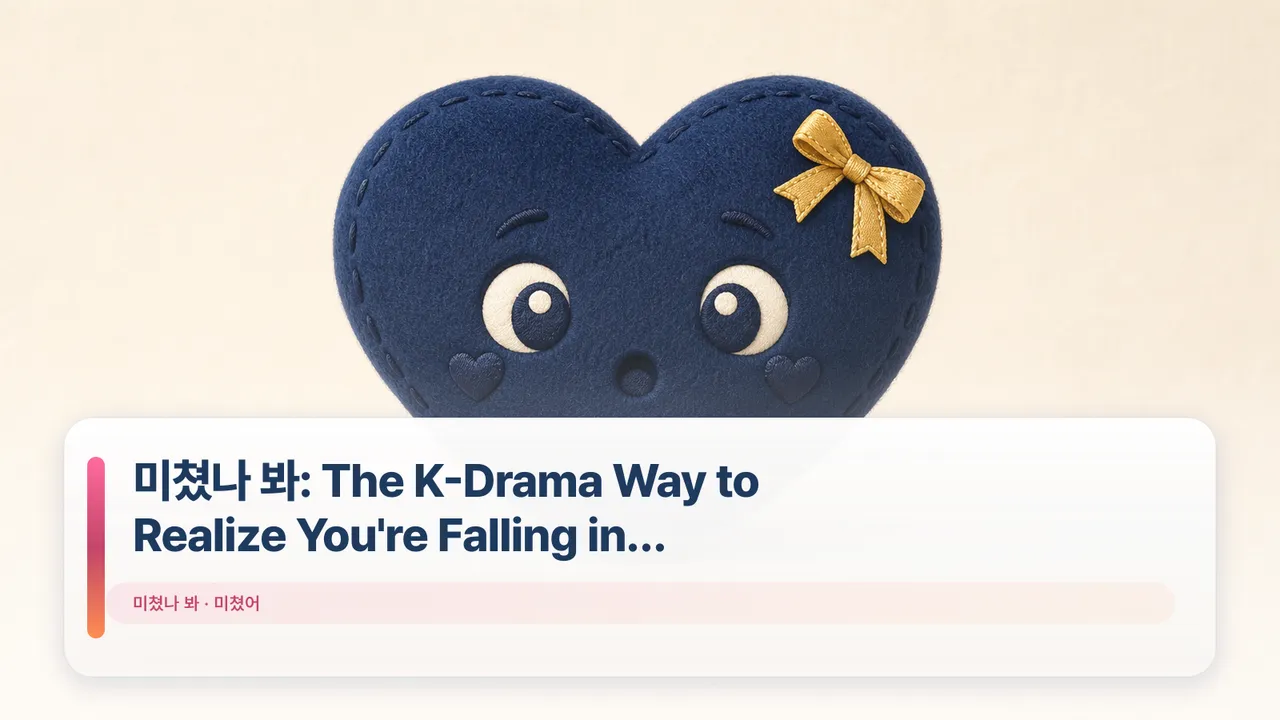
미쳤나 봐: The K-Drama Way to Realize You're Falling in Love
Master 미쳤나 봐 and 미쳤어 - essential K-drama expressions for romantic realizations and shock. Learn the nuance, tone, and usage with our quiz.
Master 미쳤나 봐 and 미쳤어 - essential K-drama expressions for romantic realizations and shock. Learn the nuance, tone, and usage with our quiz.
Discover how K-drama leads use this specific phrase to signal a sudden, heart-fluttering realization of romantic feelings.
You’ve seen the scene: the lead character is lying in bed, staring at the ceiling, thinking about a small gesture from their rival. Suddenly, they sit up, clutch their chest, and whisper to themselves, "내가 진짜 미쳤나 봐..." (I must really be crazy). It’s not a medical diagnosis; it’s the classic K-drama trope of realizing you've caught feelings against your better judgment.
Quick cheat sheet
Expressions in this post
Quick meaning
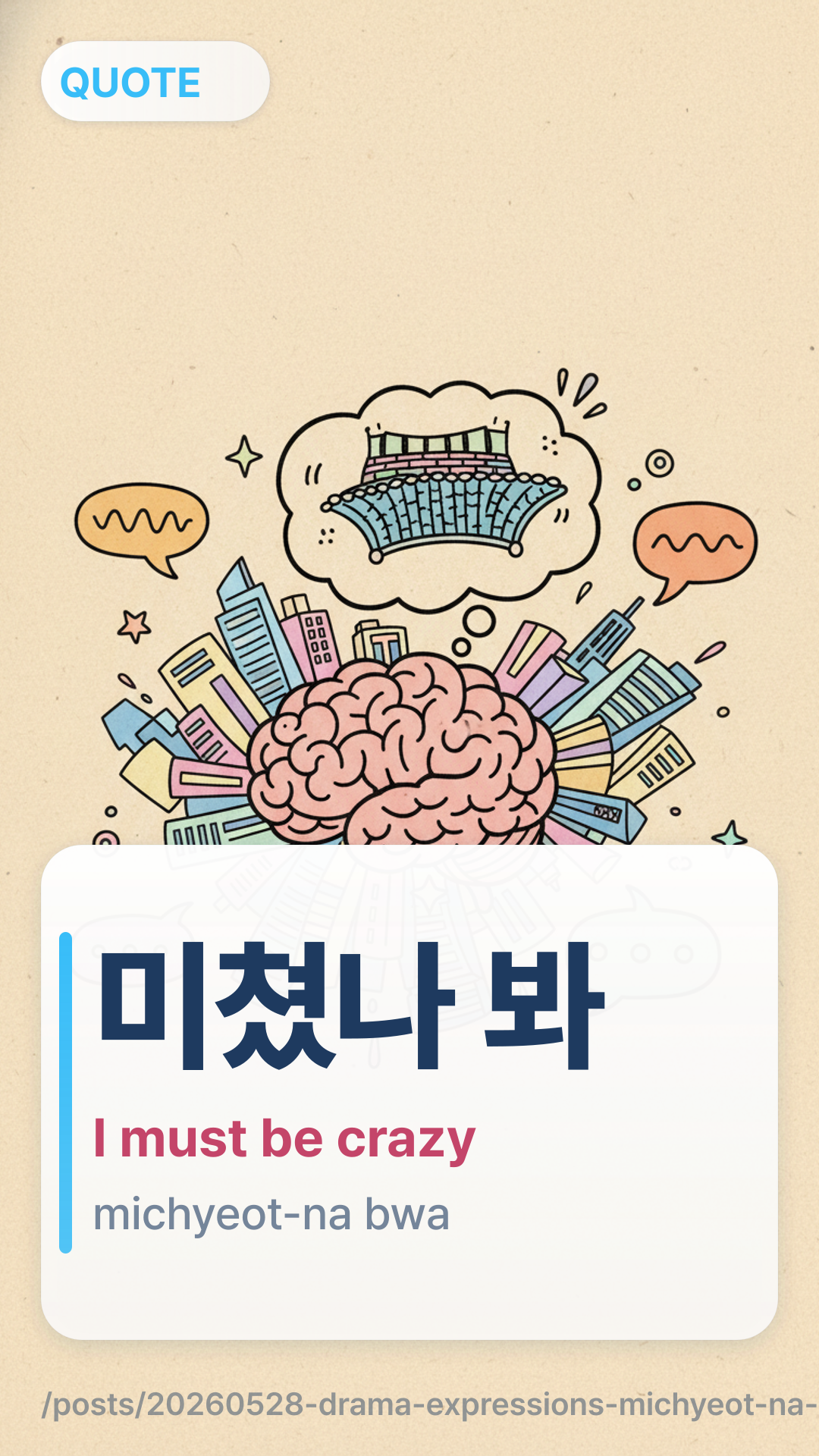
"I must be crazy" or "I think I've lost it."
Nuance (how it feels)
This is the language of internal monologue. The suffix -나 봐-na bwa adds a layer of observation or conjecture. Instead of saying "I am crazy," you are saying "Based on my weird behavior (like smiling at my phone), I appear to be going crazy." In dramas, this is the 'Self-Awareness Scale' moment where a character moves from denial to acceptance of a crush.
Common trap (misunderstanding)
Don't use this to describe someone else's permanent mental health condition. It is almost always used for temporary states of mind or specific, irrational actions.
Tone ladder (risky → safer)
- 미쳤냐? (Risky/Aggressive) — Are you crazy? (To a friend)
- 미쳤나 봐 (Casual/Safe) — I must be crazy. (Self-talk)
- 제정신이 아닌가 봐요 (Polite/Safe) — I think I'm not in my right mind.
Minimal pairs (A vs B)
미쳤어michyeosseo (A): A definitive conclusion. "That's insane."미쳤나 봐michyeotna bwa (B): A soft realization. "Wait, am I actually doing this?"
Examples (chat)
나 진짜 미쳤나 봐. 걔 생각만 해.na jinjja michyeotna bwa. gyae saenggakman hae. — I must be crazy. I only think about them.비 오는데 우산도 안 쓰고... 나 미쳤나 봐.bi oneunde usando an sseugo... na michyeotna bwa. — It's raining and I didn't even use an umbrella... I must be crazy.
Quick meaning
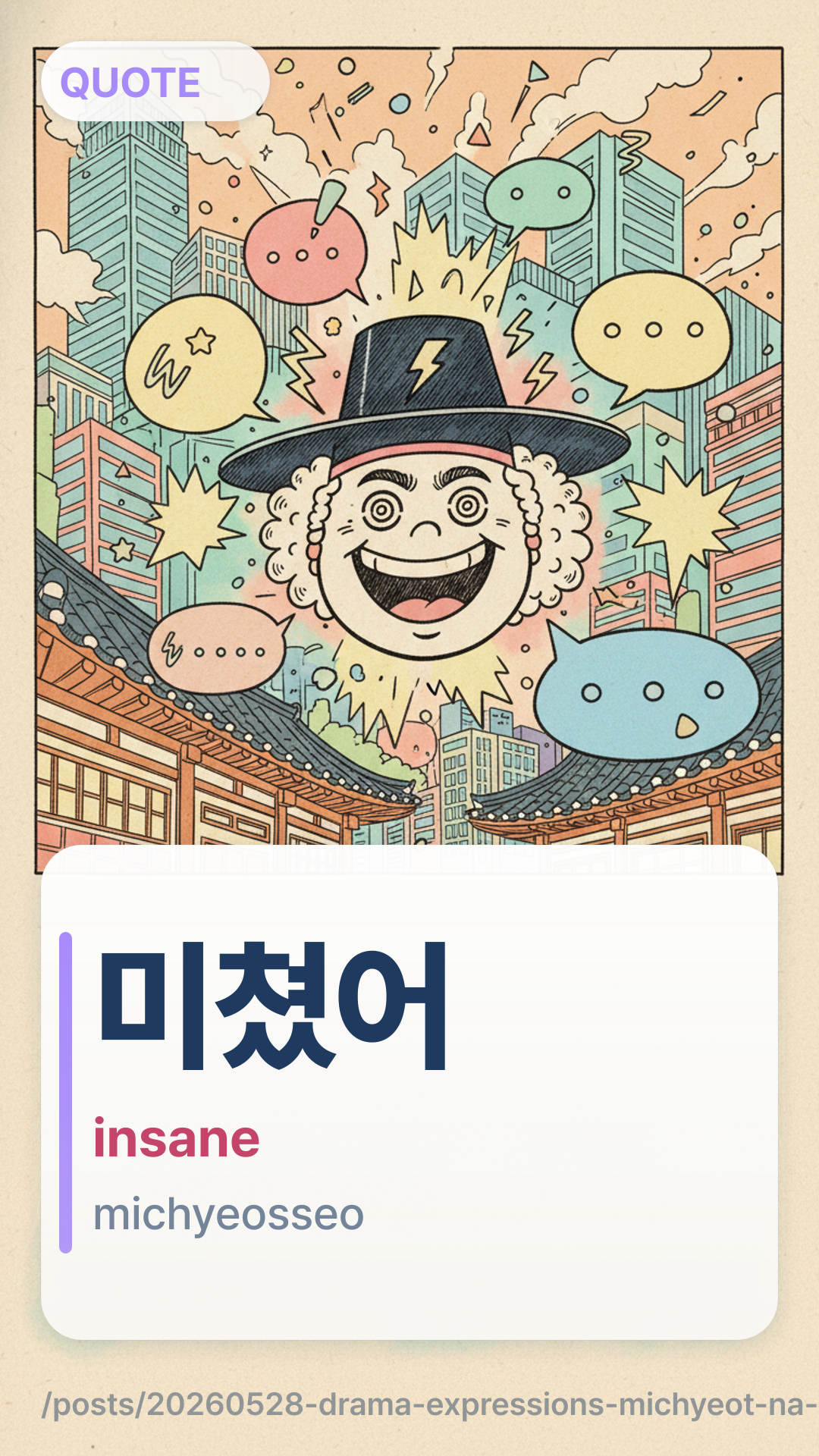
"Crazy," "Insane," or "Out of one's mind."
Nuance (how it feels)
This is much more direct and versatile than 미쳤나 봐michyeotna bwa. It can be used to criticize someone else's wild behavior, express disbelief at a situation, or even compliment something that is "insanely" good. In a serious confession scene, a character might say 너 미쳤어?neo michyeosseo? (Are you crazy?) when someone takes a big risk for them.
Common trap (misunderstanding)
Using this toward a superior or a stranger is extremely offensive. Even if you mean "That's crazy!" in a positive way, the word itself carries a heavy social weight.
Tone ladder (risky → safer)
- 미쳤어 (Casual) — You're crazy / It's crazy.
- 대박이다 (Neutral) — That's amazing/wild.
- 정말 대단해요 (Polite) — That is truly impressive.
Minimal pairs (A vs B)
미쳤어michyeosseo (A): Focuses on the external action. "That move was crazy."미쳤나 봐michyeotna bwa (B): Focuses on the internal feeling. "I feel crazy for liking that."
Examples (chat)
와, 이 날씨 미쳤어.wa, i nalssi michyeosseo. — Wow, this weather is insane.너 진짜 미쳤어? 왜 그랬어?neo jinjja michyeosseo? wae geuraesseo? — Are you seriously crazy? Why did you do that?
Scene Context: The Decision Tree
When should you use which? Follow this logic:
- Are you talking to yourself about a weird feeling? -> Use
미쳤나 봐michyeotna bwa. - Are you reacting to a shocking news story? -> Use
미쳤어michyeosseo. - Are you questioning a friend's bad idea? -> Use
미쳤어?michyeosseo? (with rising intonation).
Copy/paste mini-dialogues (with EN)
Mini quiz (2 minutes)
Notes:
- Q1:
미쳤나 봐michyeotna bwa is correct because the speaker is reflecting on their own surprising behavior (overspending). - Q2:
미쳤어michyeosseo is correct because it is a direct confrontation of someone else's reckless action.
Next steps
- Watch a romantic comedy K-drama and count how many times the lead says
미쳤나 봐michyeotna bwa during the 'denial' phase of their crush. - Try writing a sentence about a time you did something irrational (like buying 10 albums) using the realization form.
- Practice the intonation:
미쳤나 봐michyeotna bwa usually ends with a falling, sigh-like tone.