Korean BBQ vs. Korean Fried Chicken: The Two Menus Americans Love
Korean BBQ and Korean fried chicken are the two Korean meals most likely to show up on an American dinner table. They solve opposite problems — BBQ is slow and communal, chicken is fast delivery and beer. Here's the real difference, plus what to order at each.
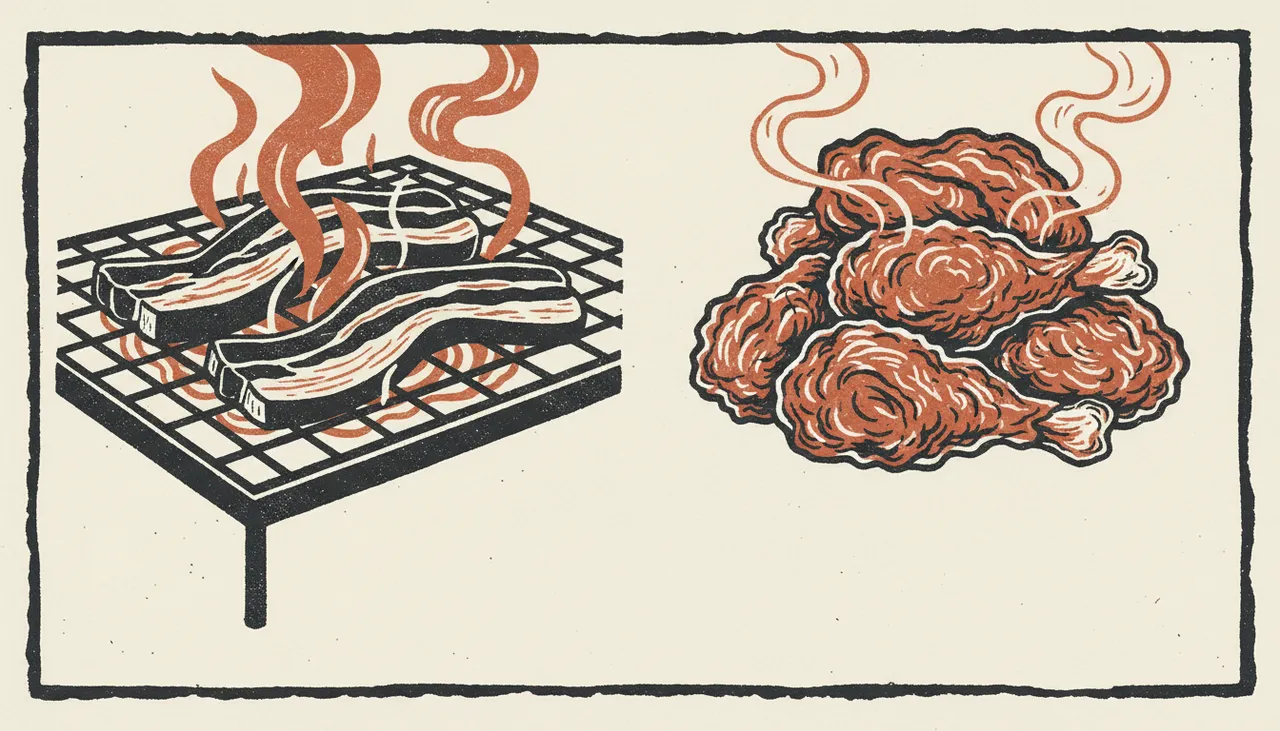
Korean BBQ and Korean fried chicken are the two Korean meals most likely to show up on an American dinner table. They solve opposite problems — BBQ is slow and communal, chicken is fast delivery and beer. Here's the real difference, plus what to order at each.
Korean BBQ and Korean fried chicken are, between them, responsible for like 80% of Americans' exposure to Korean food. Both are legitimately great. Both are very Korean in different ways. But they solve completely opposite problems: one is a slow hands-on group dinner, the other is 20-minute delivery for a small couch hang.
I've eaten both at embarrassing scale, on two continents. BBQ basements in Hongdae. A chimaek place in Busan with a friend who studied there in 2019. A 치킨 delivery in Koreatown on 6th Street in LA at 11pm. And a samgyeopsal joint in Hannam that overcharged me 18,000원 for a side of kimchi I didn't order. Here's the honest breakdown.
Korean BBQ — the tabletop grill thing
At a Korean BBQ place, the table has a gas or charcoal grill built into the middle. You order raw meat by the cut. It arrives on a plate. You grill it yourself. Or in a lot of places, an auntie comes by with tongs and does it for you, which is the superior experience because she knows exactly when to flip each piece and she will save you from yourself.
The meal unfolds in stages. First 반찬 (banchan — little side dishes) and dipping sauces hit the table. Then the meat. Then somewhere around the end, stew or cold noodles to close it out. You're looking at 90 minutes minimum. Not a meal you rush.
The cuts to know:
- 삼겹살 (samgyeopsal) — unmarinated pork belly. Three thick layers of fat and meat. This is the one. If you order just one thing at a BBQ place, order this.
- 목살 (moksal) — pork shoulder neck. Leaner than samgyeopsal, more meaty, less fat. A nice counterbalance if you're ordering for two.
- 갈비 (galbi) — marinated beef short rib. Sweet, savory, tender. This is the sugary pear-puree marinade cut. It's great but it's rich, so one order splits between two people fine.
- 소고기 등심 (sogogi deungsim) — beef loin, usually unmarinated. Leaner and expensive.
What makes it "Korean" — beyond the meat itself — is the wrap. You grab a lettuce leaf, put a little rice on it, add meat, a tiny dab of ssamjang, a garlic slice, maybe a grilled chili. Fold it up. Shove the whole thing in your mouth in one bite. Koreans are actually strict about this — the wrap-in-one-bite thing isn't a suggestion, it's how the flavors are supposed to land together.
Korean fried chicken — crunchy, saucy, delivered
Korean fried chicken (Koreans shorten it to 치킨 or the phrase 치맥 — chi-maek, short for chicken + 맥주, beer) is a different animal from American Southern fried chicken. The coating is thinner. The crunch is louder and lasts longer. The chicken is fried twice — once to cook, once to crisp — which gives it that glassy shatter you don't get in Nashville hot chicken or KFC.
American KFC vs Korean KFC is actually a running joke in Korea. A Kyochon store sits next to a Texas Chicken in the Seoul airport and they're not even the same food category.
What to order:
- 후라이드 (huraideu) — plain fried. Salt only. Lets the batter do the talking. The purist choice.
- 양념 (yangnyeom) — the sweet-spicy red sauce. Sticky, mild heat, what most people think of as "Korean fried chicken."
- 간장 (ganjang) — soy-garlic sauce. My personal favorite. Savory, deep, a little sweet.
- 반반 (banban) — literally "half-and-half." Half plain, half sauced. The safe first order for a group — everyone tries everything.
- 파닭 (padak) — fried chicken topped with a mountain of shredded scallions. Sounds weird, tastes incredible.
Standard sides: cubed pickled radish (치킨무, chikin-mu), sometimes a small salad, and beer. The chimaek formula is chicken + beer + evening, and it's one of the most important social rituals in modern Korean city life.
Delivery in Seoul is ridiculous. Under 45 minutes anywhere. I had chicken arrive in Hongdae in 22 minutes once during a Tuesday night downpour. That speed is not a feature of the American version.
What's actually "Korean" about each
The BBQ is Korean because of the wrap. Take the wrap out of the equation and it's just grilled meat. Put it back in and it becomes its own cuisine — the ssamjang, the garlic, the banchan, the lettuce cold against the hot meat. That building-the-bite process is the whole point.
The fried chicken is Korean because of the technique plus the ritual. The double-fry method is a Korean invention. So is the expectation that you order chicken with beer and share it with two or three people on a weeknight. Nobody in Korea orders fried chicken for one. It's a social-contract food.
Also: Koreans eat fried chicken with 젓가락 (chopsticks) more often than you'd think. Keeps your fingers clean for the beer.
Which one to pick when
Quick decision guide based on what I've actually seen work.
- Date, first-time, 2 people: fried chicken. Less intimidating than BBQ. Less smoke in your hair. Shareable.
- Group of 4 or more, you want an event: BBQ. The grilling is participatory. It gives everyone something to do.
- Late night, small apartment, ordered in: chicken. You can't do BBQ delivery. The meat needs the grill.
- Introducing a Western friend who's never had Korean food: BBQ. It's the more memorable experience, even if it's pricier.
- Drinking with coworkers: chicken. Chimaek is literally optimized for this. BBQ with coworkers is also great but tends to go long.
A few more useful Korean food words
Not enough of these are on the main menu, but you'll hear them:
- 고기 (gogi) — meat
- 맥주 (maekju) — beer
- 소주 (soju) — Korean distilled liquor, the BBQ drink of choice
- 배달 (baedal) — delivery. Useful to know when a delivery app asks.
- 양념 (yangnyeom) — seasoning, but also the name of the sweet-spicy chicken sauce.
FAQ
Is Korean BBQ or fried chicken spicier? Mostly neither. BBQ meat itself is salty-sweet, not spicy. 양념 chicken sauce has a mild heat but nothing that'll wreck you. Korean food as a genre is spicier than either of these — 김치찌개 and 떡볶이 will challenge your tolerance more than the BBQ menu will.
How expensive is Korean BBQ in the US? Varies wildly. A solo portion of 삼겹살 in LA or New York runs $18-28. A group dinner for 4 people with meat, banchan, stew, and drinks will be $180-280 easily. Korea itself is cheaper — maybe 40% less — but still not "cheap food."
Can I do Korean BBQ at home? Yes, with a tabletop grill or a cast iron pan. The meat is the easy part. The banchan (kimchi, ssamjang, pickled radish) is what takes the effort. Paris Baguette and H-Mart both sell decent premade ssamjang.
Is fried chicken actually Korean or is it just Korean-style American food? It's Korean. The introduction happened during the Korean War with US military presence, but the double-fry method, the sauce palette, and the chimaek ritual are all Korean innovations. It's as Korean now as the BBQ is.
Related on Korean TokTok
Quick cheat sheet
Expressions in this post