Korean Food at Korean Restaurants: A First-Timer's Order Guide
Walking into a Korean sit-down restaurant without a Korean friend is disorienting the first time. Side dishes arrive before you order. The menu has three categories you don't recognize. Here's what I wish someone had told me — what to point at, what to actually order, and the phrase that saved me.
Walking into a Korean sit-down restaurant without a Korean friend is disorienting the first time. Side dishes arrive before you order. The menu has three categories you don't recognize. Here's what I wish someone had told me — what to point at, what to actually order, and the...
Here's the restaurant experience that changed how I eat Korean food. It was 2021, a small place near Anguk station in Seoul — one of those 식당 with no English menu, maybe 12 tables, plastic stools. I sat down, and before I could say anything, an ajumma brought out six little plates of food I hadn't ordered. Pickled radish, seasoned spinach, kimchi, a tiny mound of anchovies. I thought maybe she'd given me someone else's order.
She hadn't. That was the 반찬 (banchan), and it was free. Also: automatically refillable. I had no idea.
If you're walking into your first real Korean restaurant — not a BBQ place, not a Korean-fusion spot in Brooklyn, but an actual sit-down Korean kitchen — there's a structure to the meal and a set of things worth knowing before the menu arrives. This is that set.
The three-part structure, and why 반찬 is free
A Korean meal is built around three elements.
First, 밥 (bap). Rice. A bowl per person, usually in a stainless steel dish with a matching lid. In Korean, "bap" also means "meal" in general — the standard greeting 밥 먹었어요?bap meogeosseoyo? ("Did you eat rice?") is really "Did you eat?"
Second, a soup or stew — 국 (guk) if it's individual, 찌개 (jjigae) if it's a shared bubbling pot. Doenjang jjigae, kimchi jjigae, sundubu jjigae — the stew is usually the showpiece.
Third, the 반찬. Usually 4 to 8 small plates, rotating by season and restaurant. The banchan is not a side order. It's part of the meal. It comes automatically. It refills on request. Most foreigners I've brought to Korean restaurants are stunned when I wave my empty kimchi plate at the server and another one materializes two minutes later. No charge. This isn't generosity; it's just how Korean meals work.
Plus you order a main — grilled meat, a rice bowl, noodles, a more elaborate stew. The main is what appears on the menu. Everything else arrives around it.
What to actually order as a first-timer
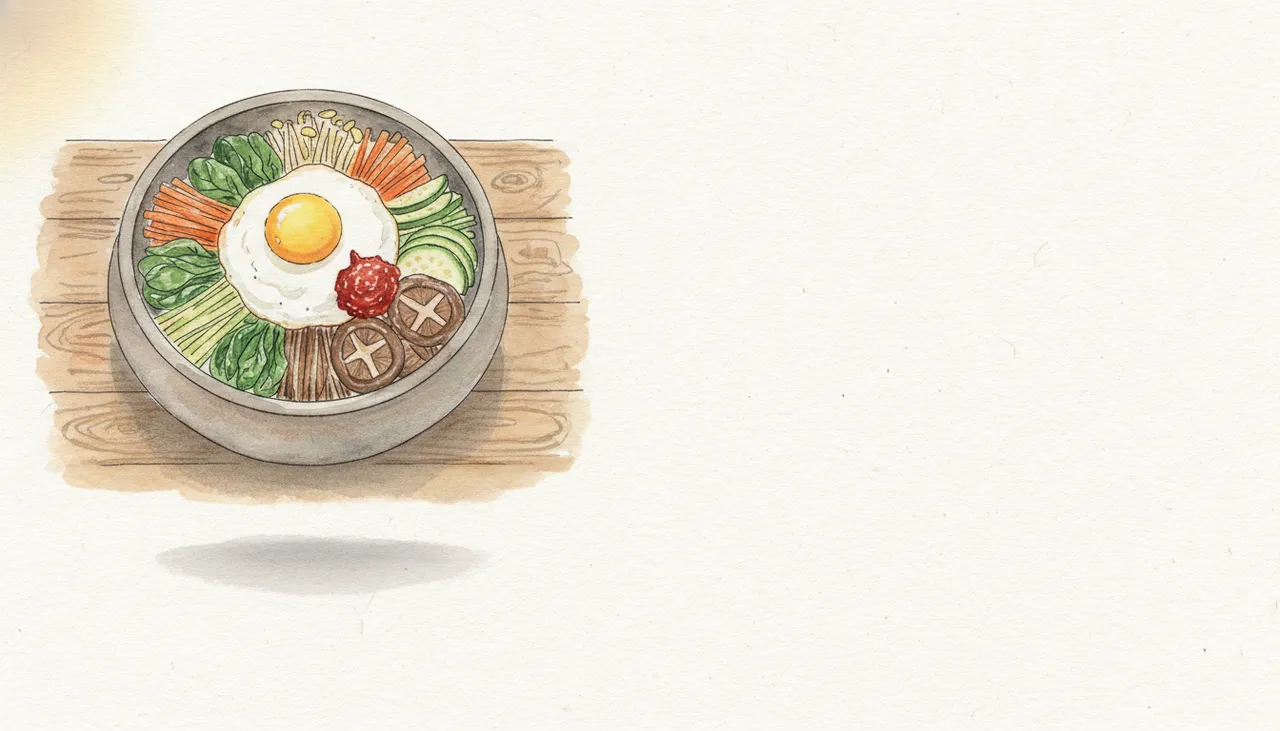
I have a standing rule for friends visiting Korea for the first time: if the restaurant looks like a home kitchen, order 비빔밥 (bibimbap). It's nearly impossible to mess up and it shows you the food in its purest form — rice, veg, a fried egg, gochujang, sesame oil, mixed all together by you at the table.
Beyond that, here's the rotation I'd send you through in your first week:
- 비빔밥 — mixed rice bowl with vegetables and egg. The safe default anywhere. If it's in a sizzling stone bowl (돌솥비빔밥), even better — the rice at the bottom crisps up while you eat.
- 김치찌개 (kimchi jjigae) — kimchi stew. Punchy, sour, red. Goes with rice. If you like kimchi, this is its ultimate form.
- 된장찌개 (doenjang jjigae) — fermented soybean stew. The "Korean home cooking" stew. Mellow, earthy, deeply savory. This is the one I keep going back to — probably 60% of my Korean restaurant meals end with 된장찌개. There's a tiny place in Jongno where the owner ages her doenjang for two years and I swear I can taste every month.
- 불고기 (bulgogi) — thin beef in a sweet-soy marinade. Always a crowd-pleaser.
- 김밥 (gimbap) — Korean-style seaweed rice roll. Light. Great solo lunch.
- 칼국수 (kalguksu) — hand-cut wheat noodles in broth. Cheap, filling, no surprises.
If you want to feel like you're eating the food a Korean grandmother cooks for her family, get 된장찌개 with a bowl of rice and whatever banchan comes out. That's the meal.
The phrases that actually get you through
You don't need to speak Korean to eat at a Korean restaurant in Seoul. But five phrases will make your life easier. Memorize these; you'll use them constantly:
이거 주세요.igeo juseyo. — "This one, please." (Point at the menu, then say it.)물 좀 주세요.mul jom juseyo. — "Some water, please." Korean restaurants don't always bring water by default.맵지 않게 해주세요.maepji ange haejuseyo. — "Please make it not spicy." If you don't do spice, say this early.반찬 더 주세요.banchan deo juseyo. — "More side dishes, please." Works every time.계산할게요.gyesanhalgeyo. — "I'll pay." You usually pay at the counter, not the table.
The one that saved me most was 맵지 않게 해주세요maepji ange haejuseyo. Early on I ordered what I thought was a mild stew at a place in Hongdae and it was, genuinely, the spiciest thing I've ever eaten. I was crying at the table. The owner was laughing. Now I ask first.
The unwritten rules
A few table manners that matter more than most guides tell you:
Don't pick up your rice bowl. In China and Japan, it's normal. In Korea, the bowl stays on the table and you use the spoon. Lifting it reads as weird. Chopsticks handle the banchan and noodles, spoon handles rice and stew. Don't mix the two for rice.
Don't jab your chopsticks straight down into your rice. That's how rice is offered to the dead at funerals. Flat on the side of the bowl, or just on the table.
And if you're eating with someone older than you, wait for them to pick up their spoon first. This is a small thing that matters a lot.
FAQ
Do I tip at a Korean restaurant? No. Tipping isn't a thing in Korea. Don't leave money on the table — servers will chase you down to return it.
What's the difference between a 한식당 and a 분식? 한식당 (hansikdang) is a sit-down Korean restaurant with a full menu. 분식 (bunsik) is cheaper street-snack-style food — tteokbokki, gimbap, ramyeon. Different vibe, different price point, both great.
Can I eat at a Korean place alone? Yes, but certain dishes are structured for two or more (BBQ especially). Bibimbap, noodles, and most rice bowls are totally fine solo.
Is there a dish for people who don't like spicy food? Lots. 갈비탕 (galbitang, beef short rib soup), 비빔밥 without the gochujang, 잡채 (japchae, glass noodles), bulgogi. Korean food ≠ spicy food.
Related on Korean TokTok
- K-Drama Korean Phrases (Top 100) — half of K-drama dinner scenes are at restaurants
- Korean Slang Dictionary — "맛있다!" is the tip of that iceberg
Quick cheat sheet
Expressions in this post