Master Hangeul Batchim and Korean Politeness Levels
By Yijun Kim, Native Korean speaker and creator of Korean TokTokPublished March 1, 2026
Review the 7 final consonant sounds and master the politeness ladder from -아요 to -습니다. Perfect your Korean basics with our quiz!
TL;DR
Review the 7 final consonant sounds and master the politeness ladder from -아요 to -습니다. Perfect your Korean basics with our quiz!
Master the 7 representative Batchim sounds and navigate the Korean politeness ladder with confidence.
Weekly recap (60 seconds)
- Mastered the 7 representative sounds of Batchim (final consonants) to improve pronunciation accuracy.
- Distinguished between the standard polite
-아요/어요-ayo/eoyo and the high-formal-습니다-seupnida endings. - Practiced identifying when to use casual
반말banmal versus polite존댓말jondaetmal based on social hierarchy. - Learned how to introduce yourself formally in professional settings.
- Explored the nuance of the particle
이/가i/ga versus은/는eun/neun in basic sentence structures.
Flashcards (10)
List all 10 expressions with a one-line meaning each:
ㄱㄱ = The 'k' sound used for final consonants ㄱ, ㄲ, and ㅋ.ㄴㄴ = The 'n' sound used for the final consonant ㄴ.ㄷㄷ = The 't' sound representing ㄷ, ㅅ, ㅆ, ㅈ, ㅊ, ㅌ, and ㅎ.ㄹㄹ = The 'l' sound used for the final consonant ㄹ.ㅁㅁ = The 'm' sound used for the final consonant ㅁ.ㅂㅂ = The 'p' sound representing ㅂ and ㅍ.ㅇㅇ = The 'ng' sound used for the final consonant ㅇ.-아요/어요-ayo/eoyo = The standard polite ending used in daily life with equals or elders.-습니다-seupnida = The high-formal ending used in the military, news, or formal presentations.안녕하십니까annyeonghasipnikka = The most formal version of 'Hello' used in professional greetings.
Politeness Decision Tree
To choose the right level, ask yourself:
- Is the person older or higher rank?
- Yes -> Use
-습니다-seupnida (Formal) or-아요/어요-ayo/eoyo (Polite). - No -> Go to question 2.
- Yes -> Use
- Are you close friends?
- Yes -> Use
반말banmal (Casual). - No -> Use
-아요/어요-ayo/eoyo (Polite).
- Yes -> Use
Mini quiz (10 questions)
Fill in the blank with one of: ㄱㄱ, ㄴㄴ, ㄷㄷ, ㄹㄹ, ㅁㅁ, ㅂㅂ, ㅇㅇ, -아요/어요-ayo/eoyo, -습니다-seupnida, 안녕하십니까annyeonghasipnikka
- The final consonant in '국' is pronounced as the representative sound
___. - The final consonant in '문' is pronounced as the representative sound
___. - The final consonants 'ㅅ, ㅈ, ㅊ' all share the representative sound
___. - The final consonant in '물' is pronounced as the representative sound
___. - The final consonant in '엄마' (the first syllable) is
___. - The final consonant in '입' is pronounced as the representative sound
___. - The 'ng' sound at the end of '강' is represented by
___. - When talking to a stranger on the street, you should use the ending
___. - When giving a formal speech at a company meeting, use
___. - To greet a CEO for the first time, you should say
___.
Answers:
ㄱㄱㄴㄴㄷㄷㄹㄹㅁㅁㅂㅂㅇㅇ-아요/어요-ayo/eoyo-습니다-seupnida안녕하십니까annyeonghasipnikka
Notes:
- Q1:
ㄱㄱ is the representative sound for ㄱ, ㄲ, and ㅋ at the end of a syllable. - Q2:
ㄴㄴ is the only consonant that produces the 'n' sound in the batchim position. - Q3:
ㄷㄷ is the 'sink' for many consonants including ㅅ, ㅈ, and ㅊ when they are at the bottom. - Q4:
ㄹㄹ produces a soft 'l' sound, never a rolling 'r' at the end of a syllable. - Q5:
ㅁㅁ is the nasal 'm' sound found in words like '엄마' or '마음'. - Q6:
ㅂㅂ represents both ㅂ and ㅍ in the final position, sounding like a 'p'. - Q7:
ㅇㅇ only makes the 'ng' sound when it is at the bottom; at the top, it is silent. - Q8:
-아요/어요-ayo/eoyo is the 'safe' default for most social interactions in Korea. - Q9:
-습니다-seupnida conveys a high level of respect and professionalism required in business. - Q10:
안녕하십니까annyeonghasipnikka is the standard formal greeting for high-stakes first encounters.
Next steps
- The Mirror Drill: Record yourself saying '밥' and '밖'—ensure the final consonant 'stop' sounds identical.
- The Switch: Take a simple sentence like '밥을 먹어요' and rewrite it into the formal '-습니다' form.
- Observation: Watch the first 5 minutes of a K-drama and count how many times characters use '-요' versus '-니다'.
Quick cheat sheet
Expressions in this post

#1cultureLv 1
ㄱ
k
k-sound batchim
The representative sound for ㄱ, ㄲ, and ㅋ in the final position. It is an unreleased 'k' sound.
국
guk
Soup
밖
bak
Outside
#2cultureLv 1
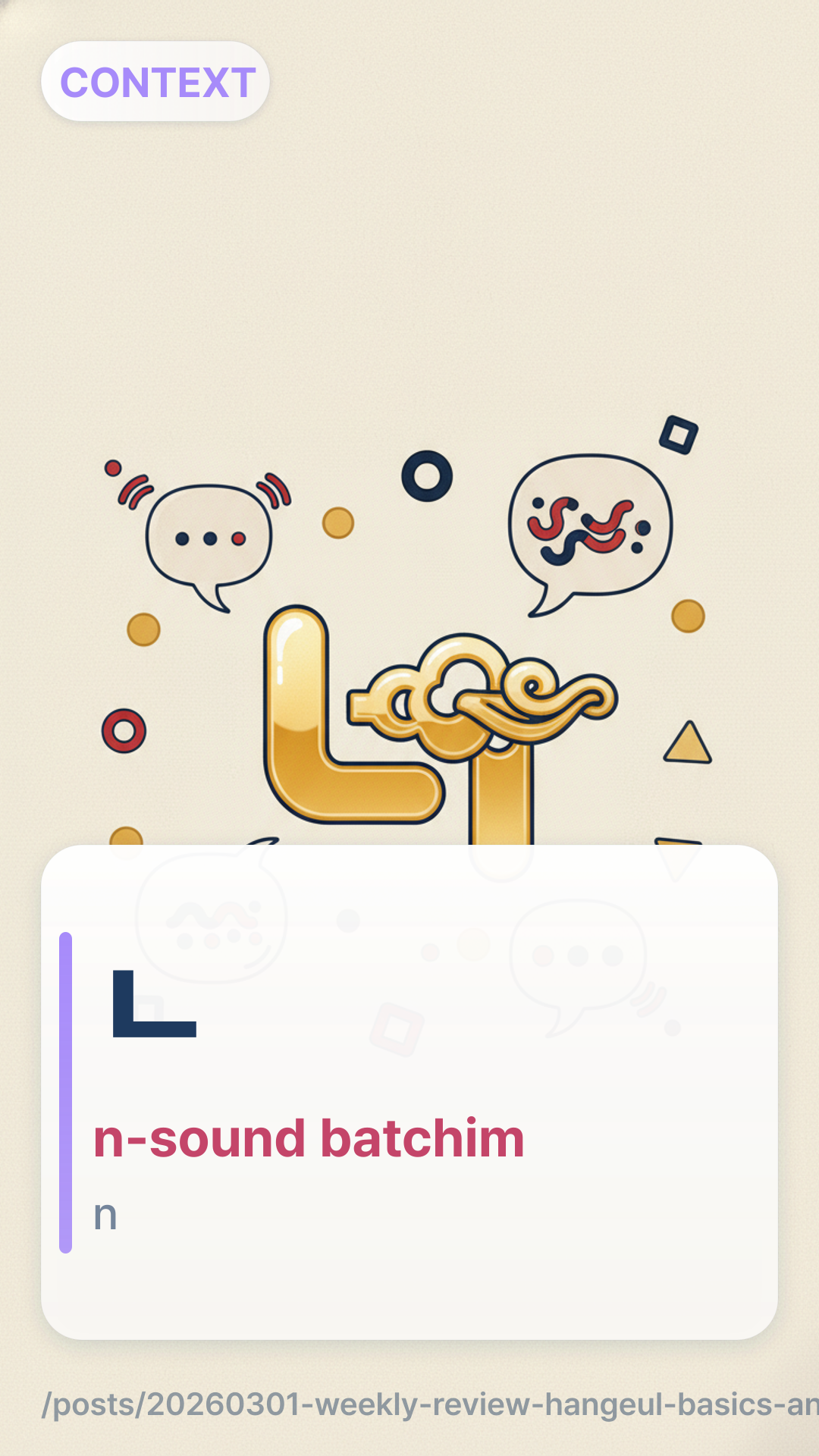
ㄴ
n
n-sound batchim
The representative sound for ㄴ in the final position, similar to the English 'n' in 'sun'.
문
mun
Door
산
san
Mountain

#3cultureLv 1
ㄷ
t
t-sound batchim
The representative sound for ㄷ, ㅅ, ㅆ, ㅈ, ㅊ, ㅌ, and ㅎ. It is an unreleased 't' sound.
옷
ot
Clothes
낮
nat
Daytime

#4cultureLv 1
ㄹ
l
l-sound batchim
The representative sound for ㄹ in the final position, sounding like a soft 'l'.
물
mul
Water
길
gil
Road
#5cultureLv 1
ㅁ
m
m-sound batchim
The representative sound for ㅁ in the final position, like the English 'm' in 'room'.
봄
bom
Spring
몸
mom
Body

#6cultureLv 1
ㅂ
p
p-sound batchim
The representative sound for ㅂ and ㅍ in the final position. It is an unreleased 'p' sound.
집
jip
House
앞
ap
Front
#7cultureLv 1
ㅇ
ng
ng-sound batchim
The representative sound for ㅇ in the final position, like the 'ng' in 'song'.
강
gang
River
공
gong
Ball
#8cultureLv 2
-아요/어요
-ayo/eoyo
standard polite ending
The most common polite ending used in daily life. Safe for almost any situation with people you aren't intimate with.
학교에 가요.
hakgyoe gayo.
I go to school.
밥을 먹어요.
babeul meogeoyo.
I eat food.
#9cultureLv 2
-습니다
-seupnida
high-formal ending
Used in formal settings like news broadcasts, military, or business presentations to show high respect.
반갑습니다.
bangapseupnida.
Nice to meet you (formal).
감사합니다.
gamsahapnida.
Thank you (formal).

#10cultureLv 2
안녕하십니까
annyeonghasipnikka
formal hello
The most formal way to say hello, typically used when addressing a large audience or a very high-ranking person.
안녕하십니까, 사장님.
annyeonghasipnikka, sajangnim.
Hello, Mr. CEO.
Spaced Review
Rate each card to schedule your next review. Cards you find hard come back sooner.
Review: flashcards & quiz
Flashcards1 / 10
ㄱ
k
Tap to reveal meaning →
Click to flip